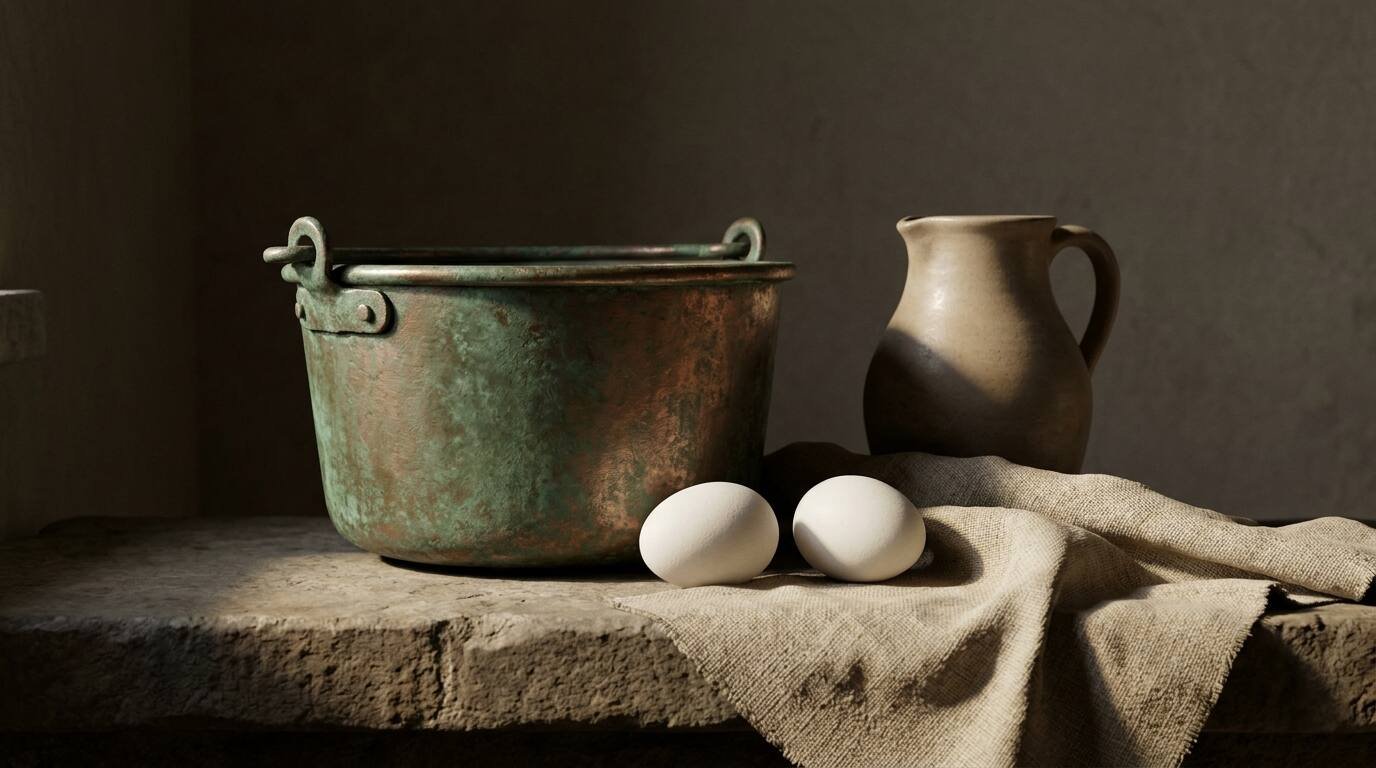
The 18th-century French painter Jean-Baptiste-Siméon Chardin spent decades painting copper pots, dead rabbits, and kitchen implements with a slow, accretive brushwork that his contemporaries found baffling. Denis Diderot, reviewing the Salon of 1763, wrote that Chardin’s objects seemed to breathe. What Diderot intuited and never fully articulated was that Chardin’s method was a refutation of Pyrrhonian skepticism — the ancient doctrine that nothing can be known — painted one glazed copper surface at a time.
This is a claim that requires unpacking carefully, because it is easy to misstate. The argument is not that Chardin held philosophical views about knowledge. It is that his practice — the specific way he built a painting — enacts a particular epistemological commitment, and that this commitment stands in direct opposition to the philosophical tradition that traces back to Pyrrho of Elis. Diderot was not a systematic philosopher, but he was one of the sharpest readers of images in Western history, and what he saw in Chardin’s work was precisely this: that the paintings argued, without arguing.
Pyrrho and the Doctrine of Suspension
Pyrrho of Elis (c. 360–270 BCE) is reconstructed for us primarily through Sextus Empiricus, whose Outlines of Pyrrhonism (available in the Loeb Classical Library, Harvard University Press) is the most complete surviving account of ancient skeptical thought. The core doctrine is epoché — suspension of judgment. For every argument that a thing is the case, Sextus argues, there exists an equally forceful counter-argument that it is not. Since we cannot determine which argument is stronger without already having the criterion of truth we are trying to establish, the rational response is to suspend judgment entirely.
Pyrrho reportedly carried this so consistently that his friends had to stop him from walking into oncoming carts. Whether the story is apocryphal matters less than what it dramatizes: the doctrine taken to its extreme produces a kind of paralysis. The Pyrrhonists’ answer to this practical objection was that one could continue to follow appearances — the phenomenal world as it presents itself — without committing to any belief about what those appearances represent. You can eat dinner without asserting that the food is nutritious. You can walk through the marketplace without asserting that the merchandise is genuinely valuable.
This is a philosophically interesting position. It is also, when you look at what Chardin was doing in his studio in the 1740s and 1750s, everything his paintings are not.
Chardin’s Method as Epistemological Commitment
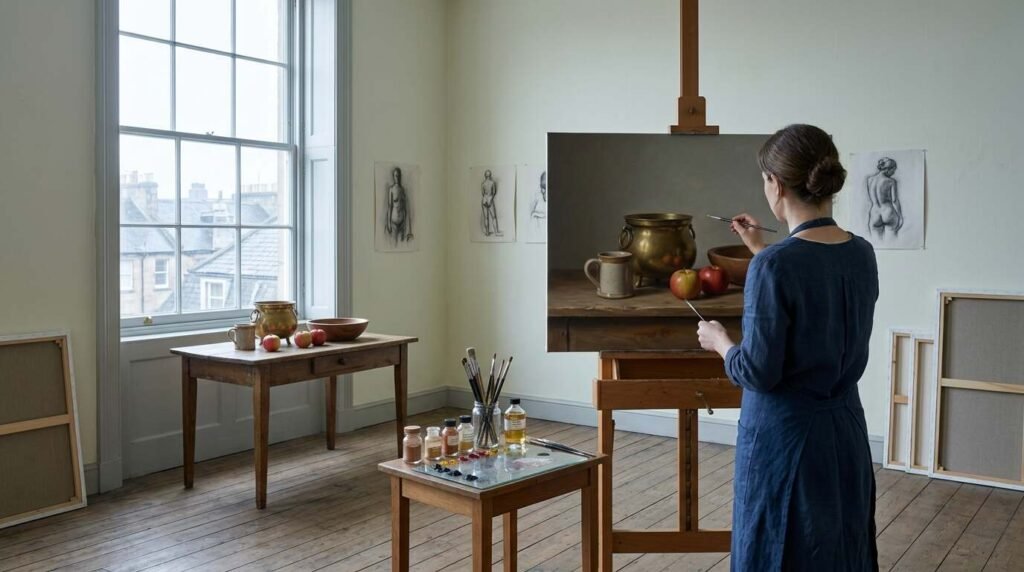
Pierre Rosenberg’s authoritative catalogue raisonné (Chardin, Metropolitan Museum of Art, 1999) documents Chardin’s technique in extraordinary detail. He built color through multiple semi-transparent layers — glazes applied over a ground, each allowed to dry before the next was added. The process was slow, methodical, and cumulative. Each layer modified the ones beneath it. By the tenth or fifteenth layer, the surface had acquired a depth that appeared to be the object itself rather than paint mimicking the object.
This is patient accumulation in the service of arriving at something real. The painter’s labor is directed toward a target — the actual surface quality of a specific copper pot in a specific light — and the method is a series of increasingly refined approximations to that target. Each layer is not an arbitrary choice but a judgment about what the previous layers have failed to capture. The painter is, in effect, reasoning toward an answer through material means.
This is the direct negation of epoché. Where Pyrrho suspends judgment because every appearance has an equally valid counter-appearance, Chardin builds judgment through the disciplined engagement with specific appearances. He does not choose between the copper pot as it appears from the left and as it appears from the right — he synthesizes both into a representation that achieves what neither angle alone can provide. This synthesis is a form of knowledge claim. It asserts that there is something to get right about this pot, and that repeated, careful attention can get it more right.

What Diderot Saw
Denis Diderot’s Salon reviews, collected and translated by John Goodman in Diderot on Art (2 vols., Yale University Press, 1995), are among the earliest sustained art criticism in Western history. They are also remarkable for the quality of their attention. Diderot does not simply describe what he sees. He attempts to articulate the experience of looking — the phenomenology of the encounter with the painted surface.
Of Chardin he writes something that has never been improved upon: the objects in these paintings do not appear to be painted. They appear to be. This is not a comment about trompe l’oeil — Chardin is not fooling the eye in the manner of the Dutch illusionists. It is a comment about a different kind of presence. The copper pot in Chardin’s Still Life with Copper Cauldron and Eggs (c. 1734) does not look like a representation of a copper pot. It looks like the copper pot has been somehow transported into the space of the picture.
What Diderot was detecting, without the philosophical vocabulary to name it precisely, was the consequence of Chardin’s accumulative method. When you reason toward an appearance through thirty layers of paint, each layer correcting the previous, you eventually produce something that carries within it the history of its own making. The surface is not smooth. It records attention. And what the viewer encounters is not a snapshot of the object but the accumulated knowledge of someone who looked at it long enough to understand it.
This is not compatible with Pyrrhonism. The Pyrrhonist response to the copper pot would be: we cannot determine whether this pot is what it appears to be, and so we should not commit to any representation of it. Chardin’s response, enacted through his method rather than stated in words, is: I will look at this pot until I have learned its surface. The pot is knowable. Looking is a form of knowing. My painting is the knowledge.
The Limits of Pictorial Epistemology
The argument needs to be stated carefully because it has obvious objections. Chardin’s pot is knowable in the sense that its surface qualities — color, reflectivity, texture — are available to sustained visual attention. This is not the same as the knowledge that concerned Pyrrho, which was knowledge of whether things are genuinely as they appear, whether our faculties reliably track reality, whether the distinction between appearance and reality is itself coherent.
Chardin does not answer Sextus Empiricus. His paintings do not refute the Outlines of Pyrrhonism at the level of argument. What they do is demonstrate that a practice of careful, cumulative attention to appearances produces results — results that Diderot could recognize as constituting a kind of knowledge — without requiring the resolution of the underlying philosophical questions. The pot can be learned without settling the metaphysical question of what it is.
This is, in a sense, what phenomenology later tried to make explicit. Merleau-Ponty argued — as explored in a related piece on Pavlov and embodied cognition — that the body’s engagement with the world is itself a form of intentionality, a knowing-through-doing that precedes and underlies explicit cognition. Chardin’s practice is a cousin of this argument. He does not think his way to the copper pot. He paints his way there, and the painting is the record of the arrival.
Nassau County’s Still Life Inheritance
There is a local angle worth holding. The Nassau County Museum of Art in Roslyn Harbor holds a collection of European decorative arts and paintings that traveled the same 18th-century trade networks that moved Chardin’s imagery across Europe. The museum’s holdings in Dutch and Flemish still life — the tradition within which Chardin worked and against which he defined himself — document exactly the visual context in which his anti-skeptical project should be read.
The Dutch and Flemish still life tradition was itself philosophically loaded. The vanitas still life — skull on a table, snuffed candle, fallen flowers — was explicitly about the impossibility of permanent knowledge, the transience of appearances. Chardin worked within this tradition but inverted its message. His dead rabbit and his copper pot are not memento mori. They are not reminders of transience. They are arguments for permanence — for the enduring knowability of things that present themselves honestly to sustained attention.
The Nassau County Museum’s European holdings, which document this tradition for Long Island audiences, provide a visible frame for understanding what was at stake in Chardin’s choices. When you walk through a collection of Dutch vanitas and then encounter a Chardin reproduction — or encounter any of the still life works in the tradition his work transformed — you can see the turn: from appearance as evidence of instability to appearance as object of patient, accumulative knowledge.
The Method and the Argument
Philosophy tends to proceed through argument: premise, inference, conclusion. Chardin argues through practice — through the decision to build a surface rather than render it, to accumulate rather than approximate. This is philosophically significant because it suggests that the most interesting epistemological commitments are sometimes enacted before they are articulated.
Diderot recognized what Chardin had done before the philosophical vocabulary existed to name it. He saw that the paintings defeated a certain kind of doubt — not by arguing against it but by demonstrating, through the accumulated labor of their making, that the world of specific appearances is available to knowledge, that patient attention is a form of cognition, and that what the body learns through looking is not nothing.
Pyrrho would have suspended judgment about the pot. Chardin painted it until he knew it. The difference between those two responses is not merely aesthetic. It is a disagreement about what a human being can do with the appearances that come to it — and what, if anything, that doing amounts to.
You Might Also Like: Jacques-Louis David’s The Death of Socrates — Conviction, Hemlock, and the Price of the Examined Life | Rodin’s The Thinker — The Sculpture That Became Philosophy’s Logo | The Problem of Induction: David Hume, Black Swans, and the Limits of Predictive Statistical Models | Nobody Talks in a Hopper Painting — A Diner Owner’s Guide to 2AM Silence
Sources
Sextus Empiricus. Outlines of Pyrrhonism, trans. R.G. Bury. Loeb Classical Library, Harvard University Press. | Rosenberg, Pierre. Chardin, Metropolitan Museum of Art, 1999. | Goodman, John, ed. and trans. Diderot on Art, 2 vols. Yale University Press, 1995. | Nassau County Museum of Art: ncmoa.org