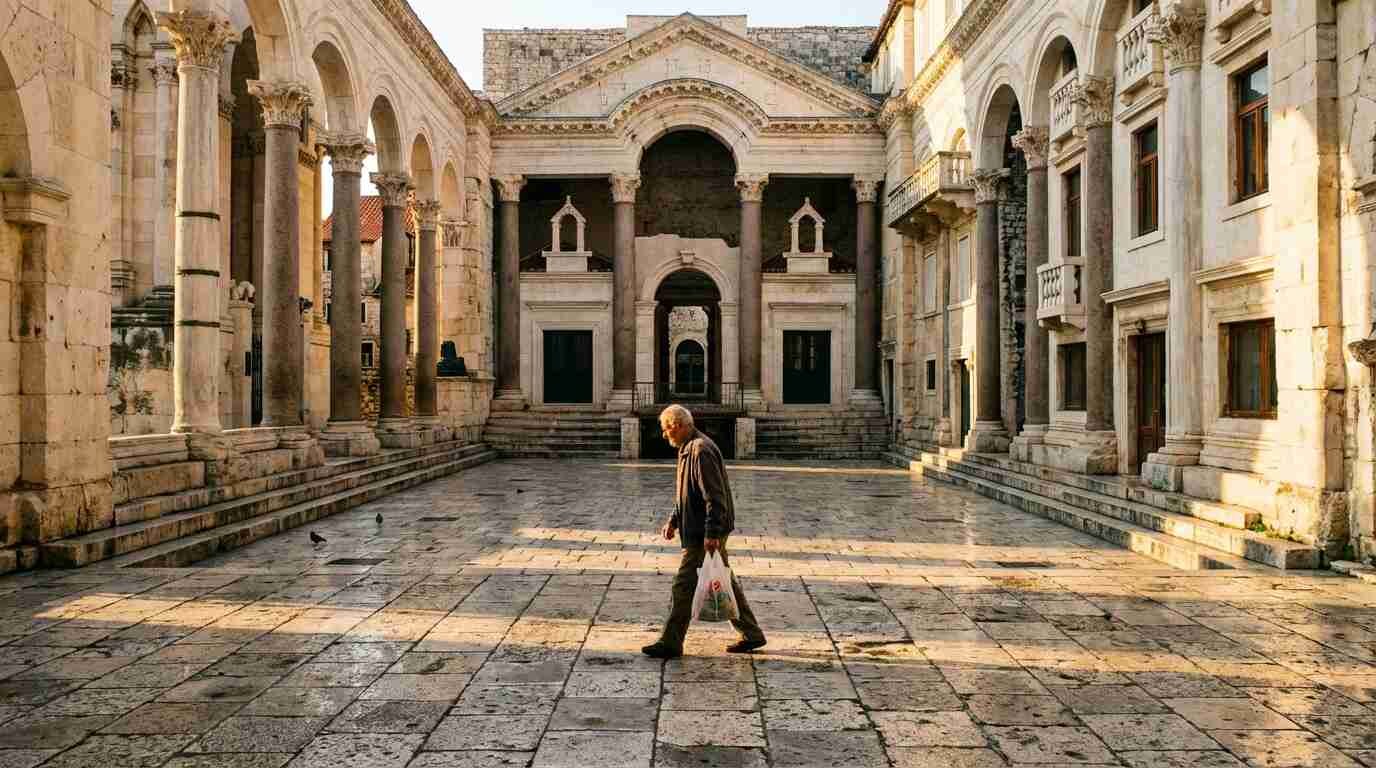
An emperor built himself a retirement palace. He grew cabbages. Centuries later, the walls are still standing and people are living inside them. The emperor is not mentioned.
That is the entire argument. Everything that follows is annotation.
What Diocletian’s Palace Actually Is
Diocletian’s Palace in Split, Croatia, was constructed between 295 and 305 AD by the Roman Emperor Gaius Aurelius Valerius Diocletianus — a man who rose from the son of a freedman in the Dalmatian province to the ruler of the Roman Empire, reorganized the imperial administration into the Tetrarchy, and then did something no sitting emperor had done before: he voluntarily abdicated.
In 305 AD, Diocletian retired to this palace on the Dalmatian coast and spent the last years of his life here. The historical record, including correspondence cited by the early Christian author Lactantius in De Mortibus Persecutorum, notes that when urged by his former co-emperors to resume power as the empire fell into civil war, Diocletian declined. He had cabbages to tend, he said. He was content.
The palace covers approximately 38,000 square meters and was built as a fortified complex — equal parts retirement villa and military garrison. Its walls are three to four meters thick, its sea-facing facade ran directly along the Adriatic (the harbor has since silted and receded), and its layout followed the Roman castrum grid: two main axes, four gates, internal divisions for the emperor’s apartments and for the garrison that protected him.
UNESCO designated Split’s historic core a World Heritage Site in 1979. Today, approximately 3,000 people live within the palace walls. The palace is not a museum. It is a neighborhood.
Off-Season, Which Is When It Reveals Itself
The tourist literature on Split does not mislead, exactly, but it describes the summer palace — the palace under the pressure of high season, the palace as a stage set for visitors who arrive, photograph the peristyle, drink coffee at the cafes built into the Vestibule, and continue. This is a valid experience. It is not the only one.
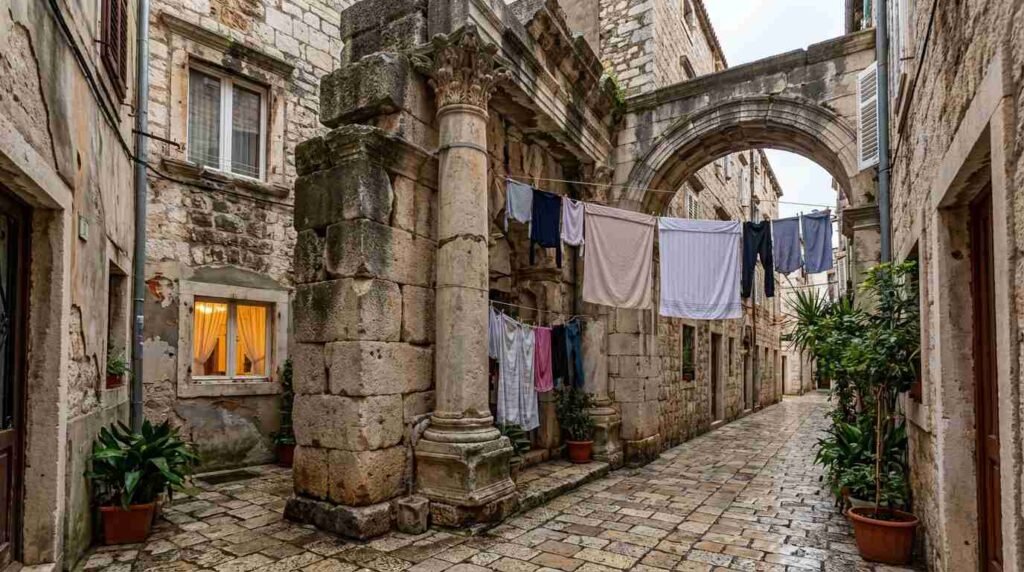
In November, Split shifts. The cruise ships are gone. The café chairs are stacked under plastic. The streets inside the palace walls — the Krešimirova, the Dioklecijanova, the unnamed alleys that the Roman axial plan has become over seventeen centuries of improvised habitation — are occupied by the people who live there.
Laundry was hanging between a Roman column and a medieval bell tower on my first morning. A woman in her seventies was sweeping the threshold of a door set directly into a section of the third-century wall. A school group moved through the Peristyle — the central courtyard that fronts the Cathedral of Saint Domnius, which is itself a repurposed Roman mausoleum, which is itself built over the crypt where Diocletian was presumably to be interred — with the bored efficiency of children whose field trip has taken them somewhere they pass every day.
This is the palace as an argument about time, not as a spectacle of antiquity. The argument takes several days to hear properly.
On Power and Its Shelf Life
Diocletian’s administrative legacy is considerable and largely invisible to the casual tourist. He reorganized the Roman Empire’s tax collection, standardized military pay, attempted to control inflation through the Edict on Maximum Prices (it failed; the market ignored it), and restructured the imperial administration into a system of co-emperors that was designed to solve the succession crisis that had produced twenty-six emperors in fifty years.
None of this is what you think about inside the palace walls in November, with the laundry overhead and the sound of a television coming through a third-century window.
What you think about is the gap between the ambition of the construction and the ordinariness of its present use. The walls were built to last — and they have lasted, so thoroughly that they became infrastructure, absorbed into the city so completely that Split grew up inside them rather than around them. Archaeology by Jerko Marasović and subsequent scholars has documented how the Roman spatial logic of the palace persisted through medieval reconfigurations, how the original grid is still legible in the modern street plan, how the substructures — the basement level, still visitable — were used for storage and eventually forgotten and then rediscovered, still intact, in the twentieth century.
Power built this. Power maintained it for a generation. Then power moved on, and the walls remained, indifferent to the departure.
Marcus Aurelius: Think of yourself as dead. You have lived your life. Now take what’s left and live it properly. He wrote this as a philosophical exercise, a practice of memento mori — not morbid, but clarifying. What Diocletian’s Palace performs, architecturally and socially, is the same exercise at architectural scale. The emperor lived his life and is gone. The walls took what was left and lived it properly, which turned out to mean becoming home to successive generations of people who needed walls.
The Substructures
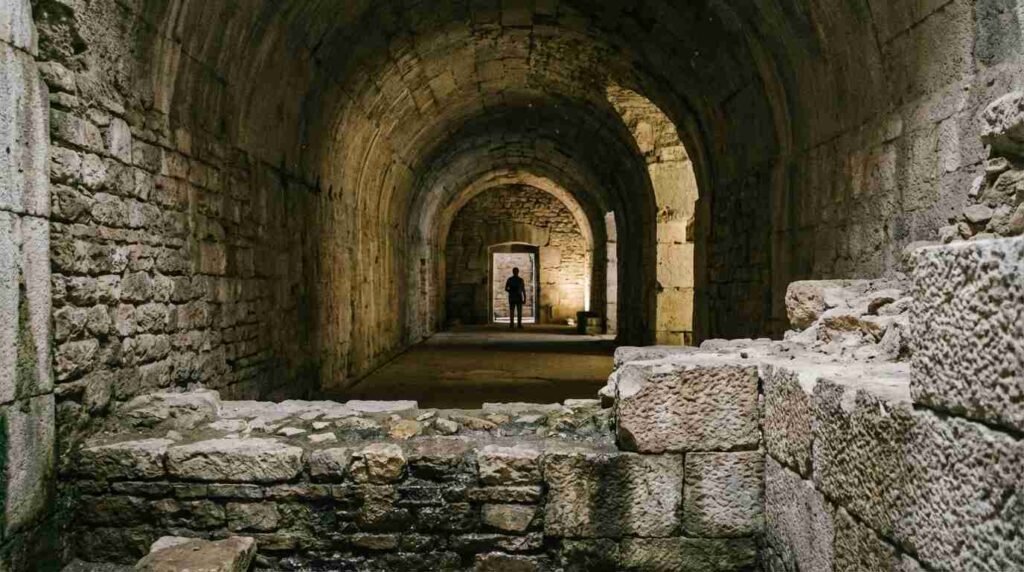
Beneath the ground floor of the palace is the Roman basement — the vaulted subterranean level that supported the emperor’s apartments above. It is possible to walk through it. In the off-season, you may walk through it nearly alone.
The vaults are barrel-shaped, built from Roman concrete and stone that has compressed over seventeen centuries into something like a geological formation. The space is not exactly dark — lights have been installed — but the quality of the air is different from the streets above, cooler, carrying the particular density of enclosed stone. There is no obvious purpose to visiting the substructures beyond the experience of being inside the bones of something very old that was built to support weight and has been supporting it for seventeen centuries.
This, I find, is sufficient purpose.
Scholars estimate the substructures were used for storage during Diocletian’s residence, then filled with waste and rubble as the upper floors were subdivided and modified over the medieval period, then excavated beginning in the nineteenth century and comprehensively in the twentieth. George Bernard Shaw, visiting Split in the 1920s, wrote that he had not felt so well in years. He attributed this to the palace. The attribution is probably too specific, but the instinct it reflects — that something in the scale and endurance of the structure transmits itself to the visitor who spends enough time inside it — does not seem entirely wrong.
What Three Days Produces That One Does Not
The single-day visitor to Split sees the Cathedral, the Peristyle, the Golden Gate, the basement. They eat at one of the restaurants with tables inside the palace walls — some of them excellent, built into the Roman spaces with a casual confidence that takes some getting used to — and they leave with a set of photographs in which ancient stone appears behind contemporary life.
Three days produce something different, not because three days reveals hidden content but because duration metabolizes what you have seen. By the third morning, the palace was simply where I was — not a marvel being continually processed but a place with a character that had become familiar. I knew which café opened earliest. I knew that the Peristyle was empty between eight and nine in the morning before the tour groups arrived. I knew that the light through the Sea Gate came differently at noon than at four, and that the fourth-century stonework showed its seam lines most clearly in low afternoon light.
None of this knowledge is dramatic. All of it is the product of staying, which is a discipline with its own returns.
The Roman Stoics were interested in duration as a moral category — not in the sense that persisting is virtuous by default, but in the sense that sustained attention produces a quality of understanding that brevity cannot. Seneca: Recede in te ipse quantum potes. Withdraw into yourself as much as you can. The instruction is spatial, and the palace makes it literal — to go inward, into the substructures, into the narrow medieval alleys inside the Roman walls, into the hours of a November morning when the city is quiet and the stones are simply there.
The Cabbages
The cabbage story is probably apocryphal, or at least improved in the telling. What Lactantius records is Diocletian’s refusal of the appeals from his co-rulers to return to power — a refusal framed in terms of the contentment he had found in his retirement on the Dalmatian coast. The cabbages enter the historical tradition as illustration: here is a man who ruled the Roman world and is now satisfied with a garden.
What is not apocryphal is the abdication. Diocletian abdicated at the height of his power, apparently of his own will, apparently in good health, and lived out the rest of his life in this palace. He was the first Roman emperor to do this. He was not the last, but the others abdicated under duress. He appears to have chosen it.
This is the most unusual thing about him, more unusual than his tax reforms or his administrative restructuring or his persecution of the Christians he suspected of disloyalty. The unusual thing is that he stopped. He built a house and he stopped.
The house is still there. Three thousand people sleep in it tonight, in apartments carved from the spaces his engineers designed, beneath ceilings that have been holding for seventeen centuries, inside walls that his garrison walked the perimeter of every night.
The emperor is not mentioned.
The walls remain. They are enough.
You Might Also Like:
- The Hudson Valley in Reverse: Why You Should Start in Beacon and Work Your Way South
- The Diner Counter as Dialectic: Would Hegel Order His Eggs Over Easy or Sunny-Side Up?
Sources:
- UNESCO World Heritage — Split and Diocletian’s Palace: whc.unesco.org/en/list/97
- City of Split official information: visitsplit.com
- Lactantius, De Mortibus Persecutorum (c. 313 AD), trans. J.L. Creed (Oxford University Press, 1984)
- Jerko Marasović, archaeological documentation of Diocletian’s Palace (published through the Society of Friends of Cultural Heritage in Split)
- Seneca, Letters to Lucilius (Epistulae Morales), trans. Robin Campbell (Penguin Classics, 1969)
- Marcus Aurelius, Meditations, trans. Gregory Hays (Modern Library, 2002)