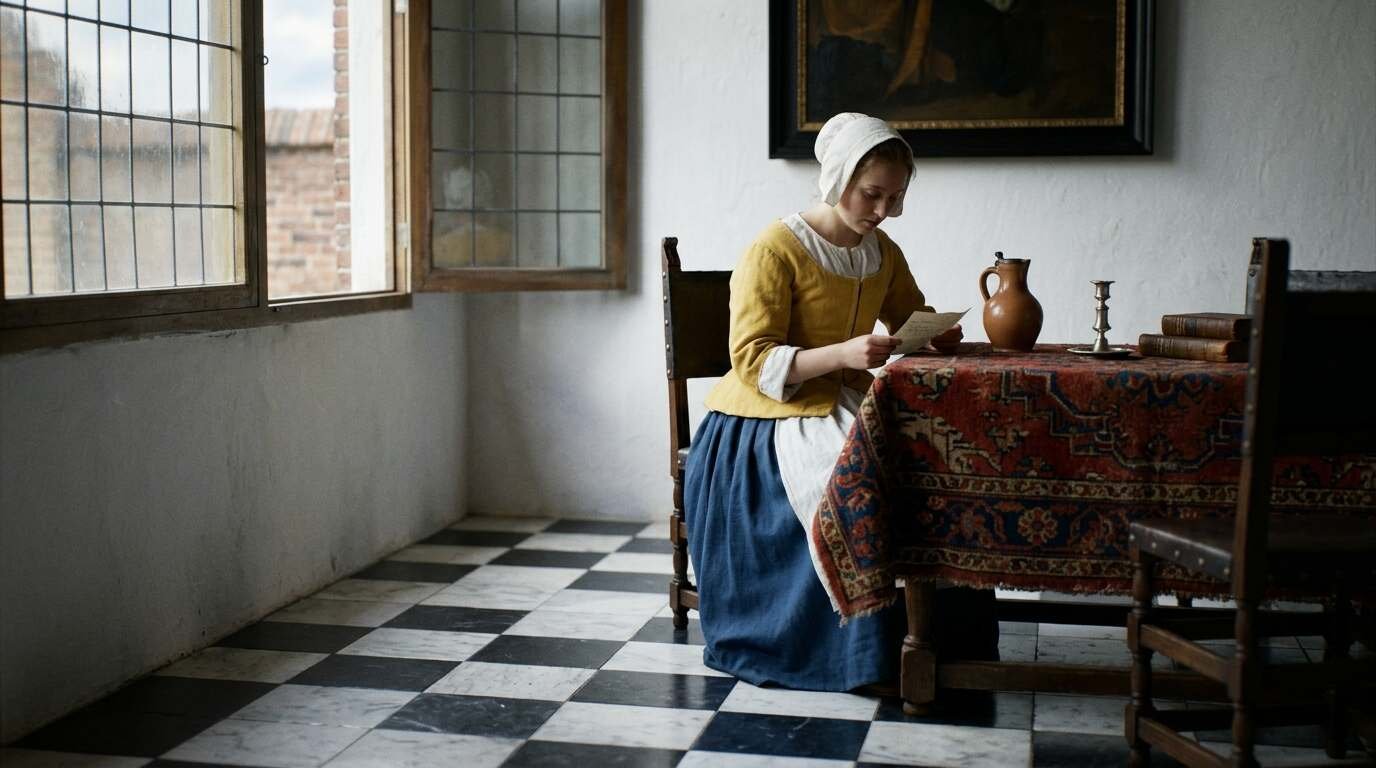
Stand in front of The Music Lesson at Buckingham Palace — or in front of Girl Reading a Letter at an Open Window in Dresden — and there is a quality in the light that does something unusual to the eye. It is not simply accurate light. It is light with a specific spatial authority, a rendering of how illumination falls across a surface that produces the sensation of presence, of being in the room rather than observing a painting of it. Art historians called it miraculous for three centuries. Some still do.
In 2001, two people independently proposed a different explanation. David Hockney, the painter, published Secret Knowledge: Rediscovering the Lost Techniques of the Old Masters. Philip Steadman, an architect and academic, published Vermeer’s Camera: Uncovering the Truth Behind the Masterpieces. Both argued that Vermeer used a camera obscura. Steadman went further: he provided the geometric proof.
What a Camera Obscura Does
A camera obscura is a room, box, or tent in which a small aperture or lens projects an inverted image of the outside world onto a surface opposite the opening. The device was well known in Vermeer’s time — Leonardo da Vinci described it, and by the seventeenth century, portable versions with lenses were in use by artists and scientists across Europe. There is no documentary evidence that Vermeer owned or used one. There is also no documentary evidence that he did not.
The projected image a camera obscura produces has specific optical characteristics. Because the image is formed by actual light projected through a lens, the relationships between light values, the rendering of out-of-focus areas, and the spatial relationships between objects reflect the optical properties of the lens rather than the conventional rules of artistic construction. A camera obscura image shows lens flare, spherical aberration, and a characteristic softening at the edges of the projected field. It also shows correct perspective in a way that is very difficult to achieve by eye alone, particularly in complex interior spaces where multiple reflective surfaces interact.
Steadman’s Geometric Argument
Philip Steadman’s contribution to the Hockney-Falco thesis is methodologically distinct from Hockney’s visual comparisons. Steadman applied architectural analysis to six of Vermeer’s interior paintings that depict the same room — identifiable by the consistent dimensions of the windows, tiles, and ceiling beams. By reconstructing the room’s geometry from the paintings and working backward to establish the likely position of the viewpoint, Steadman found that six paintings converge on a single viewpoint position, just outside the back wall of the depicted room.
That position — outside the wall — is precisely where a camera obscura lens would be mounted to project the room’s interior onto a screen inside an adjoining dark chamber. Steadman’s reconstruction placed the projection screen, scaled to the painting’s dimensions, in exact correspondence with the canvas sizes Vermeer used. The geometry is not approximate. In his reconstruction of The Music Lesson, the vanishing point, the scale of the projection, and the canvas dimensions align within measurement tolerances that would be difficult to attribute to coincidence.
Steadman was careful about what his geometric argument proved and did not prove. It showed that Vermeer could have used a camera obscura. It showed that the spatial configuration of his studio, as reconstructed from the paintings, is consistent with camera obscura use in a way that would require extraordinary coincidence to explain otherwise. It did not prove that Vermeer used the device directly to paint — only that the device was likely present and that its optical properties likely informed the work.
The Art Historical Response
The Hockney-Falco thesis was not warmly received by the art history establishment. The critical response in publications including the Art Bulletin questioned the art historical methodology, the assumption that visual similarity implied optical mechanism, and the lack of documentary evidence. Several critics argued that great painters can achieve the results attributed to optical aids through sustained observation, training, and technical mastery — and that attributing these results to a lens was reductive.
These objections have merit. Hockney’s visual comparison method — identifying characteristics in early Renaissance and Baroque paintings that look like optical artifacts — is not the same as geometric proof. Some of his attributions have been disputed by art historians with detailed knowledge of specific painters’ documented working methods.
Steadman’s geometric argument is harder to dismiss on these grounds because it is not a stylistic claim. It is a spatial claim about the physical configuration of an actual room that can be verified against the paintings. The convergence of six independent viewpoints on a single impossible physical location is either an extraordinary coincidence in Vermeer’s compositional decisions or evidence of an external optical constraint.
The art historical establishment’s resistance to optical-aid hypotheses also reflects a legitimate concern about how such claims are used. The implicit argument — that artists who used optical devices were somehow cheating, or that knowledge of the device diminishes the work — misunderstands what the device provided. A camera obscura projects an image. It does not make a painting. Translating a projected image onto canvas with Vermeer’s technical mastery of paint handling, his control of value relationships, his selectivity about what to render and what to subordinate — none of that is supplied by the lens.
What the Debate Actually Reveals
The Vermeer camera obscura debate is, at its most interesting level, a debate about the relationship between tools and genius. It surfaces a persistent anxiety in how Western art history has constructed the idea of artistic mastery: the genius who sees what others cannot, who renders light by pure perceptual intelligence, unsupported by mechanism.
The anxiety is not entirely baseless. There is something real to protect in the idea that artistic vision is not simply technical procedure. But the protection of that idea has sometimes operated by suppressing evidence of what tools artists actually used — a historiographical reflex that Hockney, in Secret Knowledge, argues has distorted the narrative of Western painting for centuries.
Vermeer’s light, if it was produced in collaboration with a camera obscura, is still Vermeer’s light. The decisions about what to paint, how to handle the paint, which qualities of the projected image to preserve and which to transcend — those decisions are not made by a lens. The lens provided a specific kind of visual information. What Vermeer did with it is the work.
The Art Institute of Chicago’s own Vermeer holdings — including The Astronomer — have been the subject of technical analysis that includes infrared reflectography and X-ray examination, some of which reveals underdrawing patterns consistent with traced outlines, another finding that the artistic establishment has treated cautiously. The Thorne Miniature Rooms, discussed elsewhere on this blog, are themselves a demonstration of how three-dimensional spatial information can be translated into two-dimensional representation with documentary precision — a different technology, but a similar epistemological position.
You Might Also Like: El Greco’s View of Toledo | Goya’s Saturn Devouring His Son