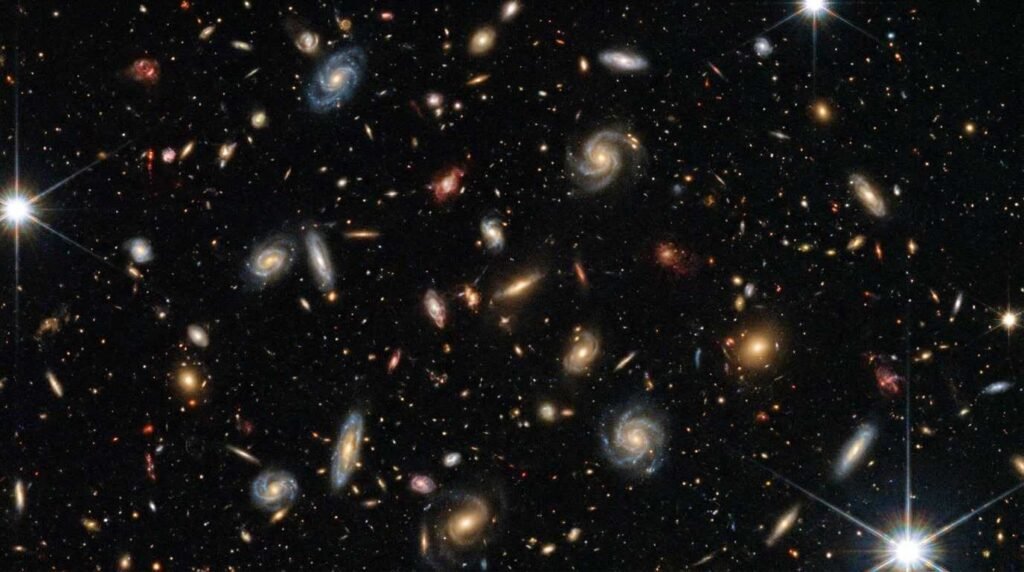
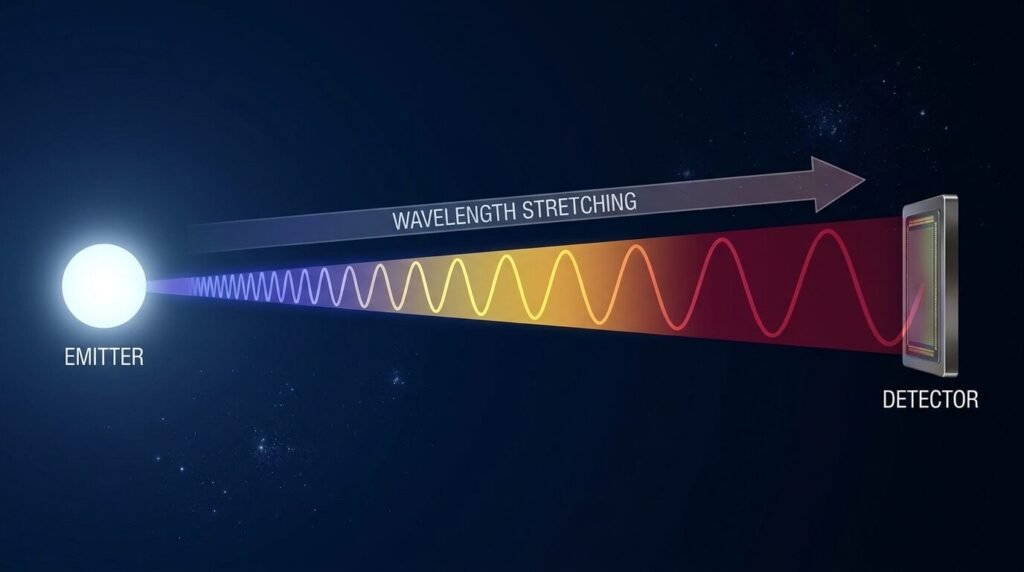
Redshift is a number that measures how far light has stretched on its way to us. The universe is expanding; as it expands, light traveling through space gets pulled toward longer wavelengths — toward the red end of the spectrum. A galaxy with a redshift of 1 is billions of light-years away. A galaxy at redshift 10 is so distant that we are seeing it as it existed roughly 500 million years after the Big Bang, when the universe was less than four percent of its current age. Standard cosmological theory — the Lambda-CDM model — makes specific predictions about what galaxies at those distances should look like: small, irregular, churning with early star formation, lacking the heavy elements that later stellar generations would produce.
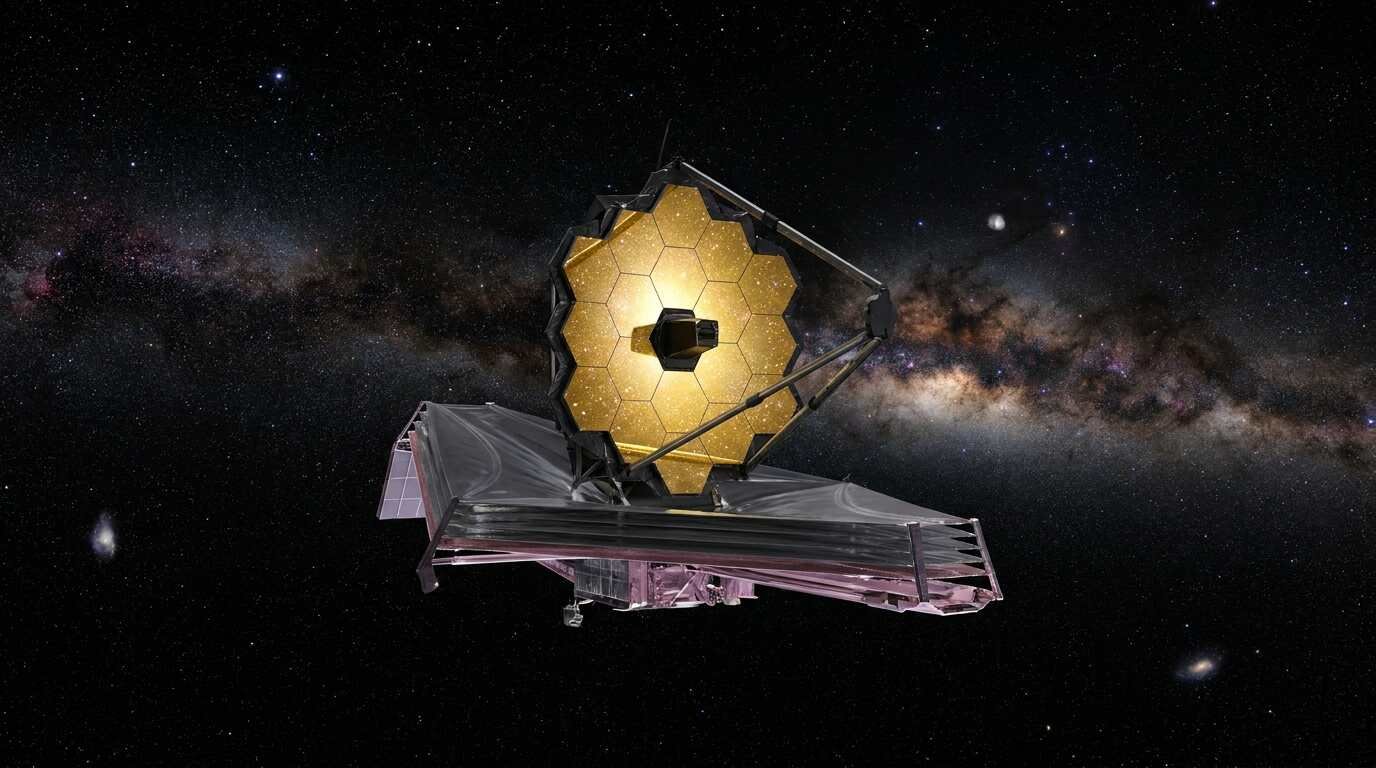
Since 2022, the James Webb Space Telescope has been finding galaxies that don’t fit those predictions. Fully formed. Massive. In some cases already quenched — their star formation already finished — at redshifts where the universe should have barely begun assembling the raw material for anything that large.
What Lambda-CDM Predicts
Lambda-CDM — Lambda for the cosmological constant representing dark energy, CDM for cold dark matter — is the standard model of cosmology. It describes how the universe’s large-scale structure assembled itself: dark matter halos formed first, then ordinary matter fell into them, then stars formed, then galaxies coalesced over billions of years of mergers and accretion. The model makes quantitative predictions about how massive a galaxy can be at a given epoch. At very high redshifts, those limits are tight. You can’t pack ten billion solar masses of stars into a galaxy at a time when the universe hasn’t had enough time to build the halos required to contain them.
JWST’s first months of public data surfaced a group of candidate galaxies at redshifts between 7 and 10 — some of the earliest epochs yet observed — with inferred stellar masses so high that, as one analysis framed it, there are no halos massive enough to contain them at those redshifts even if all baryons in those halos were converted to stars with perfect efficiency. Perfect conversion efficiency is physically impossible. The implication, if the mass estimates hold, is that the galaxies shouldn’t exist in the form they appear. JWST’s earlier exoplanet atmosphere findings raised similarly sharp questions about what the telescope would find when turned toward the deep universe — covered in detail in Decoding the Next Generation of Exoplanets.
The Measurement Problem
The first serious challenge to the alarming early results was methodological. Stellar mass estimates at high redshift depend on fitting spectral energy distributions — essentially, reading the color and brightness of a galaxy across multiple wavelengths and inferring how many stars, of what ages and compositions, could produce that light. Early JWST photometry lacked crucial rest-frame near-infrared data for the most distant objects, which introduced significant uncertainty.
A 2024 analysis using JWST’s MIRI instrument — which extends coverage further into the infrared — found that excluding MIRI data systematically overestimates stellar masses for the most massive high-redshift galaxies by roughly 0.4 dex on average. That’s a factor of about 2.5. Applying the correction reduces the number density of the most extreme objects by more than half. The tension with Lambda-CDM doesn’t disappear, but it becomes considerably less catastrophic. Models requiring only moderately enhanced star-formation efficiency can accommodate what remains.
What Remains Unexplained
The revised numbers ease the crisis without resolving it. Number densities of massive galaxies at high redshift still exceed pre-JWST theoretical predictions across multiple independent survey programs. JWST has also revealed that the issue isn’t only about mass: early galaxies are morphologically and dynamically more mature than models anticipated. Quenched galaxies — systems that had already stopped forming stars — appear as early as redshift 7, implying that the mechanisms responsible for shutting down star formation operated much earlier than the prevailing models expected.
Several candidate explanations circulate in the literature. One invokes higher star-formation efficiency at high redshift — the idea that early galaxies converted available gas into stars more rapidly than their low-redshift counterparts. Another involves modified treatments of stellar feedback: supernovae and radiation from massive stars can blow gas out of galaxies, suppressing further star formation, but those feedback processes may have been less effective in the denser, more rapidly evolving environments of the early universe. A third line of investigation looks at whether early dark energy — proposed to address the separate “Hubble tension” between measurements of the universe’s expansion rate — could alter the structure formation timeline enough to accommodate what JWST is finding. The discovery of dark energy itself came with its own crisis of interpretation, documented in The Madness of the Expanding Void.
The Productive Uncertainty
Neither the “physics is broken” reading nor the “it’s all measurement error” dismissal captures where the field actually stands. What JWST has produced is a controlled stress test of the standard model at epochs previously inaccessible to direct observation. Lambda-CDM has survived many such tests. It may survive this one too — with modifications, recalibrations, and a better understanding of star-formation physics at high redshift.
What it has unambiguously produced is data that no cosmological model was specifically calibrated to fit. Most pre-JWST galaxy formation models were built from observations at lower redshifts and extrapolated backward. JWST is observing epochs those models only predicted. When the predictions and the observations diverge, that is precisely how science is supposed to work — not as confirmation of a narrative, but as a source of productive friction that forces models to get more accurate. Thomas Kuhn had a framework for exactly this kind of structural pressure on established models, applied directly to cosmology in Paradigm Shifts in Modern Astrophysics.
What the Early Universe Is Telling Us
The galaxies JWST is finding at the edge of the observable universe formed when the cosmos was a few hundred million years old — a blink in cosmic time. Their existence raises a question the standard model hasn’t fully answered: how does structure go from the nearly smooth, hot plasma of the early universe to organized, quenched, massive galaxies in so few hundred million years? The physics of that transition — whatever it turns out to be — is one of the genuinely open questions in modern cosmology. JWST is supplying the evidence that makes the question unavoidable.
Sources
- Labbé, I., et al. (2022). “A population of red candidate massive galaxies ~600 Myr after the Big Bang.” Nature. (arXiv:2207.09436)
- Wang, T., et al. (2024). “JWST/MIRI reveals the true number density of massive galaxies in the early Universe.” arXiv:2403.02399. https://arxiv.org/pdf/2403.02399
- Krishnan, J.R., Abazajian, K.N. (2026). “Statistics Meet Systematics: Resolution of the Massive Early JWST Galaxy Tension.” arXiv:2511.13708. https://arxiv.org/pdf/2511.13708
- Fakhry, S., et al. (2025). “High-redshift Galaxies from JWST Observations in More Realistic Dark Matter Halo Models.” arXiv:2507.23742. https://arxiv.org/pdf/2507.23742
- NASA JWST Mission Site: https://webb.nasa.gov