The 1897 Sears catalog gave shoppers some frank advice: “there are hundreds of brands of Catsup on the market, a few of them good.” The catalog was right, and it was also describing a mess. By then the word had crossed two centuries and three continents, starting as a Chinese fish brine, passing through English kitchens as a mushroom pickle, and landing in America as a tomato sauce that might be bulked out with pumpkin rinds and held together by a preservative first sourced from tree bark.
What follows is the full path of that sauce. The Hokkien word at the start. The first published tomato recipe. A Pittsburgh horseradish seller who turned a glass bottle into a promise. The physics that keeps the last third stuck in the neck. A federal regulation that measures ketchup in centimeters. And a 1981 fight in Washington that turned a school-lunch rule into a national punchline.

A Fermented Fish Sauce With a Hokkien Name
The word comes from kê-tsiap, Hokkien Chinese for a sauce derived from fermented fish, according to National Geographic. Traders carried that fish sauce from Vietnam into southeastern China, and from there it traveled with the cargo. British merchants and sailors met it in Southeast Asia in the late seventeenth and early eighteenth centuries and tried to recreate it back home, swapping in mushrooms, walnuts, oysters, or anchovies depending on what the kitchen had on hand.
A 1732 recipe by Richard Bradley, titled “Ketchup in Paste,” names “Bencoulin in the East-Indies” as its source. Mushroom ketchup, a purported favorite of Jane Austen, stayed on English tables for generations afterward.
The spelling wandered the whole way. Wikipedia’s entry on the sauce records ketchup in 1682, catchup in 1690, and catsup in 1730, the year Jonathan Swift slipped it into a poem: “And, for our home-bred British cheer, Botargo, catsup, and caveer.” Mental Floss, which supplies that line, makes the plain point that ketchup and catsup are simply two spellings of the same thing.
None of it contained a tomato.
Love Apples, Filler, and a Pittsburgh Grocer
The tomato arrived through a scientist. James Mease published the earliest known tomato ketchup recipe in 1812, and he called tomatoes “love apples.” His formula used tomato pulp, spices, and brandy, and it lacked vinegar and sugar, two seasonings the modern federal standard requires in some form. The recipe turned up again in The Virginia Housewife in 1824. Jonas Yerkes is credited as the first American to sell it bottled, and by 1837 he had distributed it nationally; by the mid-1850s the anchovies were gone from American versions.
Then came the mess the Sears catalog was describing. National Geographic’s account of nineteenth-century ketchup is hard to read over a plate of eggs: tomato scraps “thickened with ground pumpkin rinds, apple pomace…or cornstarch, and dyed a deceptive red.” One critic called the result “filthy, decomposed and putrid.” Manufacturers held it together with salicylic acid, later with sodium benzoate, which the magazine describes as “industrially made, cheap, tasteless, and effective.”
Harvey Wiley, chief of the USDA’s chemistry bureau, went after the whole industry. He had found “a dismayingly reckless use of untested preservatives, ranging from formaldehyde to borax.” In 1902 he began his “Poison Squad” testing, and in 1906 Congress passed the Pure Food and Drug Act and the Meat Inspection Act.
Henry J. Heinz built his company inside that mess. According to the Heinz History Center, he began peddling produce from his family’s garden in Sharpsburg, Pennsylvania, specializing in horseradish. His business collapsed in the 1870s for lack of capital. A new company launched in 1876 with Heinz as manager, and that year the firm began selling its tomato sauce under the name catsup, per Wikipedia. Sometime in the 1880s it switched to ketchup to stand out. In 1888 the firm took the name H.J. Heinz Company.
The bottle did the persuading. An octagonal glass design appeared in 1889 and was patented in 1890, and National Geographic notes that the clear glass let customers study the sauce from many angles. Heinz also moved toward ketchup without preservatives, working with Wiley, and by 1905 the company had sold five million bottles.
Heinz did not invent ketchup. He made it safer to buy.
The slogan came later. The Heinz History Center tells the story this way: Heinz spotted a sign reading “21 Styles of Shoes” from an elevated train in New York, liked the idea, and began counting his own products. He stopped at 57 because he liked the sound of it, even though the company made many more than that. The center’s own writers date the slogan to 1896 in one article and 1892 in another, so the year deserves a shrug. The motto Heinz hung in his Pittsburgh factory, on signs and in stained glass, is better documented:
To do a common thing uncommonly well brings success.
H.J. Heinz, as displayed at his Pittsburgh factory
Why the Bottle Won’t Pour
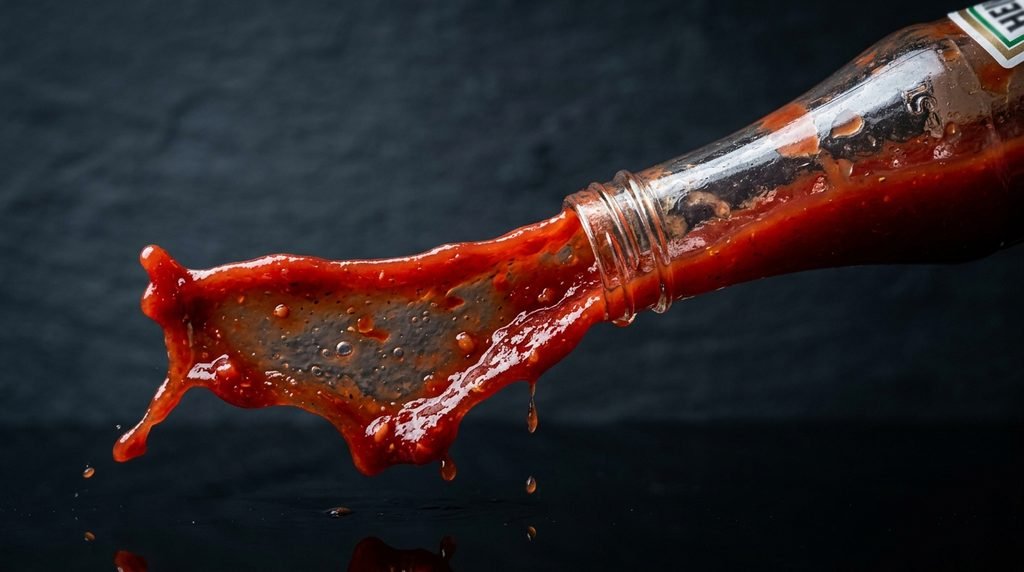
Anybody who has whacked the base of a glass bottle already knows the sauce has two moods. Left alone, it sits there like a verdict. Hit it, shake it, or squeeze it, and the whole third of a bottle arrives in one wet slap on the plate.
Physicists call this shear thinning: the fluid gets less viscous as force is applied to it. Xiang Cheng of Cornell University and his colleagues built a “confocal rheoscope,” a microscope that watches particles move while a machine measures how thick the fluid is, to see what happens at the particle level. Their test fluid was silica spheres suspended in water and glycerin, a stand-in for real sauces, not ketchup itself. Chemistry World summed up the result: “shear thinning happens when shear simply overrides the thermally induced ‘Brownian motion'” that normally keeps particles randomly scattered. The paper, in Science on September 2, 2011, put it in more formal language: “shear thinning results from the decreased relative contribution of entropic forces and that shear thickening arises from particle clustering induced by hydrodynamic lubrication forces.”
Norman Wagner of the University of Delaware told Chemistry World the study offered “the first direct imaging of the clustering theory behind shear thinning.” A mechanism physicists had theorized for two decades, caught on camera in 2011.
TED-Ed’s lesson by George Zaidan, animated by Hector Herrera, covers the same physics in about five minutes:
Restaurant servers worked out their own fix long before the paper. Tasting Table reports that the embossed “57” on the bottle’s neck has long served as a tap spot, a “waitress trade secret,” and credits University of Melbourne engineering professor Anthony Stickland with the physics of why a tap at roughly 45 degrees releases the sauce. The same article notes that Heinz makes no official statement about the trick. Heinz’s own TikTok account has taken up the same problem with a bottle-hack video whose caption asks, “What’s your hack?”:
The company eventually stopped treating slowness as a flaw. Carly Simon’s song “Anticipation” played in Heinz commercials from the late 1970s into the 2000s, according to Wikipedia, and Simon’s own verdict on the results was mild: “I wasn’t at all displeased with the results. It was well done, and funny.” One of the 1977 spots, uploaded by the channel Bionic Disco:
Measured in Centimeters
The law has opinions about thickness. Under 21 CFR 155.194, the FDA’s standard of identity, a product sold as “catsup,” “ketchup,” or “catchup” must contain at least one tomato ingredient (tomato concentrate, or liquid from mature red tomatoes or from the residue of canning or juicing), at least one vinegar, at least one nutritive carbohydrate sweetener, and at least one of spices, flavoring, onions, or garlic. Salt and water are optional.
Then comes the clause that would have delighted the people who spent decades staring at a stuck bottle: the consistency must be “such that its flow is not more than 14 centimeters in 30 seconds at 20 °C when tested in a Bostwick Consistometer.” Fourteen centimeters is about five and a half inches. A ketchup that flows farther than that in half a minute, at 20 degrees Celsius, falls outside the federal definition of the word on its own label.
Taste got its own champion. In September 2004, Malcolm Gladwell published “The Ketchup Conundrum” in The New Yorker, built around the market researcher Howard Moskowitz. Moskowitz had made his name with Prego: he created 45 varieties of spaghetti sauce that varied in spiciness, sweetness, tartness, saltiness, thickness, aroma, and mouthfeel, and found three preference groups (plain, spicy, and extra-chunky), the last of them commercially untapped. His lesson, in Gladwell’s words, was that “there was no such thing as the perfect Diet Pepsi. They should have been looking for the perfect Diet Pepsis.”
Ketchup was the exception that made the argument interesting. Tim Carmody, writing at Nieman Storyboard, explains that Heinz “perfectly balances the five fundamental tastes in the human palate: salty, sweet, sour, bitter, and umami,” which makes it the exception to the plural-tastes rule. Even Moskowitz, the man who built a career on the idea that no single taste fits everyone, concludes in the piece: “I guess ketchup is ketchup.”
The 1981 Vegetable Fight
The most famous ketchup story in American politics is slightly wrong, which is what makes it good.
In 1980 and 1981, Congress cut the federal school lunch budget, by roughly 8 percent and then by another 25 percent for 1982, according to Wikipedia’s account. On September 3, 1981, the Department of Agriculture’s Food and Nutrition Service proposed new rules to give lunchroom administrators more flexibility: smaller portions, alternative proteins such as yogurt, nuts, and tofu, and simpler paperwork. The proposal never named ketchup. It said administrators “could credit a condiment such as pickle relish as a vegetable.”
The headlines did the rest. An aide to the Agriculture Secretary, James Johnson, said that “ketchup in combination with other things was classified as a vegetable,” citing French fries and hamburgers as examples. Newsweek ran a ketchup bottle with the caption “now a vegetable.” Food and Nutrition Service administrator G. William Hoagland defended the rules in testimony on September 17: “This is not a homogeneous nation. It is a compendium of likes and tastes.” He added that “it’s an insult to me and to school lunchroom officials to say that we would even consider forcing kids to eat ketchup as a vegetable.”
One critic carried the family name. Senator John Heinz of Pennsylvania, a Republican who served from 1977 until his death in 1991 and a great-grandson of the founder, said:
Ketchup is a condiment. This is one of the most ridiculous regulations I ever heard of.
Sen. John Heinz (R-PA), 1981
Reagan withdrew the original regulations on September 25, 1981. Revised proposals dropped the condiment references on November 17, and Hoagland, per the same account, was fired at the end of the month.
The story had a sequel. In 2011, Congress blocked the USDA from raising the tomato paste requirement for school pizza, which let two tablespoons of tomato paste continue to count as a serving of vegetables. On paper, ketchup never got the title. Pizza sauce did.

Frequently Asked Questions About Ketchup
Who invented ketchup?
Nobody, exactly. The word traces to the Hokkien kê-tsiap, a fermented fish sauce, and British cooks built mushroom and walnut versions in the eighteenth century. James Mease published the first known tomato recipe in 1812. Heinz began selling its tomato version in 1876 and built the brand that most people picture today.
Is ketchup the same as catsup?
Yes. They are spellings of the same word, and the federal standard lists “catsup,” “ketchup,” and “catchup” as acceptable names for the same product. Heinz first sold its sauce as catsup in 1876 and switched to ketchup in the 1880s, according to Mental Floss.
Why is ketchup so hard to pour?
Because it is a shear-thinning fluid. It stays thick when still and thins when force is applied, so shaking or tapping the bottle makes it flow. The 2011 Science paper from Cornell and collaborators imaged the particle behavior behind that effect in a model suspension.
Does ketchup need to be refrigerated?
Heinz says yes, after opening. The company cites the sauce’s natural acidity for stability before the bottle is opened, but its 2017 guidance states: “However, its stability after opening can be affected by storage conditions. We recommend that this product, like any processed food, be refrigerated after opening.” The bottle today reads “For best results, refrigerate after opening,” per TODAY. On June 27, 2023, Heinz’s UK account settled the pantry-versus-fridge argument with considerably less diplomacy:
Did Reagan declare ketchup a vegetable?
Not in so many words. The 1981 USDA proposal said a condiment such as pickle relish could be credited as a vegetable, and a Department aide’s remark about ketchup combined with other foods set off the headlines. The administration withdrew the rules on September 25, 1981.
Why did France restrict ketchup in schools?
In 2011, France limited ketchup in school cafeterias to days when fries were on the menu. Tasting Table reports that officials cited public health, and quotes the Los Angeles Times on a deeper worry: that children were turning from traditional French foods to the ultra-processed snacks preferred in America.
What does the law say ketchup must contain?
At least one tomato ingredient, one vinegar, one nutritive carbohydrate sweetener, and one of spices, flavoring, onions, or garlic, with a consistency that flows no more than 14 centimeters in 30 seconds at 20 °C in a Bostwick Consistometer, per 21 CFR 155.194.
You Might Also Like
- The Egg Cream Has No Egg and No Cream: How a Brooklyn Soda Fountain Lie Became Long Island’s Most Contested Diner Beverage
- Diner Coffee Was Never Bad. It Was Designed for Something Else.
- The Formica Conspiracy: How a Union Carbide Patent Changed Every Diner Counter on Long Island and Nobody Noticed
Sources
- How Was Ketchup Invented? (National Geographic)
- How Henry Heinz Used Ketchup to Improve Food Safety (National Geographic)
- Ketchup (Wikipedia)
- Heinz Tomato Ketchup (Wikipedia)
- What’s the Difference Between Ketchup and Catsup? (Mental Floss)
- Heinz: Much More than 57 Varieties (Heinz History Center)
- Heinz: Mottoes and 57 Varieties (Heinz History Center)
- Imaging the Microscopic Structure of Shear Thinning and Thickening Colloidal Suspensions (Science, 2011)
- Microscopy Reveals Why Ketchup Squirts (Chemistry World)
- Why Is Ketchup So Hard to Pour? (TED-Ed)
- That 57 on Your Heinz Ketchup Bottle (Tasting Table)
- Anticipation (song) (Wikipedia))
- 21 CFR 155.194, Catsup (Cornell Legal Information Institute)
- “Why’s This So Good?” No. 35: Malcolm Gladwell on Ketchup (Nieman Storyboard)
- The Ketchup Conundrum (Bunk History excerpt)
- Ketchup as a Vegetable (Wikipedia)
- John Heinz (Wikipedia)
- Should Ketchup Be Refrigerated? Heinz Settles Debate (TODAY)
- Ketchup, Heinz and the fridge debate (CBS News)
- Why You Won’t Find Ketchup in French Schools (Tasting Table)
- Heinz Ketchup ‘Anticipation’ Commercial (1977) (YouTube, Bionic Disco)
- Why Is Ketchup So Hard to Pour? (TED-Ed on YouTube)
- Heinz US on TikTok: “What’s your hack?”
- @HeinzUK on X, June 27, 2023