A refractometer will tell you nearly everything about a cup of coffee except whether it succeeded at the job it was built to do. That instrument measures total dissolved solids, which converts to an extraction percentage, which slots the cup into a scoring range that the specialty industry has spent sixty years refining. The measurement is real. The math holds. What the number cannot register is intent — and intent is the whole argument.
The Test That Diner Coffee Keeps Failing
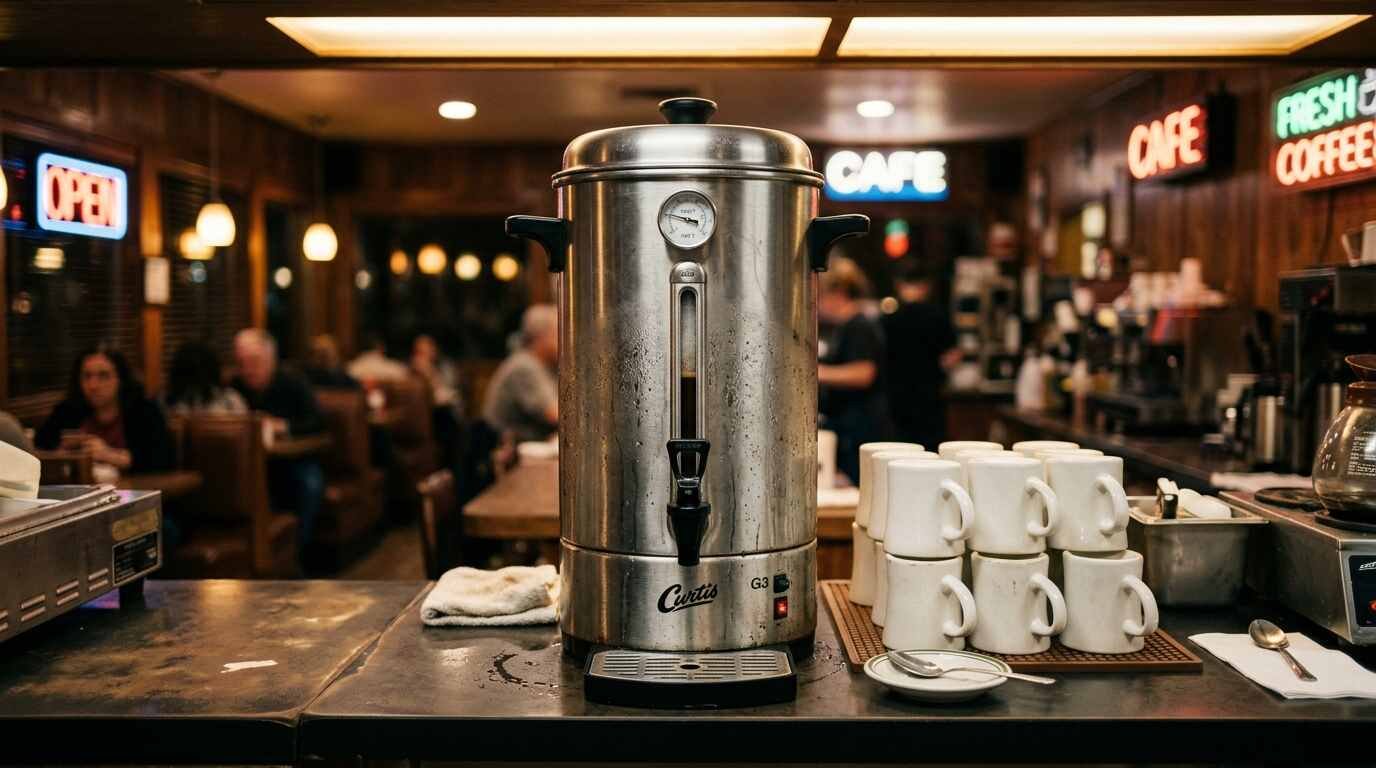
In September 2018, Chicago Tribune reporter Nick Kindelsperger brought Tim Taylor, a founding partner at Chicago’s Ipsento Coffee, into a diner with a refractometer and a set of equations. They measured the house coffee against National Coffee Association and Specialty Coffee Association recommendations for dissolved solids, and they came out the other side with a verdict: the coffee was thin, and it was bad.
Days later, Sprudge news editor Zac Cadwalader answered with a piece titled “In Defense Of Diner Coffee.” His objection was not that the numbers were wrong. He conceded them outright — by specialty standards, at their most generous, diner coffee does not measure up. His objection was to the design of the test itself, which he compared to inventing a personal scale and then discovering that everyone else scores lower on it.
That complaint sounds like a joke. It is actually a precise description of a category error, and it is the reason this argument keeps circling back every few years without resolving.
What the Golden Cup Standard Is Actually Measuring
The SCA publishes its brewing parameters openly. To hit the Golden Cup, the recommended coffee-to-water ratio is 55 grams per liter, plus or minus ten percent. Water temperature at the point of contact with the grounds should land at 200°F, plus or minus five degrees. Contact time runs one to four minutes for fine grinds, four to six for drip, six to eight for coarse. Filter media should contribute less than 75 milligrams of sediment per 100 milliliters. Extraction yield belongs between 18 and 22 percent, which for most drip coffee puts dissolved solids somewhere around 1.15 to 1.35 percent.
Read that list again and notice what governs all of it. Every parameter describes a single brew, evaluated at or near the moment of brewing, poured into a cupping vessel of specified dimensions, tasted black by a trained palate working through a scoring form.
There is no term in the standard for minute forty. There is no coefficient for a fourth refill. Nothing in the rubric accounts for four ounces of half-and-half.
The Urn Was Never Trying to Win That Contest
One correction is owed to the folklore here, because it circulates constantly and it is wrong: commercial brewers do not run scaldingly hotter than specialty equipment. Foodservice coffee brewers heat water to roughly 195 to 202°F — essentially the same window the SCA recommends. The heat at the moment of brewing is not where the two systems part company.
They part company afterward.
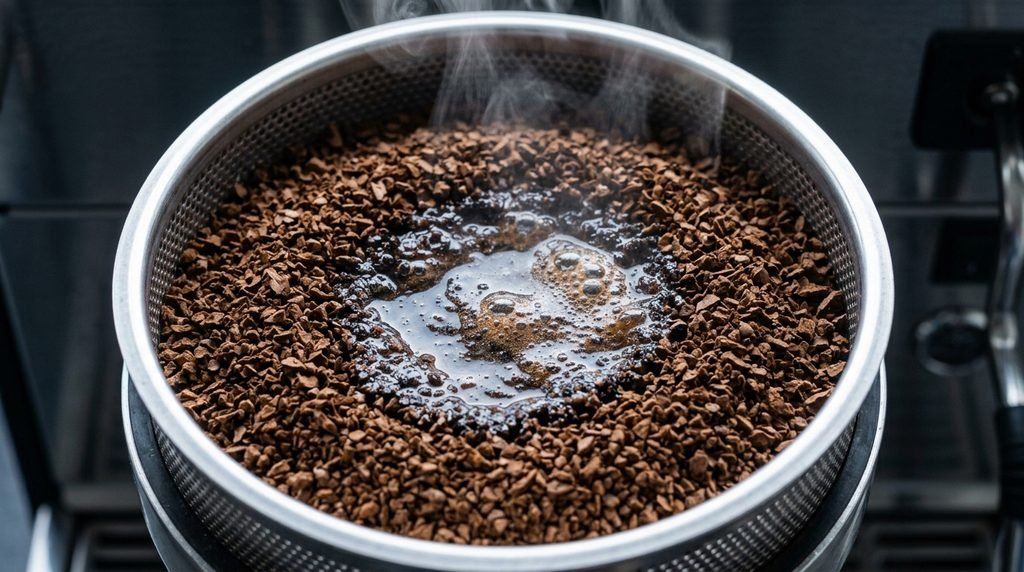
A satellite brewer or urn produces gallons against a batch of grounds several inches deep, and that geometry alone changes the physics. The bed is deeper, the thermal mass is enormous, the extraction is less forgiving of grind error, and the resulting volume has to survive a service window measured in hours rather than minutes. Every design choice downstream of that constraint — roast level, blend composition, grind coarseness, holding vessel — follows from it. The system was solving for a service problem. The Golden Cup was solving for a sensory one. Both solutions are competent. They are simply answering different questions.
Heat After the Brew Is the Variable Nobody Scores
Foodservice guidance puts the ideal holding temperature for brewed coffee between 175 and 185°F, and it comes with a warning attached: even inside that range, coffee held longer than about twenty minutes in an open container, or thirty in a closed one, starts moving toward a burnt profile. That clock is real, and the chemistry underneath it is well documented — sustained heat drives off volatile aromatics and accelerates the oxidative changes the SCA’s own literature review on staling describes.
Barista Hustle’s work on temperature explains the mechanism cleanly. A 10°C shift in brew temperature would be expected to roughly double the initial rate of extraction, and the effect is not uniform across compounds: less polar molecules, which tend to carry bitter and burnt character, respond disproportionately to higher water temperature. Two coffees extracted to identical percentages at different temperatures will taste meaningfully unlike each other.
I wrote about this at length in a piece on percolator chemistry and why the third cup tastes the way it does — the compounds responsible for that specific regret are identifiable, and pretending otherwise helps nobody.
But here is the part the standard has no language for. Batch brewing holds slurry temperature far more effectively than pour-over does, which is exactly why a diner can serve cup nine at the same temperature as cup two. Thermal stability across a long service is not a flaw in the format. It is the format’s entire reason for existing.
Built to Take Cream and Sugar Without Collapsing
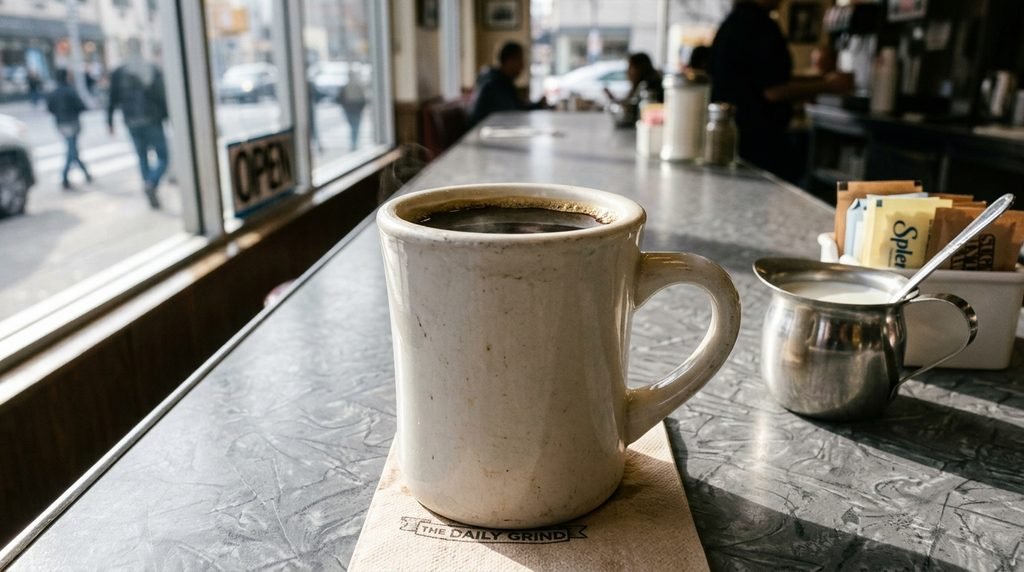
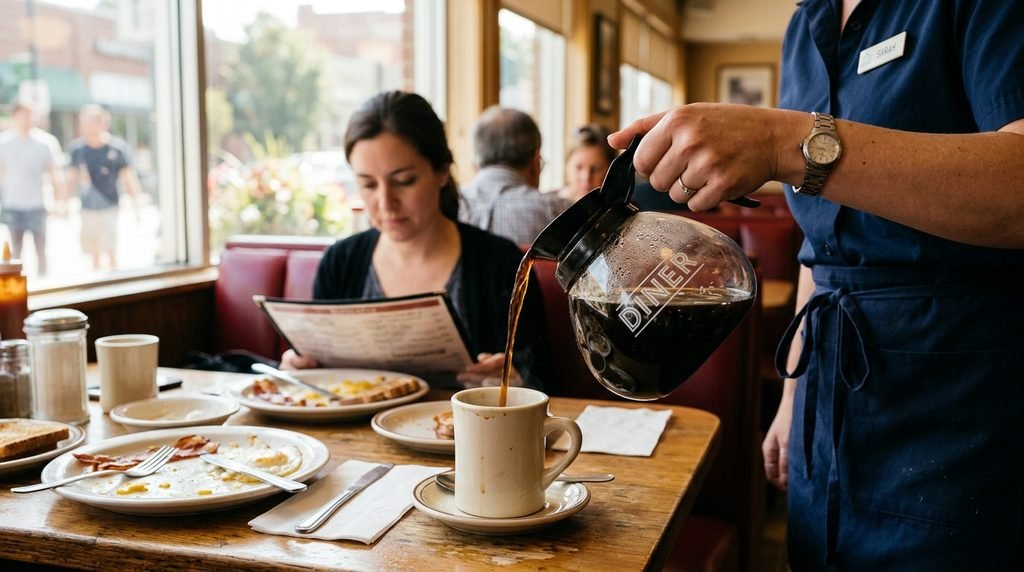
Consider what arrives alongside a diner cup: a small pitcher of half-and-half, a caddy of sugar, and the assumption that both will be used.
A coffee optimized for black consumption by a trained taster is optimized for delicacy — florality, acidity, the specific fruit character of a single origin. Introduce two ounces of dairy fat and a spoonful of sucrose into that cup and most of what earned the score disappears. Fat coats the palate and mutes aromatics. Sugar flattens perceived acidity.
Darker roasting and heavier extraction produce a cup with the structural backbone to survive that treatment. The bitterness a specialty rubric penalizes is, under the diner’s operating conditions, the thing standing between the drink and total dilution. The blend is not failing to be delicate. It is refusing to be, because delicacy would not survive the table.
The Two-Hour Sit
Diner coffee is a session beverage, and almost nothing else in American food service works this way.
The refill is not a courtesy add-on. It is the product. A cup that gets topped off six times over ninety minutes is functioning as the rent on a seat, the pacing device for a conversation, the thing your hands do while someone tells you something difficult. That format has been under renewed attention lately — the booth itself has become a subject of genuine internet enthusiasm, and the coffee is inseparable from the seat.
Specialty coffee, by contrast, is priced and portioned as an event. One vessel, consumed near peak, evaluated on its own terms. Both models are internally coherent. Only one of them has to still be drinkable when the plates have been cleared and nobody has asked for the check.
The physical infrastructure of the American diner was engineered around exactly this kind of duration — right down to the countertop material, chosen for surfaces that would take decades of abuse without complaint.
A Different Rubric, Not a Lower One
The honest version of this argument has to concede ground, so here it is.
Coffee held on heat for ninety minutes is degraded coffee. That is not a matter of taste or framing; oxidation dulls acidity and sweetness first, leaving bitterness more prominent, and continuous heat accelerates the whole process. Anyone claiming that a two-hour urn improves the cup is selling something. Plenty of diners also run genuinely stale product, brew to no particular ratio, and would not survive scrutiny under any rubric at all. Cadwalader’s rebuttal was written with real affection for coffee that had, by his own cheerful admission, been sitting on a burner since the previous shift.
What does not follow is the conclusion. A drink engineered for thermal endurance, dilution tolerance, and infinite repetition at a working-class price point is not a failed attempt at specialty coffee. Judging it by the Golden Cup is like grading a work truck on lap times.
The measurement was never the problem. The assumption that one measurement covers every case — that was the problem.
You Might Also Like
- Sunnyside Up and Structurally Compromised: The Precise Temperature Window That Separates a Diner Egg from a Cooked Mistake
- The Lard Question in Diner Pie Crust: How the Shift to Vegetable Shortening After World War II Changed the Flakiness of Every Slice on Long Island
- The Greek Diner Owners of Long Island: An Immigrant Story Told in Coffee and Eggs
Sources
- In Defense Of Diner Coffee — Sprudge, Zac Cadwalader, September 26, 2018
- Protocols & Best Practices — Specialty Coffee Association
- Æ 5.08 Playing With Temperature — Barista Hustle
- Æ 5.09 Temperature and Flow — Barista Hustle
- The Ideal Temperature for French Press — Barista Hustle
- The Science of Brewing the Perfect Cup of Coffee — KaTom Foodservice Resources
- What is the Shelf Life of Roasted Coffee? A Literature Review on Coffee Staling — Specialty Coffee Association