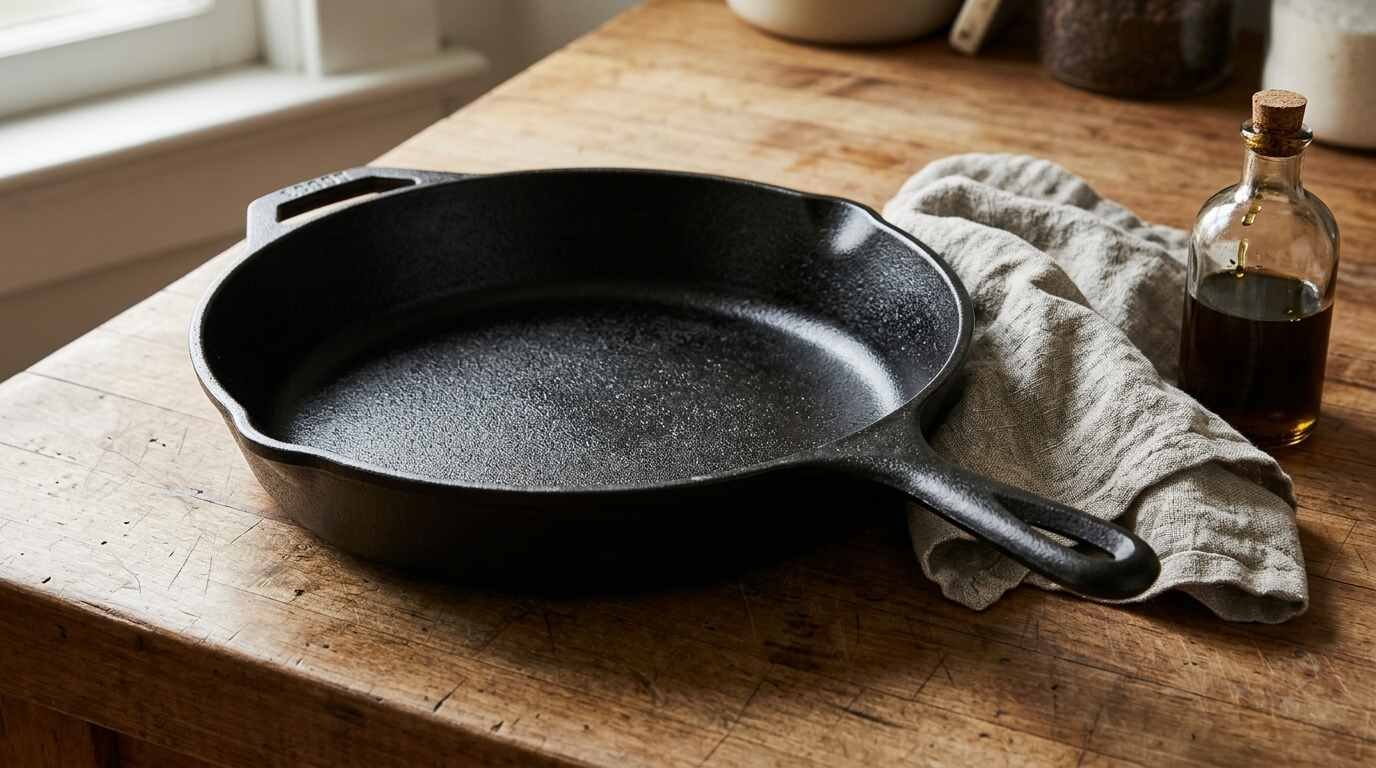
Nothing mystical happens inside the oven. A skillet goes in dull gray or spotted with rust, an hour of heat does its work, and it comes out dark and glossy, but the transformation is chemistry you could draw on a napkin, and once you see the napkin, most of the folklore around cast iron falls apart.
What Seasoning Actually Is
Seasoning is not a flavor, a spice, or a layer of old cooking residue. America’s Test Kitchen describes it as a coating of polymerized triglyceride molecules, many molecules thick, bonded to the metal. Strip away the vocabulary and the picture is simple: oil, heated hard enough, stops being oil.
PBS’s NOVA lays out the mechanism in plain steps. When oil reaches its smoke point, its fatty acids break into smaller pieces called monomers, and those pieces then link into long chains called polymers. Think of loose paper clips being hooked into a chain until the chain becomes a mesh, and the mesh becomes a film. That film is what you feel when you run a thumb across a well-kept pan.
The story has a wrinkle, though. NOVA also reports that researchers at Chongqing University, studying woks, have proposed that oxygen-driven changes at the iron’s surface, described as tiny “iron nanoballs,” help create a surface that repels water when water is scarce. The piece does not name the study or its authors, so treat it as an intriguing lead and not settled science. The practical instructions below work either way.
Why Heat Is the Whole Trick
Oil on a cold pan is just grease. The seasoning process begins only when the temperature climbs past the oil’s smoke point, and that number varies enormously from one oil to the next. NOVA’s examples show the spread: virgin avocado oil smokes around 520°F, while coconut oil starts at roughly 350°F.
This is why a pan rubbed with oil and left on a shelf never improves, and why a pan that sees repeated high-heat cooking slowly gets better. Lodge makes the same point from the cook’s side of the stove: each time you cook with oil or fat, you add another layer, and over time the layers build into a nonstick surface. The oven just does it all at once, on purpose, and evenly.
The Oven Method, Step by Step
Lodge’s own instructions are the clearest published recipe, and they hold up against what America’s Test Kitchen recommends. In order:
- Wash the pan with warm, soapy water, then dry it completely with a towel. Lodge is explicit that soap is fine before seasoning.
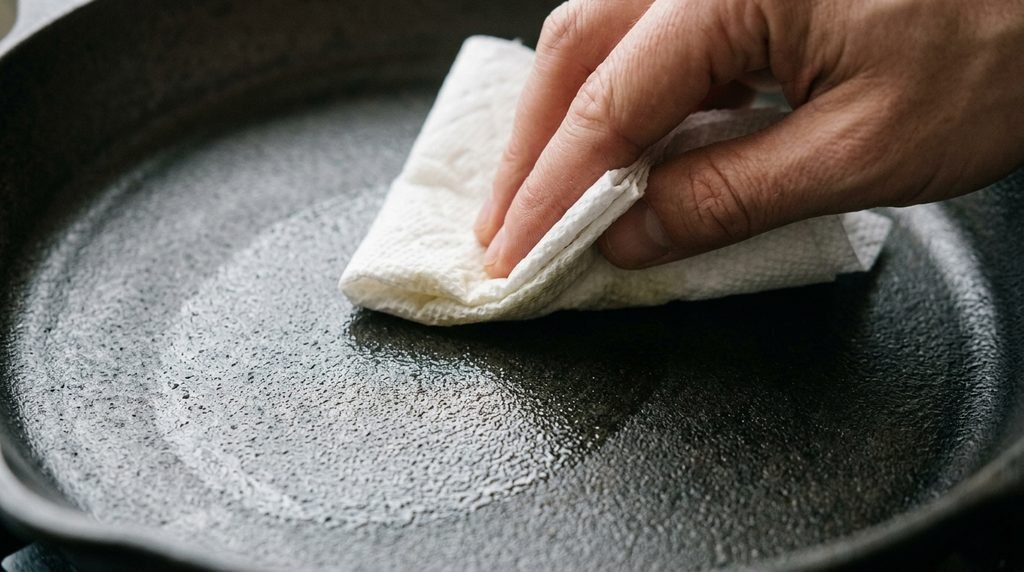
- Rub on a very thin layer of oil with a cloth or paper towel, thin enough that nothing drips when you tilt the pan.
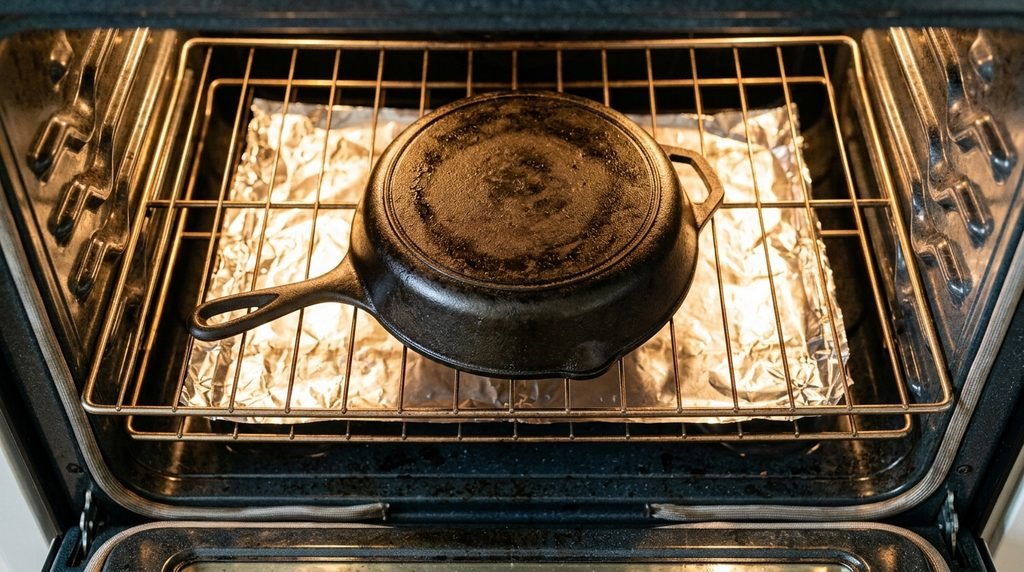
- Set the pan upside down on the center oven rack, with foil on the rack below to catch any stray oil.
- Bake at 450 to 500°F for one hour. America’s Test Kitchen leans toward the hotter end, a 500-degree oven.
- Let the pan cool completely inside the oven before you touch it.
That instruction about a thin layer exists for a reason. Puddled oil tends to bake into uneven, tacky patches, while a barely-there film cures into something hard and even. If a pan comes out sticky, the usual fix is another hour in the oven with a lighter hand.
One coat gives a start, not a finish. Cooks who want a dark, durable surface repeat the cycle, and the pan keeps improving with ordinary use afterward.
Which Oil to Use
Highly unsaturated oils polymerize most readily, and America’s Test Kitchen names canola, sunflower, soybean, and corn oil as good choices, with flaxseed oil, rich in omega-3 fatty acids, singled out for especially durable coatings. Lodge keeps it simpler: vegetable oil, melted shortening, or canola, preferably with a high smoke point.
Flaxseed oil has a devoted following, and one well-documented trial shows why. Cambria Bold, writing for The Kitchn, stripped a 12-inch Lodge skillet in the oven’s self-cleaning cycle, then applied six coats of unfiltered flaxseed oil at 500°F over roughly 18 hours of baking and cooling. She reported a smooth, black, flake-free finish that released egg residue with little scrubbing, though the pan still wanted some oil for cooking eggs. That is one cook and one pan, so it is evidence of what can work, not a guarantee, and it demands far more time than a single pass with canola.
For most kitchens the sensible path is the boring one: a common cooking oil you already own, a thin coat, one hour, and then regular cooking to do the rest.
Soap, Salt, and the Rest of the Myths
The loudest rule in cast iron culture says soap destroys a pan. Lodge disagrees in writing: soap isn’t necessary, but mild dish soap is fine, because a properly polymerized coating is far tougher than a film of loose grease. America’s Test Kitchen agrees, advising a small amount of soap if you like, rinsed well, and a nonmetal brush or nonabrasive pad.
What matters comes after the wash. America’s Test Kitchen dries the pan thoroughly instead of letting it air-dry, then warms it over medium-low heat until the last moisture evaporates, and finally wipes in about half a teaspoon of oil with a paper towel. Lodge boils the routine down to three verbs: wash, dry, and rub with oil.
A few other claims get the same treatment from Lodge:
- Acidic foods: small amounts are fine. Large quantities cooked for a long time can break down seasoning, which re-seasoning repairs.
- Metal utensils: welcome. Lodge calls cast iron the most durable metal you will cook with.
- Water and rust: rust can happen, but steel wool and re-seasoning remove it. Prompt drying and a light oil film prevent it.
- Dishwashers: Lodge’s care guidance stresses hand-washing with warm water, so skip the machine.
Questions People Ask
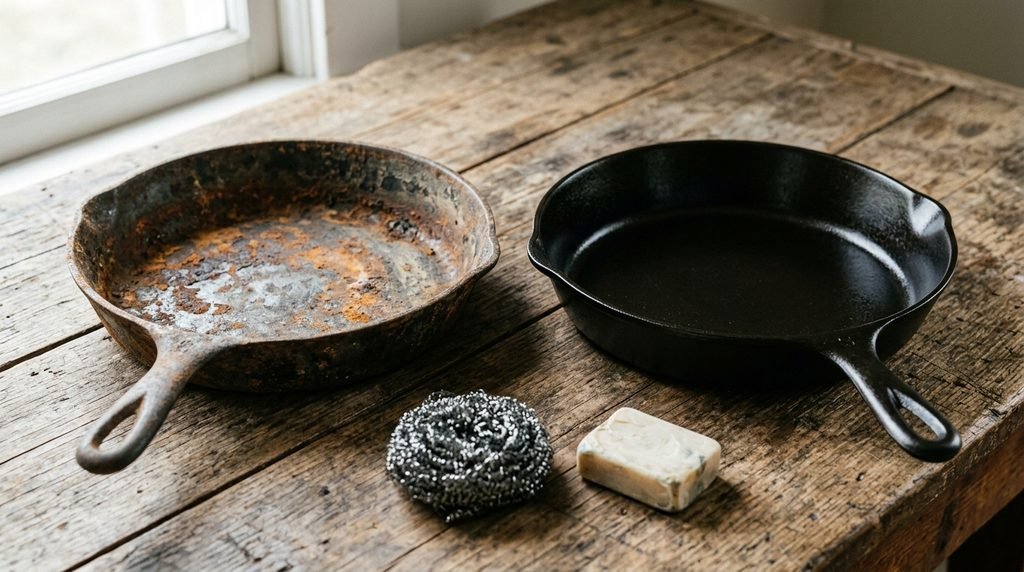
Can a rusty pan be saved? Almost always. America’s Test Kitchen recommends scrubbing with steel wool and soap to remove crusty residue, and a badly damaged pan may need stripping and a full re-seasoning. Lodge likewise says rust is easily removed with steel wool, followed by re-seasoning.
How often should a pan be re-seasoned? Whenever the surface looks dull, patchy, or food begins to stick. Regular cooking with oil rebuilds the coating between oven sessions.
Does the pan have to be expensive? America’s Test Kitchen’s testing named a premium skillet as its top pick and a Lodge 12-inch as the budget choice, and both were rated on searing and browning performance. The seasoning method is identical either way.
Why does a seasoned pan feel slightly sticky after cooking? Usually a layer of oil that never fully cured. Another thin, hot pass in the oven typically clears it.
The same logic behind a good skillet shows up wherever heat meets a metal surface and a fat, including the flat-top temperature window in the science of the perfect diner fried egg. For the philosophy side of the cookware aisle, there is the Lodge versus Le Creuset debate, and for a pan with something to prove, crispy griddled corned beef hash with fried eggs.
Sources
- What happens when you season a cast iron pan — PBS NOVA
- How to Season — Lodge Cast Iron
- 10 Myths About Cast Iron Cookware, Busted! — Lodge Cast Iron
- The Science of Seasoning — America’s Test Kitchen
- How to Clean a Cast Iron Pan — America’s Test Kitchen
- I Seasoned My Cast Iron Pan with Flaxseed Oil, and Here’s What Happened — The Kitchn