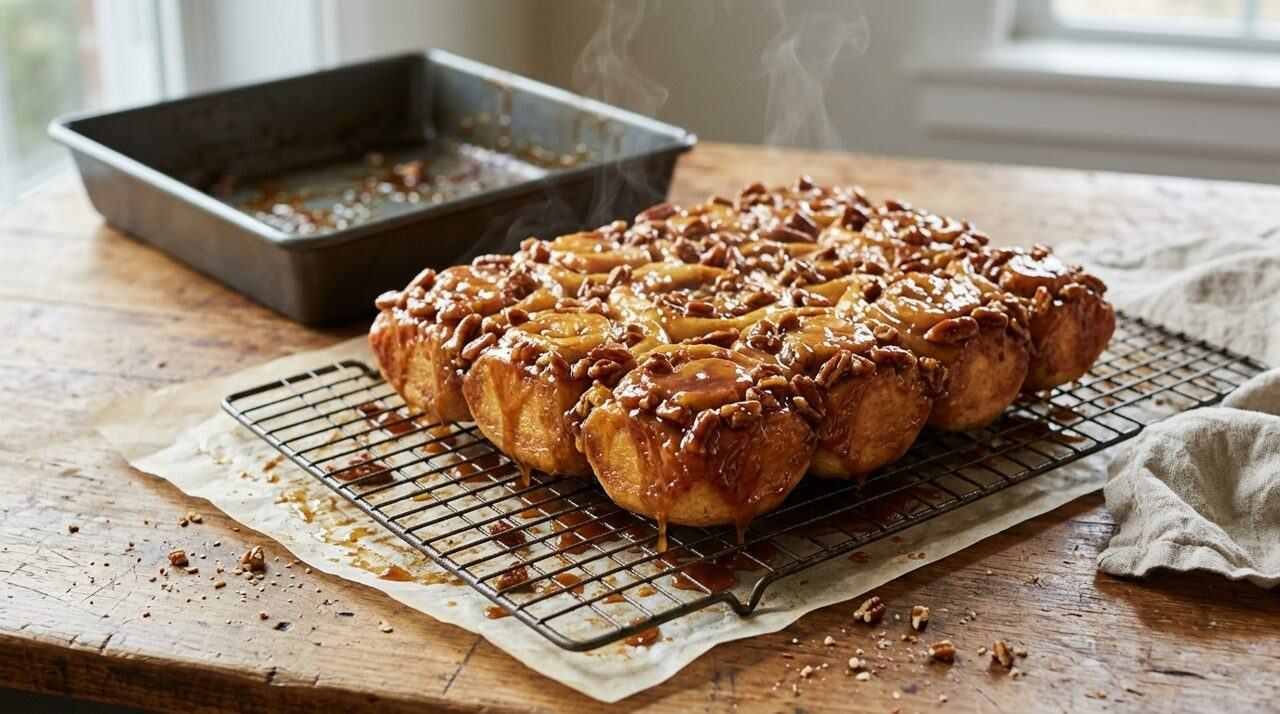
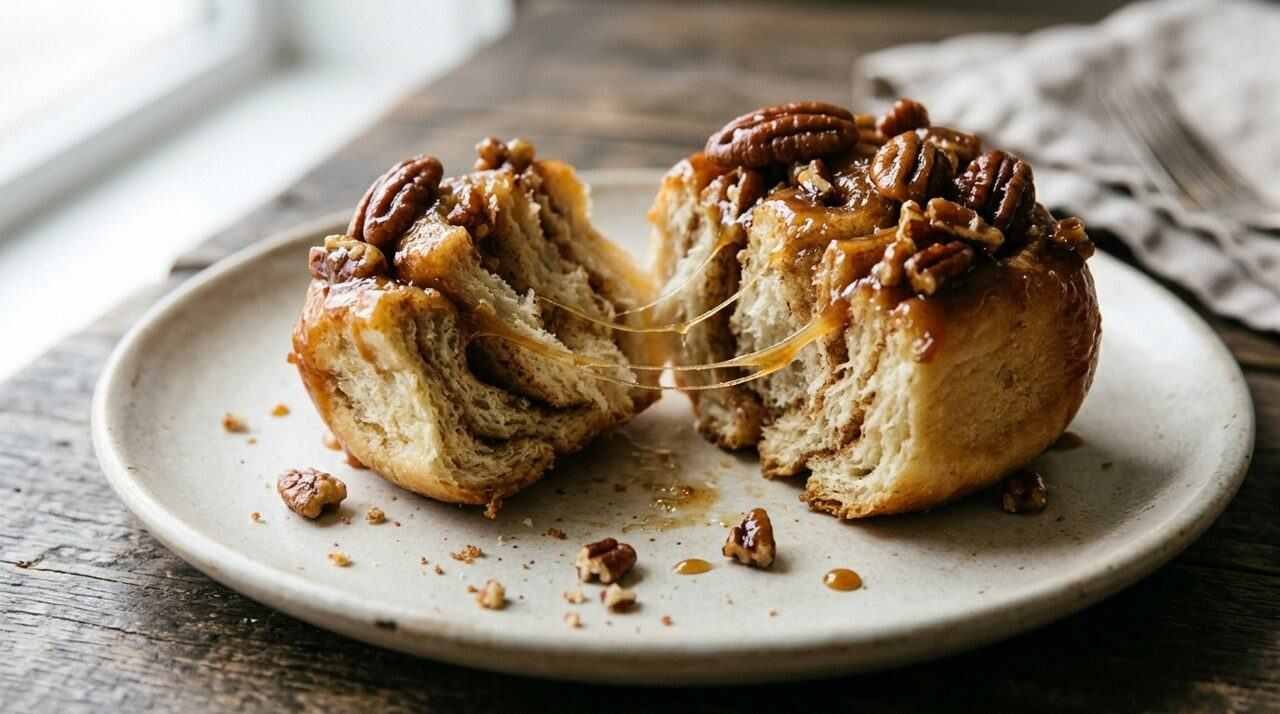
A sticky bun is a cinnamon roll turned upside down, and that single inversion changes nearly everything about it. The caramel goes into the pan before the dough does. After baking, the pan is flipped, and what was the bottom becomes a glossy, pecan-studded crown. Done well, the result is tender dough, a thin crackle of cooked sugar, and a pool of glaze that has to be scraped off the pan with a spatula because nobody wants to waste it.
The recipe below follows the proportions of King Arthur Baking’s sticky buns, which yield sixteen buns from two 9-inch round pans, with notes from America’s Test Kitchen and others on why each step is built the way it is.
Sticky buns and cinnamon rolls are not the same bake
The two share a yeasted dough and a cinnamon-sugar filling, and the resemblance ends about there. According to Tasting Table, cinnamon rolls are finished with icing after baking, while sticky buns carry a baked-in caramel of butter, brown sugar and often nuts that is revealed when the pan is inverted. Cinnamon is central to the roll. In a sticky bun it can share the stage with nutmeg or allspice, or be left out altogether.
America’s Test Kitchen draws the line in texture as well. In its comparison of cinnamon buns, sticky buns and honey buns, sticky buns come out generally denser, topped with pecans and a caramel glaze. Honey buns swap the caramel for honey and bake upside down in a similar way.
As for origins, the same Tasting Table piece says sticky buns “can be traced back” to Pennsylvania Dutch country, where European baking traditions met local ingredients, and it offers no town, date or documentation. That is a hedged attribution and should be read as one. None of the pages consulted here settles the question.
The dough
Soft, a little sticky, and enriched without being heavy
King Arthur’s sticky bun dough is built from all-purpose flour, butter, a modest amount of sugar, dry milk and, unusually, dried potato flakes. The potato flakes and dry milk are the unexpected ingredients; the recipe does not say why they are there, but the dough that results is soft and easy to pat out by hand.
Water is the one variable that needs a judgment call. The recipe gives a range of about 198 to 255 grams and says to use less in summer or humid weather and more in winter or dry climates. Starting near the low end and adding water as the dough comes together is the safer way to land inside that range.
Temperature matters more than most home bakers expect. America’s Test Kitchen tested yeasted doughs made with 130°F water against controls mixed at 110°F or below and found that pizza bianca and cinnamon swirl bread mixed with the hot water came out denser, squatter and slightly sour than the controls. The testers also report that water above 120°F saves no real time. Lukewarm means comfortable on the inside of the wrist, not hot. An Ohio State University Extension bread article puts the ideal figure at 110 degrees and notes that hot water kills yeast.
The recipe
Makes 16 buns in two 9-inch round pans
Dough:
- 2 1/2 teaspoons instant yeast
- 7/8 to 1 1/8 cups (198 to 255 g) lukewarm water
- 3 cups (360 g) unbleached all-purpose flour
- 6 tablespoons (85 g) unsalted butter, room temperature
- 3 tablespoons (35 g) granulated sugar
- 1 1/4 teaspoons (8 g) table salt
- 1/4 cup (28 g) dry milk
- 1/2 cup (43 g) dried potato flakes
Caramel for the pans:
- 1/2 cup (156 g) light corn syrup or maple syrup
- 3 tablespoons (43 g) butter, melted
- 1 cup (213 g) light brown sugar, packed
- 1 cup (113 g) diced pecans, optional
- 1 tablespoon (14 g) rum, optional
Cinnamon filling:
- 1/2 cup (99 g) granulated sugar
- 2 teaspoons ground cinnamon
- 1 tablespoon all-purpose flour
Method:
- Weigh the flour, or spoon it into the cup and level it. Mix and knead all the dough ingredients until smooth, about 5 to 7 minutes on the second speed of a stand mixer. The dough should nearly clean the bowl.
- Put the dough in a lightly greased bowl, cover, and let it rise at room temperature for 1 to 2 hours, until nearly doubled and quite puffy.
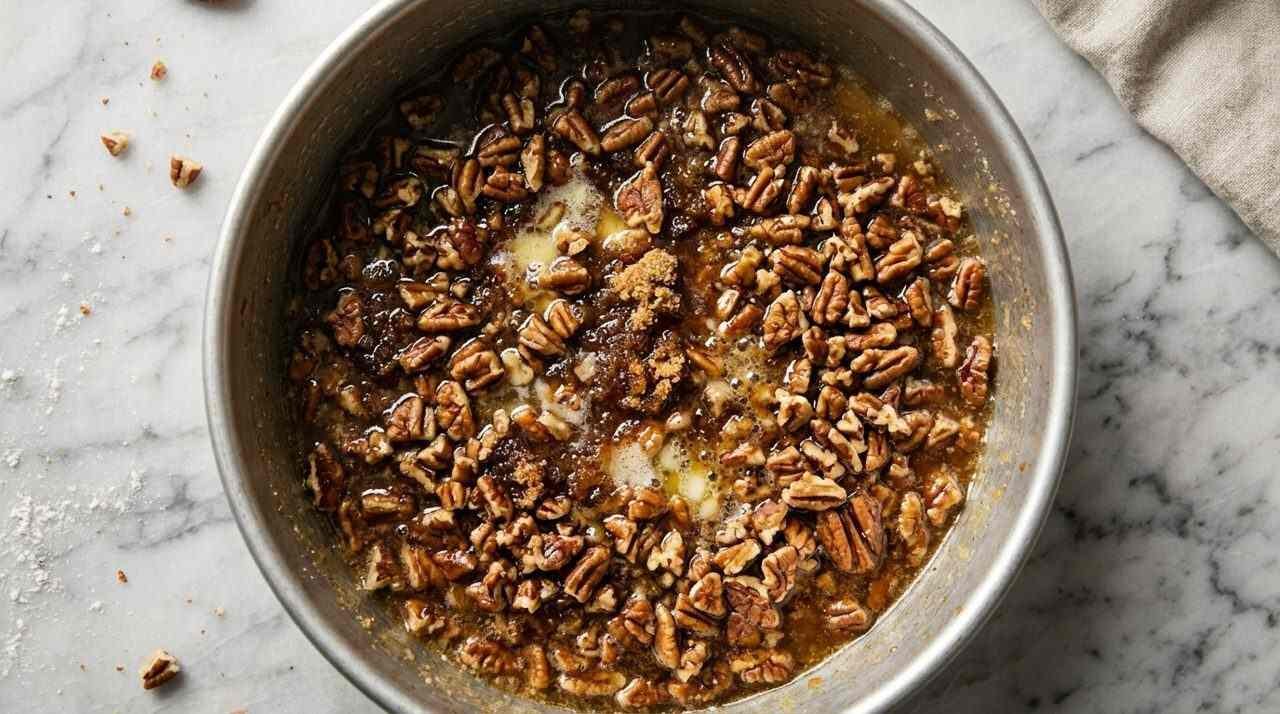
- Grease two 9-inch round pans. Whisk the syrup, melted butter and rum, if using. Divide it between the pans, then scatter the brown sugar and pecans over each.
- Whisk the filling ingredients together. Pat or roll the dough into a 16-by-12-inch rectangle on a lightly greased surface.
- Sprinkle the filling over the dough, leaving a 1-inch bare strip along one long edge. Starting from the opposite long edge, roll into a log so the bare strip seals the seam.
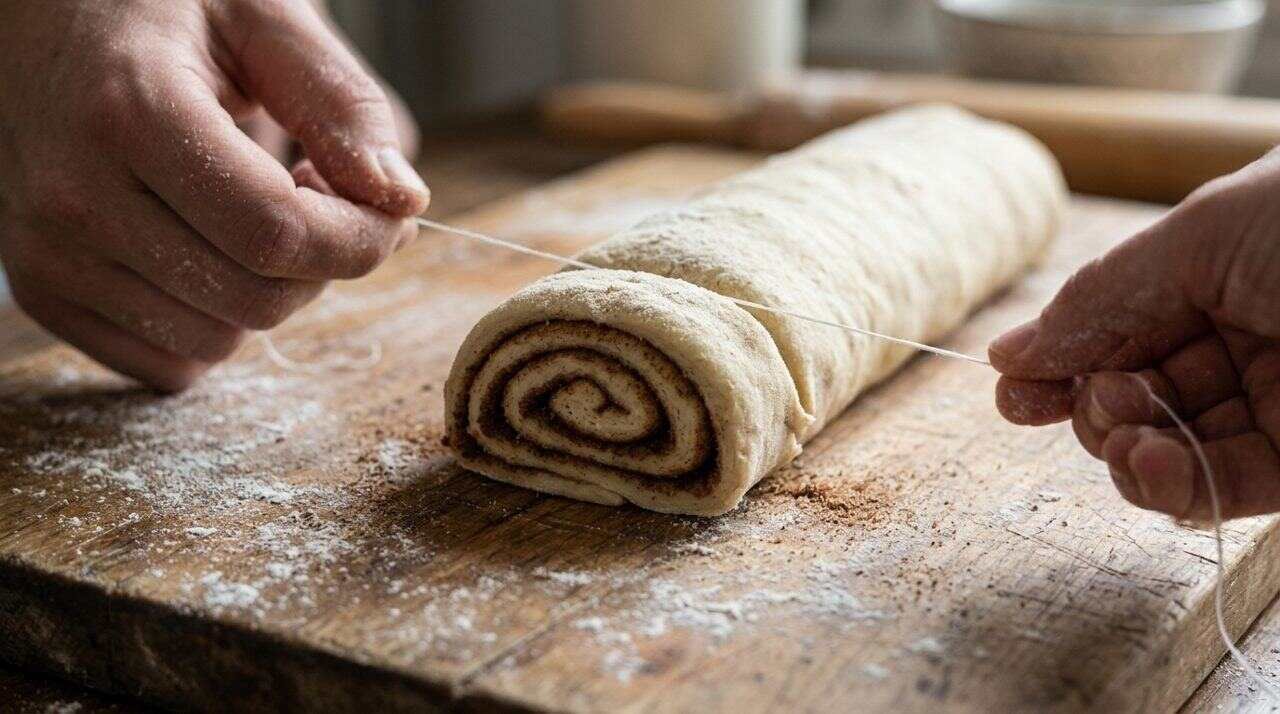
- Cut the log into 16 pieces with a serrated knife, rinsing the blade in hot water and wiping it between cuts.
- Set 8 buns in each pan. Cover and let them rise 1 to 1 1/2 hours, until they have spread and touch. Heat the oven to 350°F during this rise.
- Bake 15 minutes, tent loosely with foil, and bake about 10 minutes more, until light golden brown.
- Loosen the edges with a knife and invert each pan onto a rack or parchment-lined sheet right away. Scrape any remaining glaze onto the buns.
Why the caramel goes in first
Layering syrup, melted butter, brown sugar and nuts in the bottom of the pan builds a caramel in place. While the buns bake, the sugar dissolves into the fat and syrup, bubbles up around the dough and thickens. Flip the pan, and gravity delivers the topping without a single step of stovetop candy work.
That is also why timing at the end matters. King Arthur’s instructions say to invert the buns immediately after baking and warn that waiting too long leaves the glaze stuck in the pan. Caramel left in the pan after the buns come out is caramel the buns do not get.
The recipe allows either light corn syrup or maple syrup as the base of that glaze, and a tablespoon of rum is optional.
Rolling, cutting and the second rise
The dough is described as soft and easy to shape, so a rolling pin is optional. Patting it out on a lightly greased surface, as the recipe directs, keeps extra flour off the board; America’s Test Kitchen’s rolls carry the same advice, to avoid flouring the work surface once the first rise is done.
Cutting is where a good log can lose its shape, since a blade can drag through the soft dough. King Arthur’s soft cinnamon roll recipe suggests dental floss: slide a length under the log, cross the ends over the top and pull. America’s Test Kitchen’s cinnamon swirl rolls offer the same choice of floss or a serrated knife.
The filling in this recipe uses white granulated sugar and a spoonful of flour. America’s Test Kitchen explains the white-sugar choice for its own rolls this way: brown sugar melts more readily and can leak through the dough during baking. In a sticky bun, the brown sugar is safely underneath, where leaking is the point.
The second rise is judged by sight. The buns should spread until they touch and look puffy, which King Arthur puts at 1 to 1 1/2 hours. Rise times in these recipes are guides, and the baker’s notes make the same point: yeast activity varies, so the dough’s size matters more than the clock.
Baking and the flip
Bake at 350°F for 15 minutes, then tent loosely with foil and give the pans about 10 minutes more. The target is light golden brown.
Recipes for filled rolls often give an internal temperature as a second check. King Arthur’s soft cinnamon rolls call for a center reading of about 188°F, and the America’s Test Kitchen swirl rolls call for 185°F to 190°F in the center roll. The sticky bun recipe itself goes by color, but those numbers are a reasonable cross-check on a thermometer if a pan is in doubt, applied to a bun taken from the center.
Loosen the edges with a knife before the flip. Set a rack or a parchment-lined sheet over the pan, grip both firmly with oven mitts, and turn it over in one motion. Lift the pan after a moment and spoon or scrape any caramel left inside back over the buns. Serve warm or at room temperature.
Making them ahead
Shaped the night before, baked in the morning
King Arthur lays out a make-ahead path for a fresh breakfast. Make the dough, shape the buns and set them in the glazed pans without the second rise. Refrigerate the covered pans for up to 16 hours. Take them out and let them rest at room temperature for an hour, then bake at 350°F for about 35 minutes, until golden and the filling is bubbling.
For a softer crumb that holds for days, the tangzhong method is worth a look. King Arthur explains that cooking a small portion of the flour with liquid gelatinizes its starch, which lets the dough hold more moisture and keeps the rolls soft longer. The cinnamon roll version in that post cooks 7 percent of the total flour in milk. That formula is built for rolls rather than sticky buns, so swapping it in means adjusting hydration, and the recipe above is not written for it.
Leftover buns keep airtight at room temperature for several days, according to King Arthur, and they freeze for longer storage.
Sources
- King Arthur Baking: Sticky Buns
- King Arthur Baking: Soft Cinnamon Rolls
- King Arthur Baking: Tangzhong Method for Soft, Pillowy Cinnamon Rolls
- America’s Test Kitchen: Cinnamon Swirl Rolls
- America’s Test Kitchen: Cinnamon Buns vs. Sticky Buns vs. Honey Buns
- America’s Test Kitchen: The Impact of Too-Hot Water on Yeast
- Tasting Table: The Sweet Differences Between Cinnamon Rolls and Sticky Buns
- Ohio State University Extension (Wayne County): Baking Bread, How to Get a Rise Out of Dough