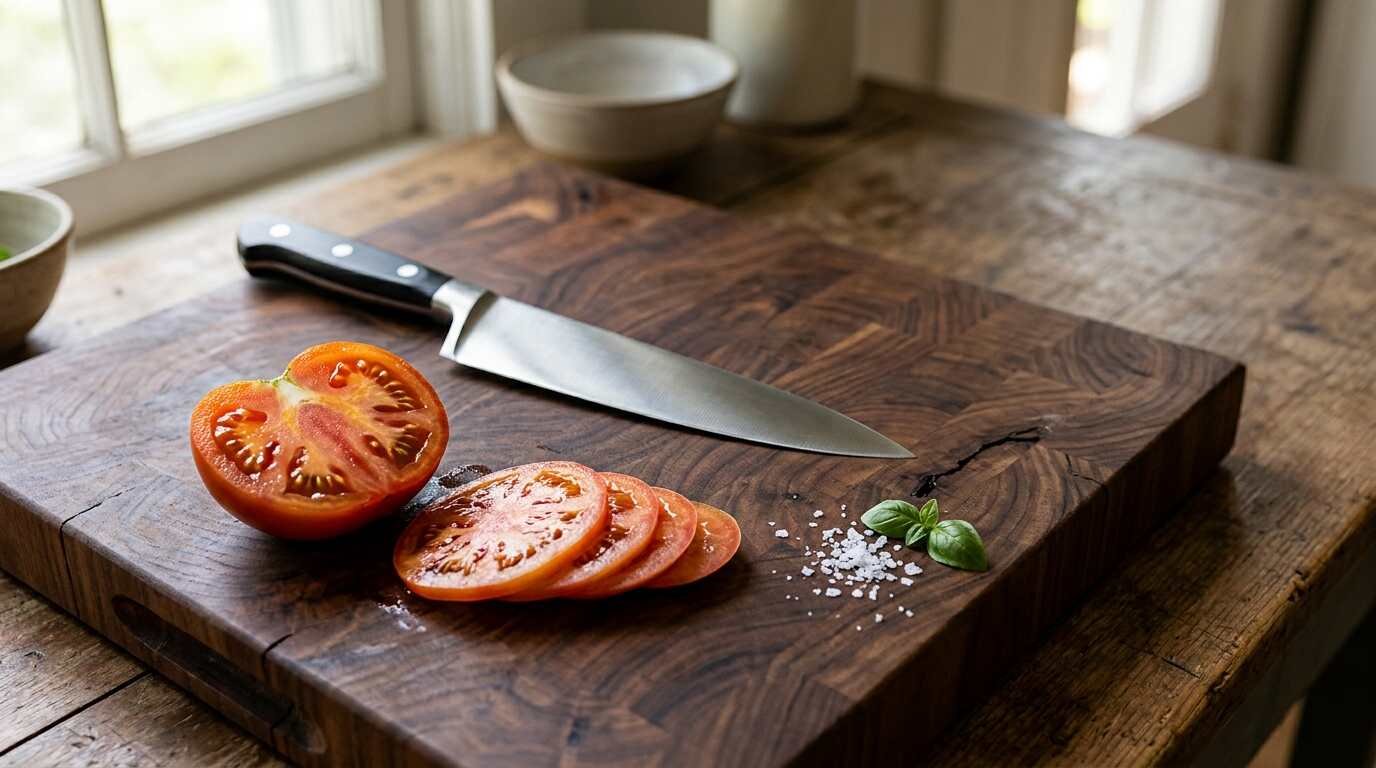
In September, J. Kenji López-Alt retracted an explanation he had repeated for years: that a honing rod simply nudges a bent edge back into line. The evidence against it came from electron-microscope images, and the correction arrived in the middle of a long argument about what makes a kitchen knife cut well. It also showed how much of what people believe about blades rests on repetition rather than measurement. Everything below leans on measured results from a metallurgist, a microscopist, and a knife-care expert, and sets the marketing vocabulary aside.
Geometry Beats Steel Almost Every Time
An edge is a wedge, and wedges obey arithmetic. The thinner the wedge, the less metal has to part the food and the less force the cook has to supply.
Metallurgist Larrin Thomas, who runs the Knife Steel Nerds site, has tested this from several directions. In a February 2026 article he pointed to standardized CATRA cutting trials: some steels cut under 300 millimeters of cardstock, while others passed 1,150. Then came the twist. A budget steel called AUS-6, sharpened to 12.5 degrees per side, could match the cutting performance of premium S110V sharpened to more than 20. (Angles here are counted per side. Double them for the full included angle.)
His earlier steel ratings put numbers on the trade-off. A 10-degree-per-side edge kept its keenness roughly five times longer than a 25-degree edge. Thin has a price, though. A 15-degree edge chipped noticeably under an impact of 0.3 foot-pounds, while a 25-degree edge took 2 foot-pounds with minimal damage.
Think of a razor blade beside a splitting maul. Each is a wedge, each is perfect at its own job, and each fails miserably at the other’s. A chef’s knife lives between them, which is why one blade rarely suits both a ripe tomato and a chicken backbone, and why edge angle deserves as much attention as the name stamped on the steel.
German and Japanese Knives Are Different Tools, Not Different Tiers
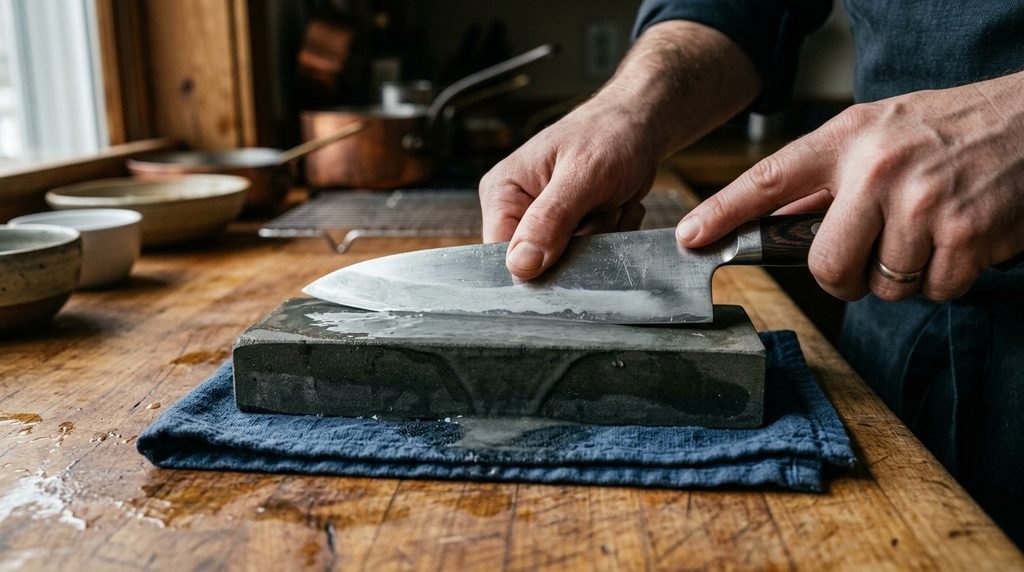
Retailer Cutlery and More puts typical German knife hardness at 56 to 58 on the Rockwell scale and Japanese knives at 60 to 66. Harder steel can hold a thinner, keener edge, but it behaves more like glass than like a spring. The same source notes that Japanese blades are more prone to chipping and call for careful storage and stone sharpening.
Shape matters as much as hardness. German blades carry a pronounced belly that sweeps up toward the tip, a profile built for rocking the knife through herbs and onions. The Japanese gyuto runs flatter, suited to push cuts and tap chopping, though modern versions have drifted toward a more centered tip that allows rocking too. Balance differs as well: the full tang and bolster of a German knife pull the weight toward the handle, while the minimal tang of a Japanese knife leaves it blade-heavy.
So the question is not which tradition wins. It is how a given cook moves a blade. Rock-chop mincers tend to feel at home on a German profile. People who slice with long, clean push strokes often prefer a gyuto. Hold both before buying if possible; a knife that balances at the bolster feels nothing like one that balances forward, and the difference shows up by the tenth onion.
Stainless, Carbon, and the Alloys in Between
Steel families sort into four rough groups, and each asks something different of its owner. The figures below come from Modern Cooking’s steel guide and reflect typical ranges, not guarantees for any single knife.
| Steel family | Example steels | Typical hardness | Upkeep and character |
|---|---|---|---|
| Carbon | 1084, W2, 52100, Shirogami (White Paper) | 60–64 HRC | Easier to sharpen, clean refined edge, but will patina and rust without a wipe-and-dry habit |
| Stainless | VG-10, AEB-L, 14C28N, Ginsan #3 | 60–62 HRC | Corrosion resistant and low maintenance, harder to sharpen, slightly coarser feel at the apex |
| Semi-stainless | Niolox, SKD11 | SKD11 about 62–63 HRC | Very low maintenance but not truly stainless; better refinement than full stainless |
| Specialty high-carbon | Apex Ultra, 26C3, Aogami Super, Shirogami #1 | 63–66 HRC | Thin geometry and refined edges; Shirogami #1 has the highest purity but low toughness |
Thomas’s own recommendations for kitchen use sort the same field by temperament. AEB-L and 14C28N are his picks for high toughness on a budget, CPM-MagnaCut for balanced performance, and CPM-S90V where edge retention rules. For work near salt water, he points to LC200N and Vanax, which top out around 60 to 61 HRC. Knife Steel Nerds also announced a newer stainless called MagnaMax in January 2026, aimed at combining strong edge retention with corrosion resistance, so the menu keeps growing.
A carbon blade rewards the same habit that keeps a cast-iron skillet seasoned: wipe it, dry it, put it away. The cookware debate over that philosophy is laid out in Lodge vs. Le Creuset: The Cast Iron Philosophy War Hiding in Your Kitchen. Stainless forgives a damp towel left on the counter. It does not forgive a dull edge any faster, and it is slower to bring back on the stone.
Honing Removes Metal, and That Changes the Routine
For decades the standard line went like this: sharpening removes metal, honing merely realigns a rolled edge. Cooks, instructors, and cookbook authors repeated it because it sounded right and sat comfortably with how a bent paperclip behaves.
Todd, the author behind Science of Sharp, tested it. In 2018 he examined ribbed steels, ceramic rods, and polished steels under a scanning electron microscope, cross-sectioning edges with a focused ion beam. Every rod removed metal. He called the realignment story “a common misconception that steeling does not remove metal,” and showed that ordinary dulling tends to leave a blunted, mushroomed apex rather than a neatly folded one.
López-Alt’s September 8, 2026 correction credits readers who pointed him to that work. He now describes honing as removing a little damaged steel and creating “a microscopic bevel right at the apex,” while sharpening works over a much larger share of the bevel. When that micro-bevel has taken too much damage, a stone becomes necessary.
For the kitchen, the revision tidies the routine rather than overturning it. Honing is the quick, light, frequent touch-up. A stone resets the whole edge when touch-ups stop working. David Olkovetsky, founder of Artisan Revere, told Gear Patrol he suggests a ceramic rod weekly for home cooks and daily for professionals. Treat those intervals as a starting point and let the knife’s behavior on a tomato skin set the real schedule.
Sharpening on a Whetstone, Step by Step
A stone feels intimidating until the first burr appears. After that it is mostly rhythm.
- Pick two stones. A medium stone (around 1,000 grit is a common starting point) does the shaping, and a finer one refines the result. Many beginner stones are sold as a two-sided pair.
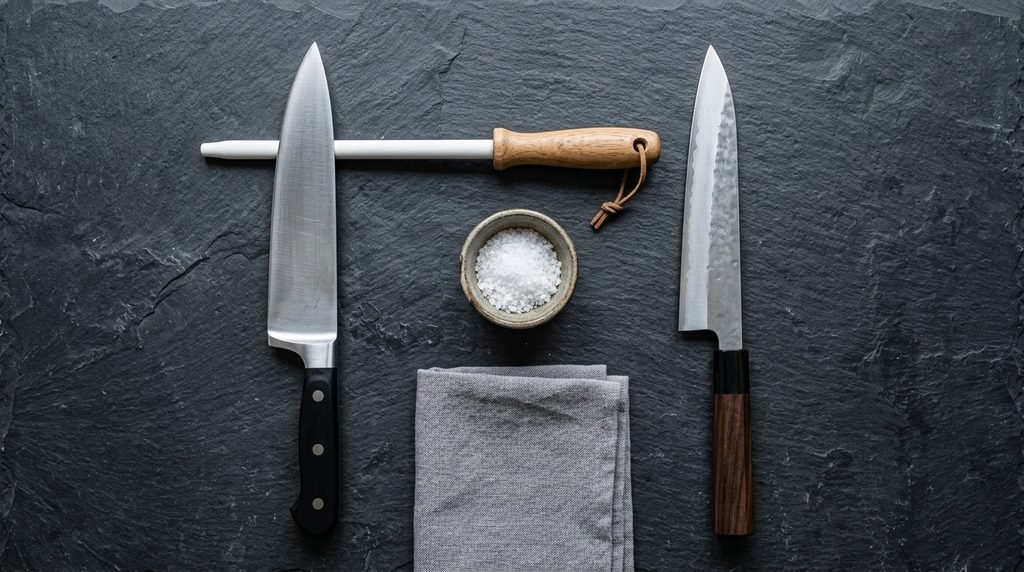
- Prepare the stone. Follow the maker’s instructions. One guide from Reviewed calls for a ten-minute soak for its recommended stone, while others only need a splash of water. Set the stone on a damp towel so it cannot slide.
- Find the angle. Most home cooks work somewhere between roughly 15 and 20 degrees per side, which fits the geometry research above. Lift the spine until the bevel lies flat against the stone, then hold that position. Consistency matters more than the exact number.
- Raise a burr. Using light pressure, push the edge across the stone as though shaving a thin slice off its surface, covering the whole length of the blade. Keep going on one side until a thin wire of metal, the burr, forms along the opposite edge. Check by drawing a fingertip across the edge, never along it.
- Flip and repeat. Work the other side until the burr moves back across the blade.
- Refine. Switch to the finer stone with lighter strokes to remove the burr and polish the apex.
- Clean and test. Wipe the blade and stone. The Reviewed guide suggests testing by slicing paper; a ripe tomato works too, and the knife should enter the skin under its own weight.
Science of Sharp has a series on burrs, including “Seven Misconceptions About Knife Burrs,” for readers who want the microscopy behind step four.
Boards, Dishwashers, and Magnets
Most edges die from daily habits rather than hard use. Gear Patrol’s list of ways people ruin knives, drawn from Olkovetsky, reads like a confession: prying with the tip, leaving blades wet, scraping food off the board with the cutting edge, tossing them in the dishwasher, parking them in a wooden block, and sharpening too rarely.
Cutting surface comes first. Olkovetsky accepts wood (walnut, cherry, or maple), plastic, and synthetic rubber. Glass and stone surfaces are widely advised against because they offer no give to the edge. Scrape debris with the spine, not the edge, and the apex lasts noticeably longer.
The dishwasher is the other habitual offender. Tom’s Guide writer Katie Mortram lists the damage: heat and humidity invite rust and corrosion, blades knock against other items, detergent is harsh enough to dull and discolor steel, and wooden handles splinter. Carbon blades suffer most. Olkovetsky adds that the heat and abrasive detergent can compromise handle epoxy.
For storage, he recommends a magnetic strip, preferably wood- or bamboo-covered, with knives placed spine-first so the edge never meets the magnet. Treating blades with mineral oil is also on his list.
Questions People Ask Before Buying
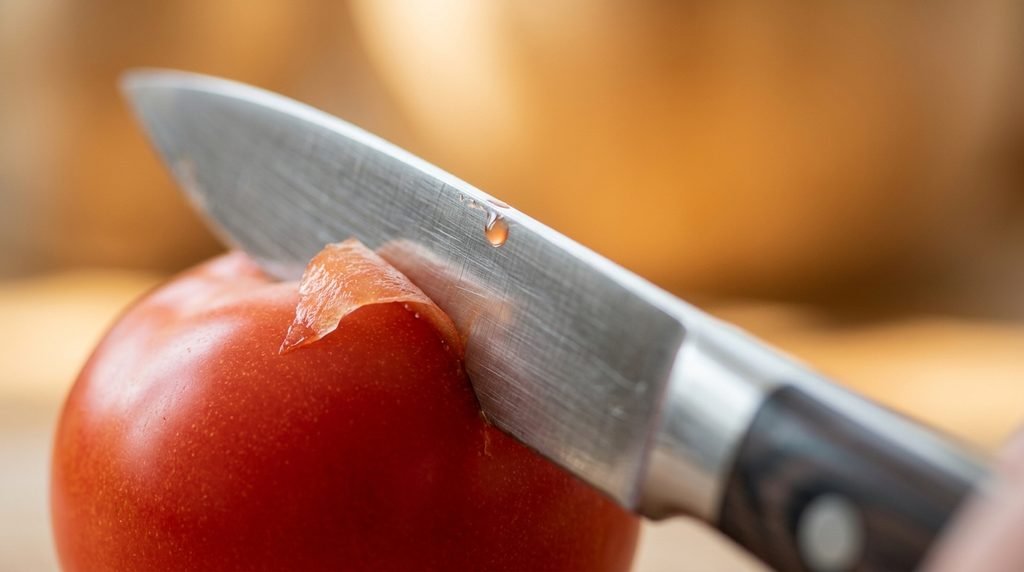
How often should a chef’s knife be sharpened? When honing no longer restores a clean bite into a tomato skin. The interval depends on use, steel, and cutting surface, so the knife itself is the best clock.
Is a Japanese knife better than a German one? Neither is better. Japanese knives are usually harder and finer-edged and more prone to chipping. German knives are usually tougher, with a belly built for rocking. Match the profile to the way the knife is used.
Does expensive steel make a big difference? It can, in measured edge-retention tests. But Thomas’s data shows edge geometry can erase much of the gap, and a well-sharpened modest steel often beats a poorly sharpened premium one.
Can one knife do everything? An 8-inch chef’s knife is the common home size and covers most vegetables, boneless meat, and herbs. Bones and frozen food call for a thicker edge, because the chipping data above shows what thin edges do under impact. A thick-edged cleaver, or a different tool entirely, belongs there.
Is carbon steel worth the fuss? For cooks who enjoy the stone and the wipe-down habit, yes. Carbon steels are easier to sharpen and take a clean edge. For cooks who want a knife that tolerates a wet sink, stainless is the practical choice.
Which knife suits steak and roasts? A chef’s knife handles trimming and portioning, and a slender slicer makes long carving strokes easier. The cut of beef matters too, and aged meat gets its own treatment in Dry-Aged vs. Wet-Aged Beef: What’s the Difference and Does It Matter?.
A knife is the one tool in a kitchen that tells the truth after every cut. It will tell you about the angle, the steel, and the last time anyone cared for it.
Sources
- How Honing Really Fixes Knives (A Correction), J. Kenji López-Alt, September 8, 2026
- What Does Steeling Do? Part 1, Science of Sharp, August 22, 2018
- Seven Misconceptions About Knife Burrs, Science of Sharp, February 3, 2024
- Knife Steel: Can You Tell the Difference?, Larrin Thomas, Knife Steel Nerds, February 23, 2026
- Knife Steels Rated by a Metallurgist, Larrin Thomas, Knife Steel Nerds
- MagnaMax Is Here: The Next Evolution in Knife Steel, Knife Steel Nerds, January 19, 2026
- German vs Japanese Chef’s Knives, Cutlery and More
- Steel Guide, Modern Cooking
- 8 Ways You’re Ruining Your Kitchen Knives, According to an Expert, Gear Patrol, March 29, 2024
- Dishwashers Are the Worst Thing for Knives, Tom’s Guide, August 28, 2021
- How to Sharpen a Knife Properly, Reviewed, August 23, 2019