 275 Route 25A, Mt Sinai, NY 11766

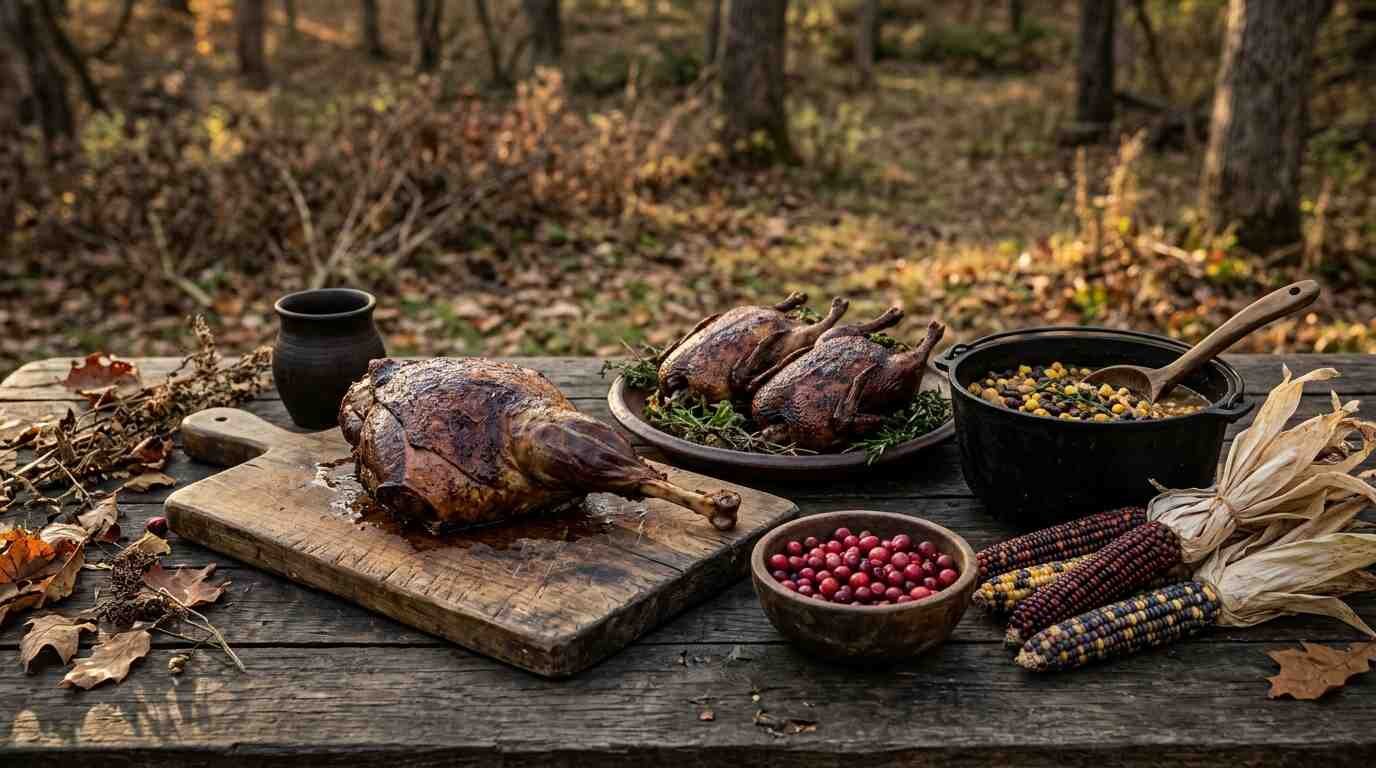
Five deer. That is the only food anyone bothered to count at the meal a whole country now reenacts every November, and the deer were not even brought down by the hosts’ own hunters. They arrived with the guests. Everything else on the famous table, from the bird to the bread, is either a single line in a letter or a careful inference from what grew, swam and flew near Plymouth in the fall of 1621.
@@YOUTUBE@@ The written record is thin enough to fit on an index card. The Pilgrim Hall Museum states that there are two, and only two, primary sources for the events of that autumn: Edward Winslow’s account in Mourt’s Relation and William Bradford’s Of Plymouth Plantation. The menus printed since, on placemats and grade-school worksheets, lean on those two documents plus a great deal of archaeology, botany and cookbook history.
The holiday menu most American kitchens will turn out today has almost nothing in common with the one that can be traced to Plymouth. The distance between the two is mostly a matter of what had not arrived yet.
Two documents and a short shopping list
The founding meal has fewer citations than a diner check has items.
Winslow’s letter is the closer of the two to an eyewitness report. According to the text reproduced by the Pilgrim Hall Museum, once the harvest was gathered the governor sent four men out fowling, and their haul fed the company for almost a week. During the days of recreation the colonists exercised their arms, and Massasoit arrived with about ninety men, who were entertained and feasted for three days. Those men went out, killed five deer, brought them to the plantation and presented them to the governor and the captain. Winslow closed the passage with a line meant for readers back in England: “we are so far from want, that we often wish you partakers of our plenty.”
It reads a little like a brochure. A letter home about plenty does a different job than a ledger.
Bradford’s account, covering the whole season rather than one gathering, adds the larder in general terms. The same Pilgrim Hall page records his description of men fishing for cod and bass, waterfowl arriving as winter approached, a large supply of wild turkeys along with venison, and a ration of about a peck of meal a week per person, or Indian corn in its place after the harvest. Bradford never says which of these foods appeared at the three-day gathering. He describes what the colony had. Historians fill in the rest.
Fowl, and the long argument over the turkey
The bird on the platter is a guess with good odds, not a fact on paper.
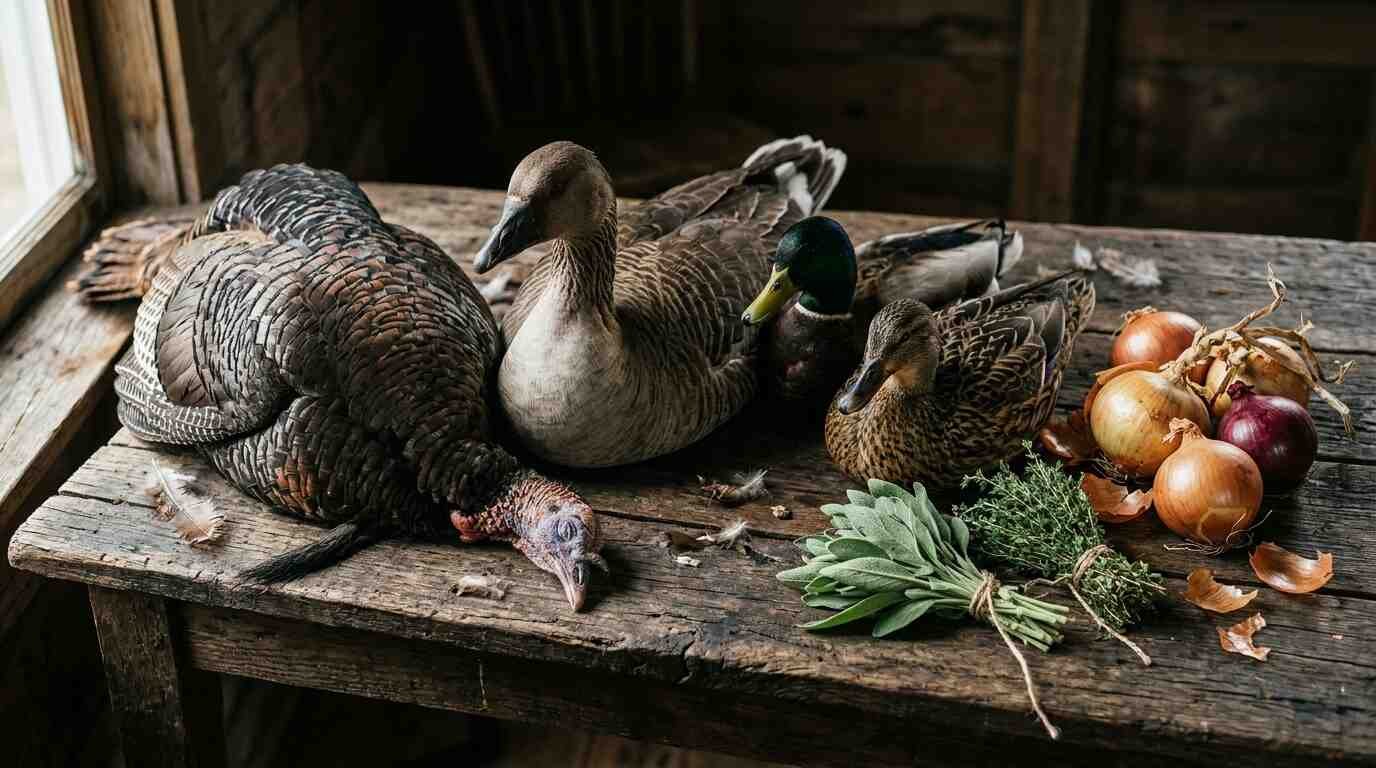
“Fowl” is the word Winslow used, and it is a broad one. It does not name a species. The Smithsonian Magazine article on the menu quotes Kathleen Wall, a foodways culinarian at Plimoth Plantation, the living history museum in Plymouth, on what is reasonably certain, and reports her view that turkey was not the centerpiece the way it is today. Wall suspects goose or duck was the wildfowl of choice, and her research found that swan and passenger pigeons would also have been available.
Plimoth Patuxet Museums takes a slightly warmer line on the turkey. Its education page on what was eaten at the 1621 harvest celebration calls turkey probable, pointing to Bradford’s note about the season’s wild turkeys, and adds smaller birds such as quail and the now-extinct passenger pigeon to the list of possibilities.
So the turkey survives the fact check, but as one bird among several in a pile of feathers. Bradford’s turkeys were wild birds, too, a long way from the animal that sits under foil in a modern roasting pan. The hot turkey sandwich on a diner menu descends from a different animal and a different century, and its gravy owes nothing to Plymouth.
One more detail from the Smithsonian account matters to anyone who has fought over the side dishes. Birds were filled, but not with bread. The colonists stuffed them with chunks of onion and herbs, which makes the old regional fight laid out in stuffing vs. dressing a much later quarrel than either camp tends to assume.
The deer came with the guests
Five carcasses walked into the story through the front gate, carried by Wampanoag hunters.
The arithmetic of the gathering is lopsided. The Pilgrim Hall Museum lists 53 Pilgrims present, all of them survivors of the Mayflower, which had reached Plymouth in December 1620. Winslow counted about ninety men with Massasoit. Plimoth Patuxet puts the total at no fewer than 140 people over three days. The guests outnumbered the hosts by close to two to one, which is the kind of reservation that makes a kitchen manager sit down for a minute.
Nobody brought venison as a garnish. Plimoth’s page uses the leader’s own name, Ousamequin, alongside Winslow’s Massasoit, and it is direct about why the meat mattered: “The presence of venison, hunted and brought back to New Plymouth by Ousamequin’s men, was significant.” The museum describes the gift of five deer as essential to the diplomacy of the occasion. Food was the language of the alliance, and the Wampanoag were the ones speaking it in quantity.
That alliance had a context that the paper-plate version of the story leaves out. A post from the Smithsonian’s National Museum of the American Indian explains that epidemic disease had already wiped out entire Wampanoag villages before the colonists landed, and that by 1620 the survivors were under pressure from the neighboring Narragansett, who had been less affected by disease and outnumbered them. In that account, the Wampanoag proposed a relationship that served both sides: food for the English, European weapons and help against the Narragansett for the Wampanoag. The same post credits Tisquantum, an English-speaking Patuxet man, with helping the colonists grow food that first summer.
Read with that background, five deer stop looking like a neighborly casserole. They look like a statement about who could feed whom.
Corn, eels and the rest of the table
The staple was flint corn, and the shellfish were close at hand.
The bread question is easier to answer than the bird question. Wall told Smithsonian Magazine that flint corn, the multicolored Indian corn, was the colony’s staple, eaten as bread or porridge. That fits Bradford’s ration of corn in place of meal.
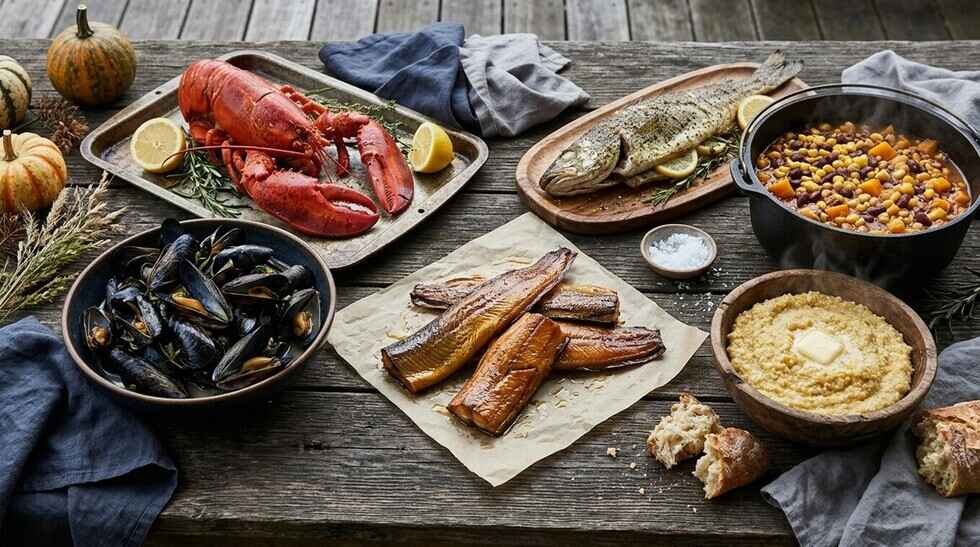
Plimoth Patuxet fills out the Wampanoag side of the kitchen in more detail. Flint corn was a staple of Wampanoag diets as well, and Wampanoag women grew beans, squashes, pumpkins, melons and sunflowers, cooking corn and beans together in soups and stews. The museum names sobaheg, a stew, along with boiled bread and nasaump, a corn porridge, as possible dishes. Nuts were crushed and boiled for oil or ground into flour.
Fish and shellfish supplied the rest. Bradford’s men fished for cod and bass, and Plimoth notes that mussels, lobster and eel were available throughout the fall. The Smithsonian piece adds clams. A modern menu that put eel next to venison would read like a tasting menu in a converted firehouse in Brooklyn. In 1621 it was simply what the tide brought in.
From the English gardens came cabbages, carrots and onions, plus herbs such as sage and thyme, according to the Plimoth page, and eggs and goat’s milk were probably on hand. Imports that survived the crossing, including dried fruit, wine, pepper, sugar, ginger, nutmeg or cinnamon, may have appeared in small amounts. Water was the most likely drink. The museum adds, with a straight face, that the colonists likely missed beer, which is the most relatable sentence in the entire historical record.
Potatoes, cranberry sauce and the missing pie
Half the modern plate had not arrived yet, and the other half lacked a crust.
Start with the potatoes, because the absence is total. The Smithsonian article states that white potatoes, from South America, and sweet potatoes, from the Caribbean, had not yet made their way into North America. Plimoth Patuxet adds that white potatoes were not yet part of the English diet and that sweet potatoes were a rare luxury for the wealthy. The mashed mountain with a gravy crater in the middle belongs to a later America.
Cranberries were there in the landscape. Plimoth lists them among the native fruits still available, a Wampanoag seasonal food. What was missing was the sauce. The museum says a recipe for cranberry sauce or cranberry tart would not appear in print for about another half century, and that those recipes were sweetened with substantial amounts of sugar. The Smithsonian piece puts it the same way: another 50 years before an Englishman wrote about boiling cranberries with sugar into a sauce for meat. The ridged, can-shaped version traced in the history of canned jellied cranberry sauce came along more than two centuries after that.
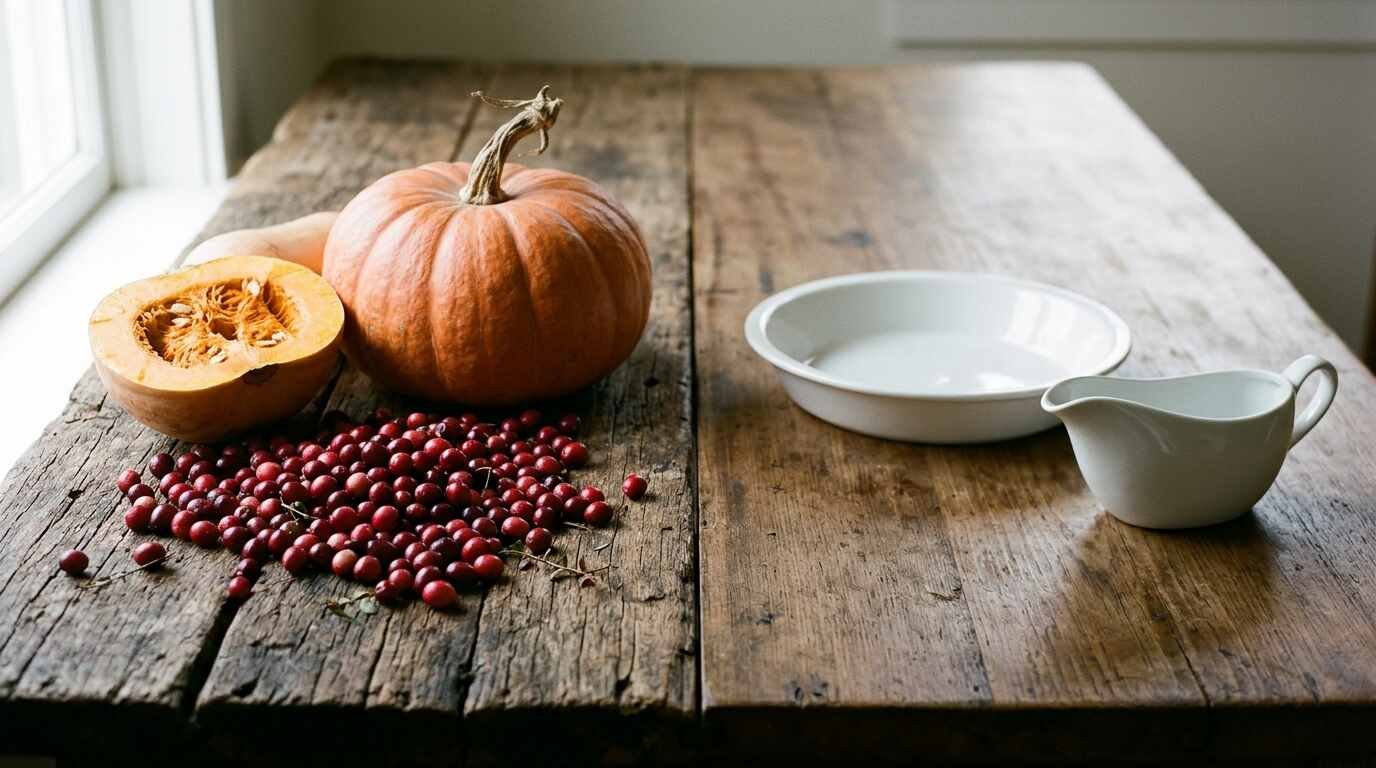
Then the pie. Plimoth says pumpkin was very likely on the table in some form, just never baked into a pie, and that the earliest English pumpkin recipes, which came after 1621, treated the vegetable much like apples. The deeper problem was structural: the settlement probably lacked butter and wheat flour in quantities large enough for a crust. The Smithsonian article, citing the same shortage, rules out pumpkin pie with an exclamation point. Apple pie was out of the question as well, since Plimoth notes there were no apples in Plymouth yet.
The founding feast of American dessert culture, in other words, had lots of deer and no dessert. The custard, the crust and the argument over canned or fresh pumpkin all arrived later, as did the pecan pie that now shares the case with it.
Why the menu is the easy part
The food can be reconstructed. The meaning of the meal is still being argued.
The menu question has a satisfying shape. It has evidence, a list, a few firm absences and a couple of probable birds. It rewards a fact check. That may be why it gets so much attention every November, and also why it can crowd out the harder conversation.
Nor was the gathering the start of an annual tradition. In a Smithsonian Magazine piece about how the event became a national myth, Paul Chaat Smith, a co-curator at the National Museum of the American Indian, put it flatly: “They didn’t repeat it the next year.” Smith said the meal was not special at the time and was forgotten for hundreds of years until the 1800s. Washington, Lincoln and 19th-century women’s magazines, the article notes, pushed for national days of thanks long after the deer had been eaten.
Wampanoag history complicates the warm version further. The National Museum of the American Indian post notes that the Wampanoag held Thanksgiving-like feasts and games long before any English ship arrived, and it frames the 1621 meal as one that “more notably symbolized the rare, peaceful coexistence of the two groups.” Rare is the operative word. The same post points readers toward what happened to New England’s Native nations later in the 17th century, a history that does not fit on a paper turkey made from a traced hand.
There is also the plain problem of the word “probably.” Nearly every item on a reconstructed 1621 menu, apart from the fowl and the deer, carries a hedge, because the two English writers who were there did not bother to list side dishes. A historian building that menu is a little like a cook reading a ticket with half the modifiers rubbed off. The food that can be named with certainty is the food that mattered to the politics of the moment: birds the English brought down, and deer the Wampanoag brought.
Which leaves an odd question for anyone carving today. If the only dish with a firm count was a gift from the guests, whose meal was it?
You Might Also Like
- Green Bean Casserole History: Dorcas Reilly’s 1955 Recipe and How It Became a Thanksgiving Fixture
- How to Make Turkey Gravy From Scratch, With or Without Drippings
- After the Bird: Eight Ways to Use Leftover Turkey
Sources
- Pilgrim Hall Museum, “Primary Sources for ‘The First Thanksgiving’ at Plymouth”: https://www.pilgrimhall.org/primary-sources-for-the-first-thanksgiving-at-plymouth/
- Plimoth Patuxet Museums, “What did they eat at the 1621 harvest celebration?”: https://plimoth.org/yath/unit-4/what-did-they-eat-at-the-1621-harvest-celebration
- Smithsonian Magazine, “What Was on the Menu at the First Thanksgiving?”: https://www.smithsonianmag.com/history/what-was-on-the-menu-at-the-first-thanksgiving-511554/
- Smithsonian Magazine, National Museum of the American Indian blog, “Everyone’s History Matters”: https://www.smithsonianmag.com/blogs/national-museum-american-indian/2017/11/23/everyones-history-matters-and-wampanoag-indian-thanksgiving-story-deserves-be-known/
- Smithsonian Magazine, “How an Unremarkable ‘Brunch in the Forest’ Turned Into the Thanksgiving We Know”: https://www.smithsonianmag.com/smithsonian-institution/how-unremarkable-brunch-forest-turned-thanksgiving-we-know-180970811/
Suggested category: Food History
Leave a Reply