Edmund Husserl delivered his lectures on the phenomenology of internal time-consciousness at the University of Göttingen between 1905 and 1910. He was trying to solve a problem that had bothered philosophers since Augustine: how is it that we experience time as a flow when each moment, strictly speaking, is gone before we can register it? By the time the clock ticks, the tick is already past. How do we hear a melody as a melody — as a sequence, not a series of unrelated notes — if each note vanishes the instant it sounds?
Husserl’s answer was retention. Consciousness, he argued, is not a series of discrete now-points. Each moment carries within it a “retention” of the just-past and a “protention” of the about-to-come. We don’t merely hear notes; we hear them in their temporal relation to what came before and what we expect to come. Time-consciousness is layered — the present moment contains its own past and future as living dimensions of experience.
The lectures were edited and published in 1928 by Martin Heidegger, who was Husserl’s assistant at the time and had his own complicated relationship with almost everything his mentor believed. But the text stands on its own, and its central insight — that consciousness is always already temporal, that the present moment is thick with retained past and anticipated future — is one of the most useful philosophical tools anyone has given us for understanding what actually happens in a professional kitchen.
The Sauce Breaks Before It Breaks
Every cook knows what I mean by this. There is a moment — and experienced cooks feel it before they see it — when an emulsion begins to lose itself. A béarnaise starts to go before any visible separation occurs. The hollandaise gives a signal, almost a texture-shift in the resistance on the spoon, before the fat begins to pool at the edges. The cook who catches it in time does not catch it by looking. They catch it by feeling the temporal dimension of the sauce — by retaining, in Husserl’s sense, the state the sauce was in two minutes ago and protending the state it will be in two minutes from now, and recognizing that the present state is an inflection point between the two.
This is Husserlian phenomenology operating without a lecture hall in sight. Harold McGee’s On Food and Cooking (Scribner, revised 2004) documents the physical chemistry of emulsion collapse with admirable precision — the dispersed fat globules lose their surfactant coating, begin to coalesce, the emulsion inverts. McGee notes that the process is gradual before it is sudden. But the cook’s knowledge that the sauce is going is not chemical knowledge. It’s temporal knowledge: the awareness of a direction of change, of the present as a moment in a trajectory. That’s retention and protention applied to fat and heat.
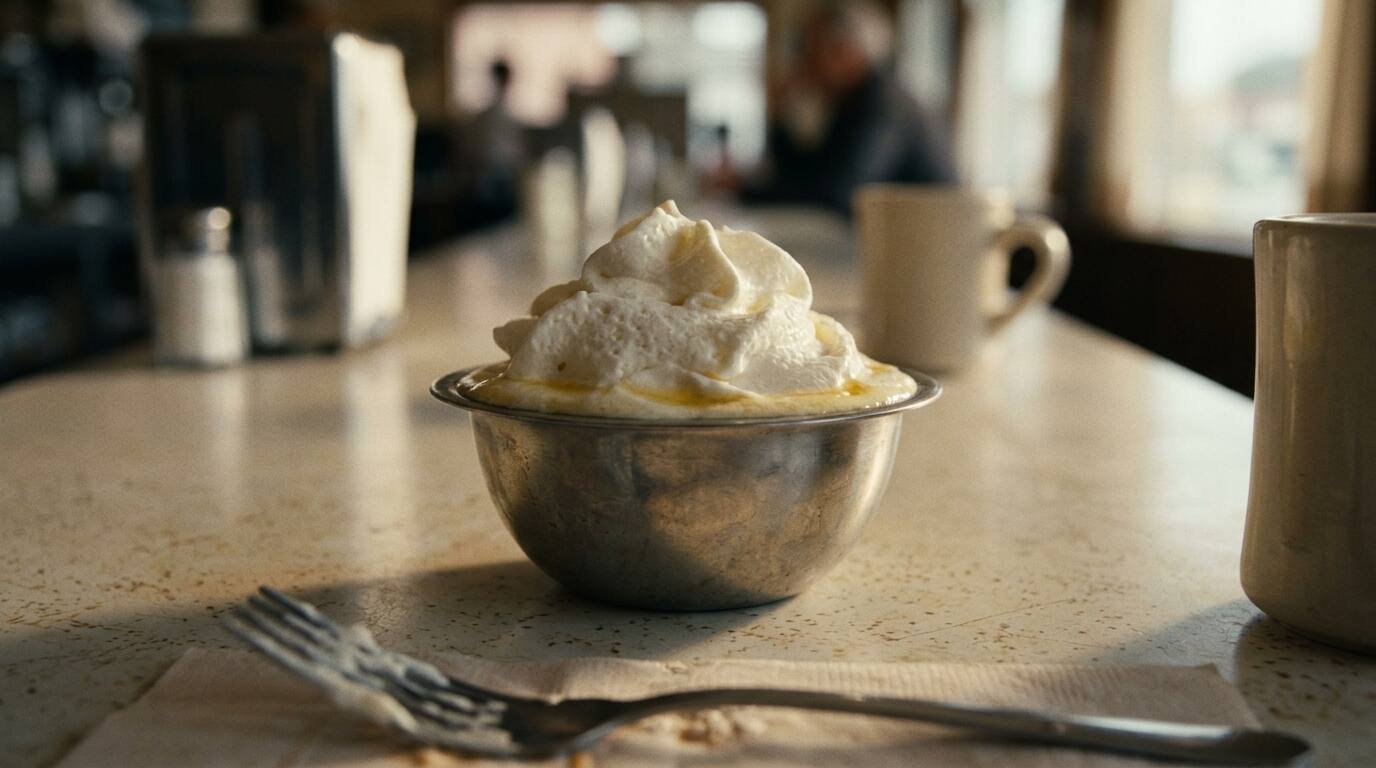
Whipped cream, specifically, is an emulsion of a different kind — air beaten into fat — and its collapse back into liquid is one of the cleanest illustrations of what Husserl was after. The cream that has been sitting too long is not the cream it was. But it is also not yet something else. It exists in a phenomenological in-between: it retains the structure of what it was (you can still see the soft peaks, or what remains of them), and it protends the liquid it is becoming. The present state of the cream is haunted by its past form and its future dissolution simultaneously. If Husserl had spent any time in a pastry kitchen, he might have found his central example there rather than in the problem of hearing a melody.
Bergson’s Kitchen Clock
Henri Bergson came at time from a different direction, and the tension between him and Husserl — they were roughly contemporary, though they rarely engaged each other directly — is worth tracking through the kitchen as well.
Bergson’s complaint, developed in Time and Free Will (1889) and then in Matter and Memory (1896), was that philosophy had been systematically falsifying time by treating it as if it were space. Clock-time — seconds, minutes, measurable intervals — is a spatial metaphor applied to what is actually a continuous, undivided flow. He called the real thing durée: lived duration, the time you actually experience, which has no edges and no units and cannot be cut into pieces without destroying what it is.
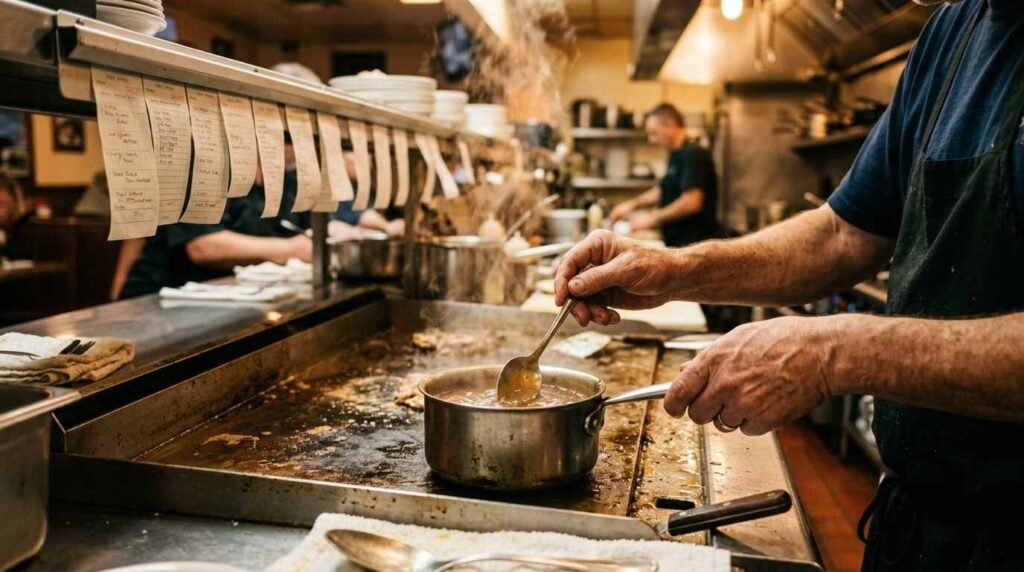
The clock above a diner counter shows time as space: equal intervals, each identical to the last. But no one actually experiences breakfast-rush time and 3 PM Tuesday the same way. Bergson is obviously right about this. The cook at the flat-top during the 8 AM rush is living in a different temporal universe than the cook cleaning the grill at 2 PM. The rush has its own durée — a continuous pressing-forward quality that cannot be broken into units without losing the essential feature, which is its relentlessness. This is what Bergson was getting at.
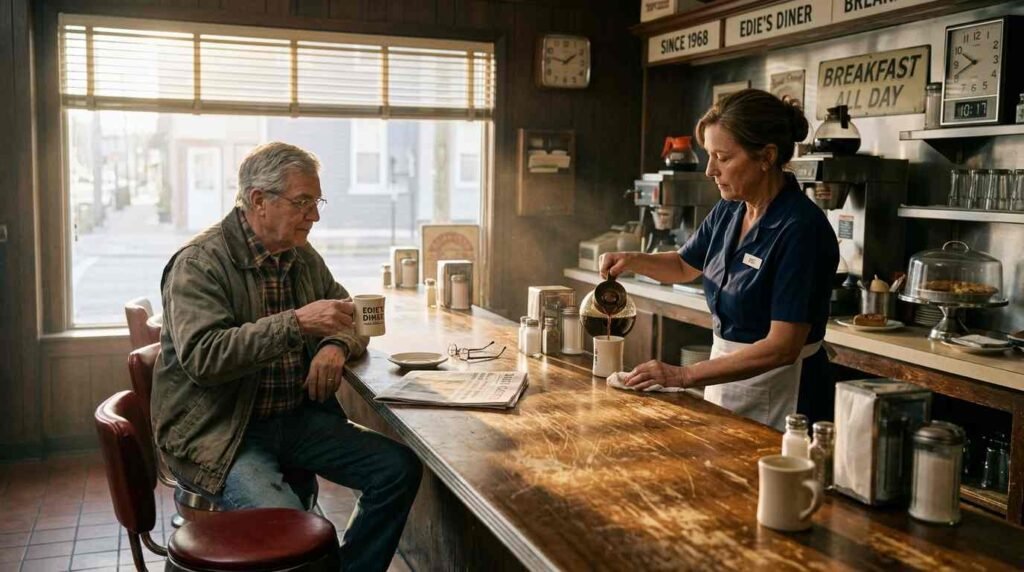
His durée also explains something about diner regulars that Husserl’s framework, on its own, does not quite capture. There are people who have been coming to Heritage Diner for twenty years. I know their order before they sit down. I know their mood before they’ve said anything, because I know the duration they carry with them — the accumulated durée of twenty years of Tuesday mornings, and how today’s Tuesday morning sits within that continuous flow. The waitress who picks up that same knowledge — and every good long-tenured diner waitress does — is operating on Bergsonian durée, not clock-time. She doesn’t know it’s 8:15 and Mr. Henrikson always has the two-egg platter. She knows the flow of Mr. Henrikson across twenty years, and today’s version of him registers against that flow before any explicit cognition occurs.
The Landmark Diner in Commack, documented in a 2019 Newsday feature, employed a pie baker who had worked the same station for thirty-one years. Thirty-one years of pie durée. That’s not a fact about how many crusts she’s crimped. It’s a quality of temporal knowledge that has no spatial equivalent, no clock-reading equivalent. Bergson would have recognized her immediately.
Where Husserl and Bergson Disagree
The disagreement between them is not trivial. Husserl thought Bergson’s durée was too vague — a poetic gesture at the right problem rather than a rigorous account of it. For Husserl, the structure of time-consciousness could be analyzed: retention, primal impression, protention. These were distinct functional components of every conscious moment. Bergson thought Husserl was doing exactly what he’d criticized everyone else for doing: cutting a continuous flow into pieces, even if the pieces were phenomenological rather than chronological.
The kitchen is a laboratory where this dispute plays out practically. Husserl’s framework is better for the immediate tactical situation: the cook catching the sauce before it breaks is operating with retention and protention in real-time, moment to moment. Bergson’s framework is better for the longer temporal knowledge: the thirty-year pie baker, the waitress who knows the regular, the diner owner watching a booth of teenagers and knowing, from accumulated duration, that they’ll be there for ninety minutes and tip poorly. That knowledge doesn’t come from retaining the last five seconds. It comes from a Bergsonian flow of experience that has built up a kind of temporal sediment — a thickness of durée.
Put differently: Husserl describes how experience is structured in the moment. Bergson describes how experience accumulates across a life. Both things are happening in a working kitchen simultaneously, which is one of the reasons kitchen work is so cognitively demanding without appearing to be, and why it develops a particular kind of intelligence that philosophy departments rarely study.
The Cream, Again
Return to the whipped cream that has been sitting too long. What are we actually looking at?
For Husserl, we are looking at a present moment that retains the cream’s earlier form — the soft peaks, the aerated structure — as a “just-past” that still belongs to the current experience. The cream that it was is still phenomenologically present as a retained horizon even as it collapses. We are not comparing two separate states — the cream then and the cream now — because retention is not memory. It’s the living edge of the present moment, carrying its own past inside it.
For Bergson, the cream’s collapse is a moment in a durée that can’t be extracted from the continuous flow of the pastry station’s morning. The cream sat out during the rush, during the particular duration of those forty minutes when three tables wanted dessert simultaneously and nothing could be done. The duration of the cream’s collapse is not separable from the duration of the cook’s morning. They share a lived time.
Neither philosopher, I want to be honest here, fully accounts for the practical problem, which is: the cream has collapsed and a customer is waiting. The phenomenological crisis resolves itself in a particular way in a working kitchen. Someone makes a decision and acts. Someone remakes the whipped cream. The flow of Bergsonian duration pauses for no one, and Husserlian retention of the old cream is not going to restore it.
There’s a slightly different kind of knowledge here — practical, immediate, consequential — that both of them were somewhat shy about. I’ve written about where philosophy meets practice before, in pieces on the Demarcation Problem and the Problem of Induction. The gap between the theoretical account and the moment of decision is consistent. The philosopher can describe the structure of time-consciousness with great precision and still not be helpful when the cream breaks.
What the Kitchen Knows That Philosophy Doesn’t
There’s a word in Japanese cooking culture — shokunin — for the craftsman who has internalized a practice so completely that deliberate consciousness mostly gets out of the way. The sushi master who has made ten thousand rolls, the ramen cook who has calibrated broth by smell for thirty years. Western philosophy has never quite known what to do with this kind of knowledge, because it resists articulation. You cannot write it down in a way that transfers it. It lives in the body, in the hands, in the accumulated durée of a practice.
This is neither Husserlian retention nor Bergsonian duration, quite. It’s something older — closer to what Aristotle meant by phronesis, practical wisdom: the knowledge that only comes from doing the thing over and over in real conditions. The cook who senses the sauce going before it goes is not running a phenomenological analysis. The knowledge is below analysis. It runs deeper.
Both Husserl and Bergson were trying to restore to philosophy the richness of actual lived experience, against the tendency to reduce experience to abstract quantities. In that project they were right, and the kitchen is their best argument. Time in a kitchen is not what a clock measures. It’s what accumulates in a cook’s hands across a career. The whipped cream doesn’t know any of this. But the person making it, if they’ve been doing it long enough, does.
You Might Also Like
The Conscious Mind by David Chalmers: The Last Wall Science Hasn’t Scaled
The Demarcation Problem: Karl Popper, Falsifiability, and the Boundary Between Science and Pseudoscience
What Is It Like to Be a Brain? The Philosophical War Between Reductionism and Emergence in Consciousness Research
Sources
Edmund Husserl, On the Phenomenology of the Consciousness of Internal Time (1893–1917), trans. John Barnett Brough. Kluwer Academic Publishers, 1991.
Henri Bergson, Time and Free Will: An Essay on the Immediate Data of Consciousness, trans. F.L. Pogson. Allen & Unwin, 1910.
Henri Bergson, Matter and Memory, trans. Nancy Margaret Paul and W. Scott Palmer. Zone Books, 1991.
Harold McGee, On Food and Cooking: The Science and Lore of the Kitchen. Scribner, revised edition 2004. simonandschuster.com
Newsday feature on the Landmark Diner, Commack, 2019. Searchable via Hofstra University Library digital archives. hofstra.edu/library