 275 Route 25A, Mt Sinai, NY 11766


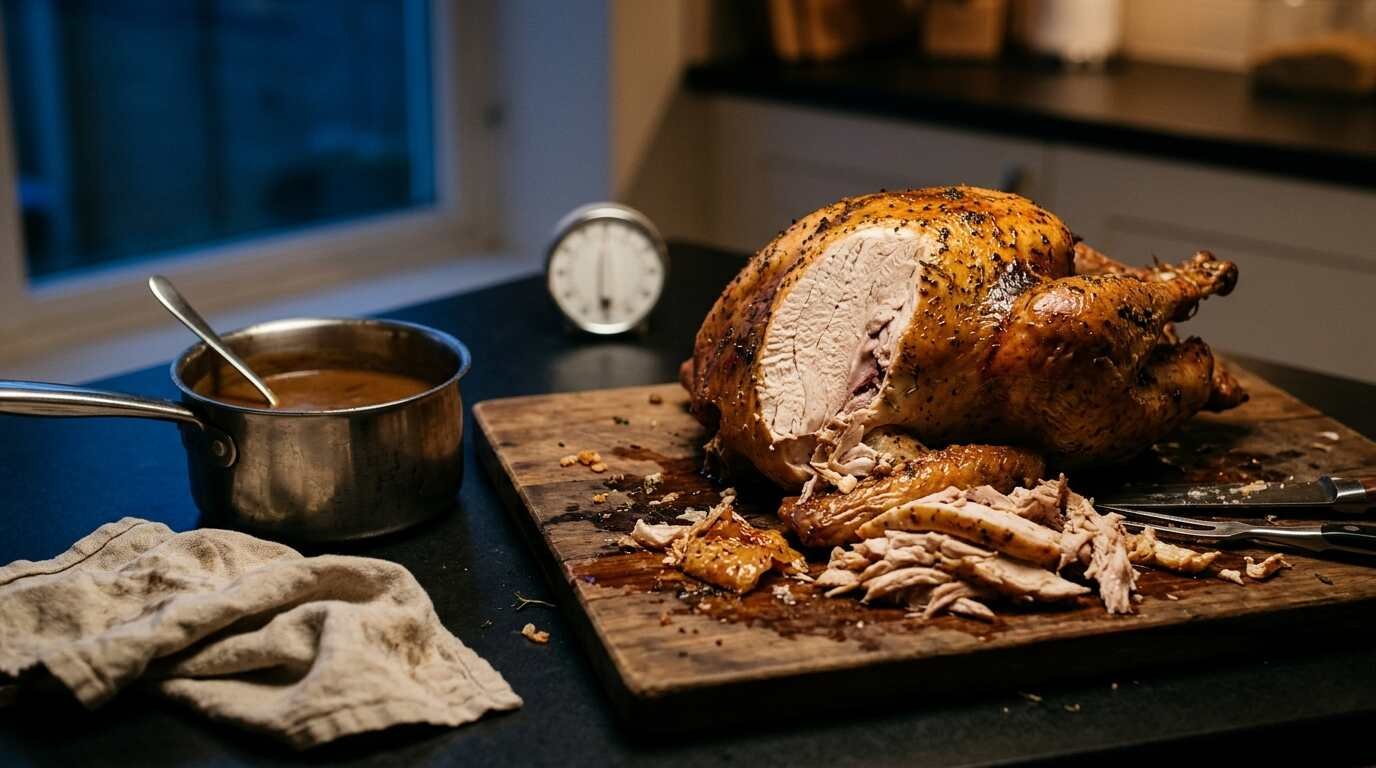
Almost 900,000 people in the United States get food poisoning from a single bacterium every year, according to the Centers for Disease Control and Prevention. The organism is Clostridium perfringens, and its calendar is easy to read. “Most outbreaks happen in November and December,” the CDC page on C. perfringens states, a few lines above a list of risky foods that could pass for the back half of a holiday menu: turkey, chicken, beef, pork and gravy.
Nobody in the kitchen sees it, and it has no interest in the meal itself. Its moment is the stretch of the evening when the carved bird sits on the counter beside a pot of gravy going lukewarm and everyone has agreed, without saying so, that cleanup can wait until after pie.
That stretch is the whole story. The two-hour rule printed on government food-safety pages is a direct answer to it, and the rule makes more sense once the germ behind it is understood.
A short list that reads like a menu
The bacterium keeps the same holiday schedule as the cook.
On the federal health agency’s site, the description of C. perfringens is brief and pointed. Outbreaks most often involve food cooked in large batches and then held at unsafe temperatures, and they tend to happen where large groups of people are served, according to the agency’s overview. The same page notes that many outbreaks have been linked to popular holiday foods such as turkey and roast beef. Poultry, meat and gravy are named outright as the foods involved.
Put plainly, it is a bacterium that celebrates Thanksgiving harder than anyone at the table, and it never helps with the dishes.
The illness itself is unglamorous. The CDC lists diarrhea and stomach cramps as the symptoms. The University of Nebraska–Lincoln’s food safety extension gives an onset time of 6 to 24 hours after eating, which places the reckoning somewhere between the late-night turkey sandwich and Black Friday morning (UNL Food). The CDC explains that after contaminated food is eaten, the bacteria can produce a toxin in the body, and that toxin is what causes the diarrhea.
The trouble, then, is not a single bad ingredient. A turkey can be bought fresh, handled carefully and roasted correctly, and still become a problem later, because the risk lives in what happens to cooked food afterward.
Spores that come through the oven
Cooking kills the soldiers. The sleepers wait it out.
C. perfringens has two forms. The UNL extension page describes it as an anaerobic bacterium that can exist either as an active vegetative cell or as a dormant spore in food. The CDC adds that the spores have protective coatings.
That coating changes the arithmetic of a roast. Thorough cooking kills the vegetative cells, according to UNL, “but spores may survive.” The U.S. Department of Agriculture’s Food Safety and Inspection Service made the same point in its 2005 risk assessment for ready-to-eat meat and poultry: “Spores, on the other hand, are not destroyed by heat and other processes applied to RTE foods” (FSIS risk assessment executive summary).
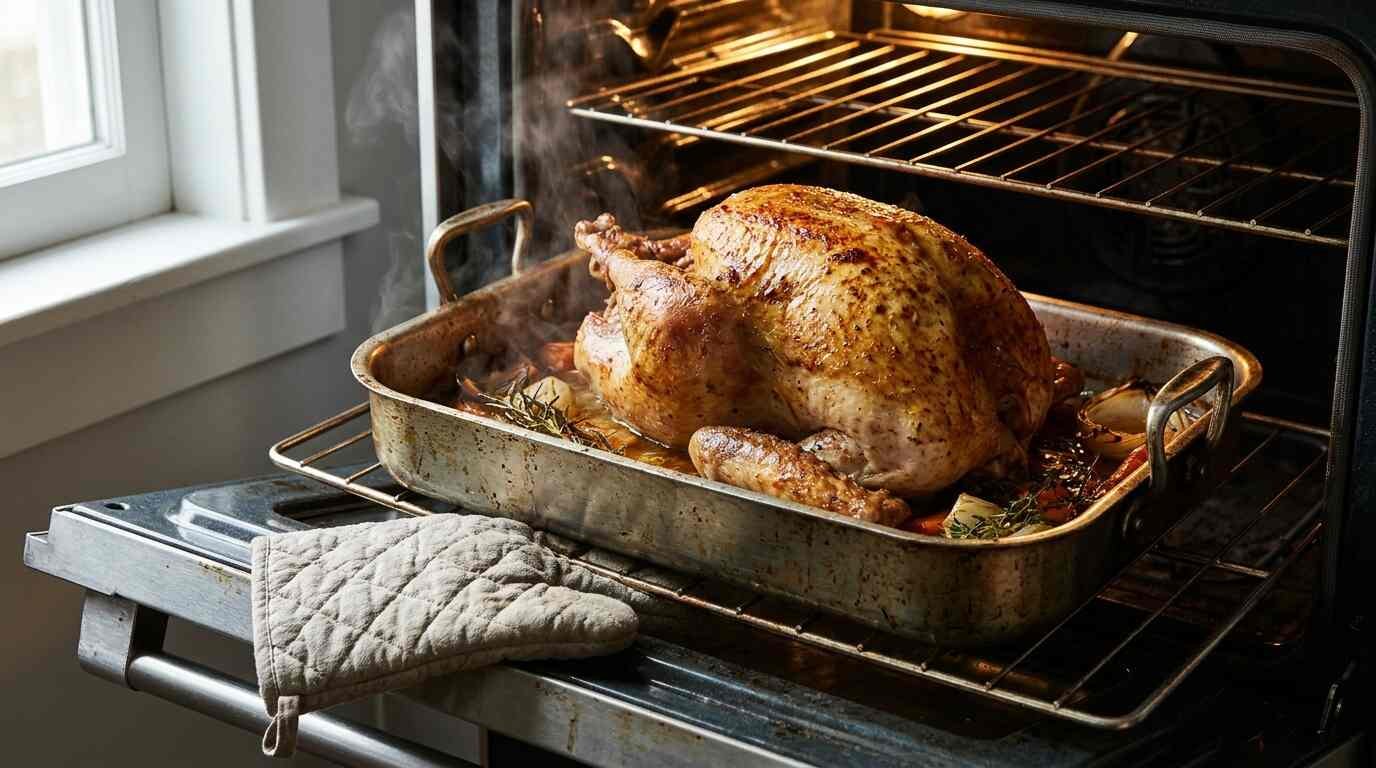
Then comes the twist that makes this germ different from the usual kitchen villain. The FSIS document explains that heat can actually activate spores to germinate and develop into vegetative cells, which can then multiply as the food cools. The oven, in other words, is not only failing to finish the job. It is also flipping the switch.
Think of a furnace with a pilot light. Turning the main burner off does not put the pilot out, and the pilot is all it takes to relight the whole system. A roasted turkey coming out of the oven is, for this one organism, a furnace whose main burner has just shut off.
This is why the safety advice concentrates on the hours after cooking rather than on the cooking itself. The CDC still tells home cooks to bring food to a safe internal temperature to kill harmful germs, as its prevention page says. That step handles a great deal. It simply cannot handle everything.
Forty to one hundred forty
The danger zone is a temperature band, and dinner passes straight through it.
The CDC describes the unsafe range for C. perfringens as between 40°F and 140°F, and its prevention guidance says the bacterium and other germs “can multiply rapidly” in food left in that band (CDC prevention). From the other side of the government, the USDA’s leftovers page gives the same band, warning that bacteria grow rapidly between 40°F and 140°F (FSIS, Leftovers and Food Safety).
The band has two exits. Food held hot, at 140°F or above, stays out of it; the CDC’s advice for anything that will be served later is to keep it at that temperature until serving. Food chilled to 40°F or below sits under it. Everything between those two lines is a waiting room, and the germ is not bored there.
What makes C. perfringens especially suited to a holiday kitchen is where in that band it prefers to work. According to the 2005 FSIS assessment, the organism grows best at relatively high temperatures. The warm end of the range, then, is the busy end. That is exactly where a platter of sliced turkey sits for the first hour or so after it leaves the carving board, warm enough to be pleasant, cool enough to be forgotten.
A flat-top grill offers a fair comparison. A short-order cook knows that the edge of the griddle, where the heat falls off, is where food lingers and goes wrong; the hot center does its job and the cold rail does no harm. Leftovers on a counter are food parked permanently on that lukewarm edge.
Where the two hours come from
The rule is a clock, because almost nobody owns a probe thermometer for the counter.
One sentence carries the whole rule. Leftovers must go into the refrigerator within two hours of cooking, or within two hours of being removed from an appliance that was keeping them warm, according to FSIS. The same page tells readers to discard perishable food left at room temperature for more than two hours, or for more than one hour when the temperature is above 90°F.
Federal health officials give matching advice on the CDC prevention page: refrigerate within two hours after cooking, and within one hour if the food is somewhere hotter than 90°F, such as a hot car or a picnic. It also asks cooks not to keep food at room temperature if it will not be served and eaten soon.
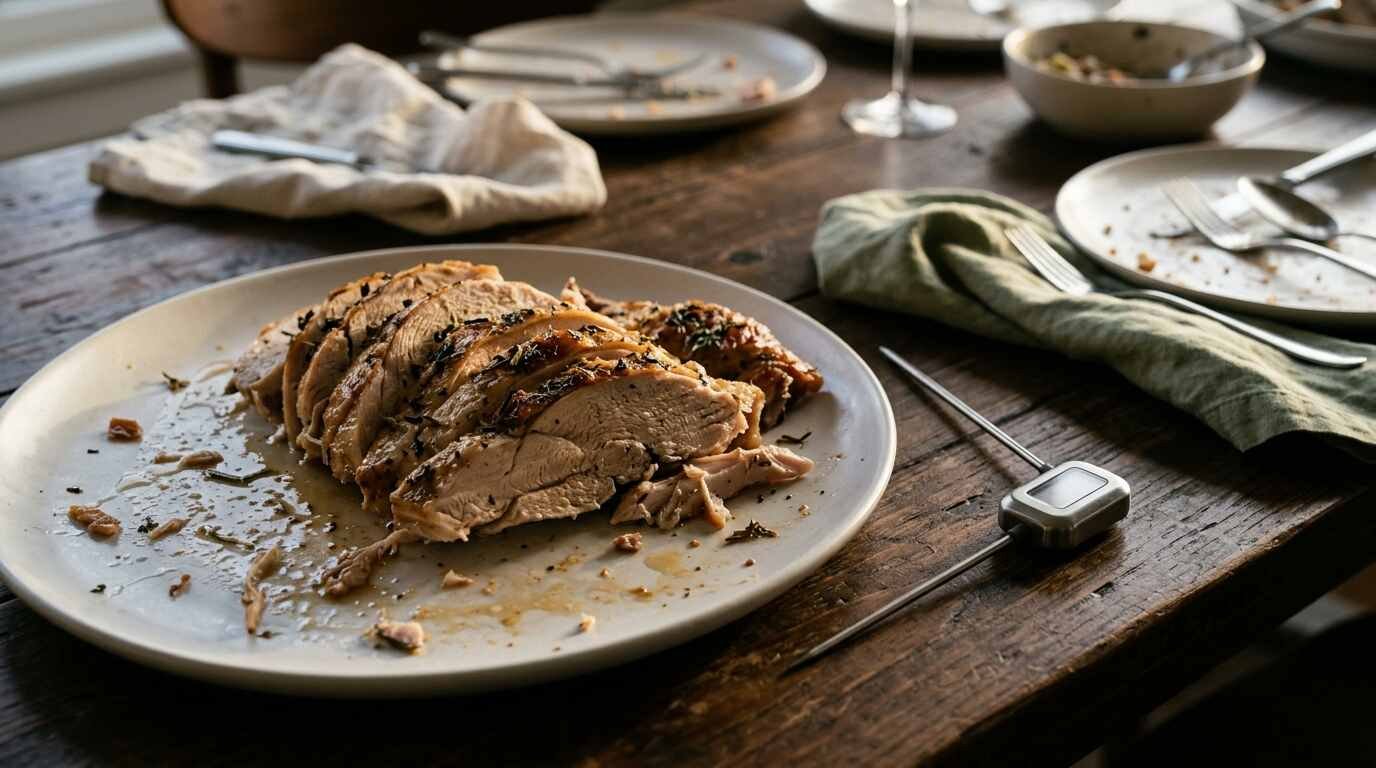
Note where the clock starts. It does not start when guests sit down or when the last plate is cleared. It starts when the food comes off the heat, or when it leaves a warming tray or slow cooker that was holding it hot. A turkey that rested 40 minutes before carving and then sat through a long dinner may have used most of its allowance before anyone pushed back a chair.
A clock is a crude instrument for a biological process, and that is the point. Two hours is a number a tired family can remember after a long day of cooking. It turns a temperature problem into a time problem, the way a parking meter turns a city’s traffic policy into a coin slot.
The case against cooling food on the counter
The fridge is not the fragile thing in this story.
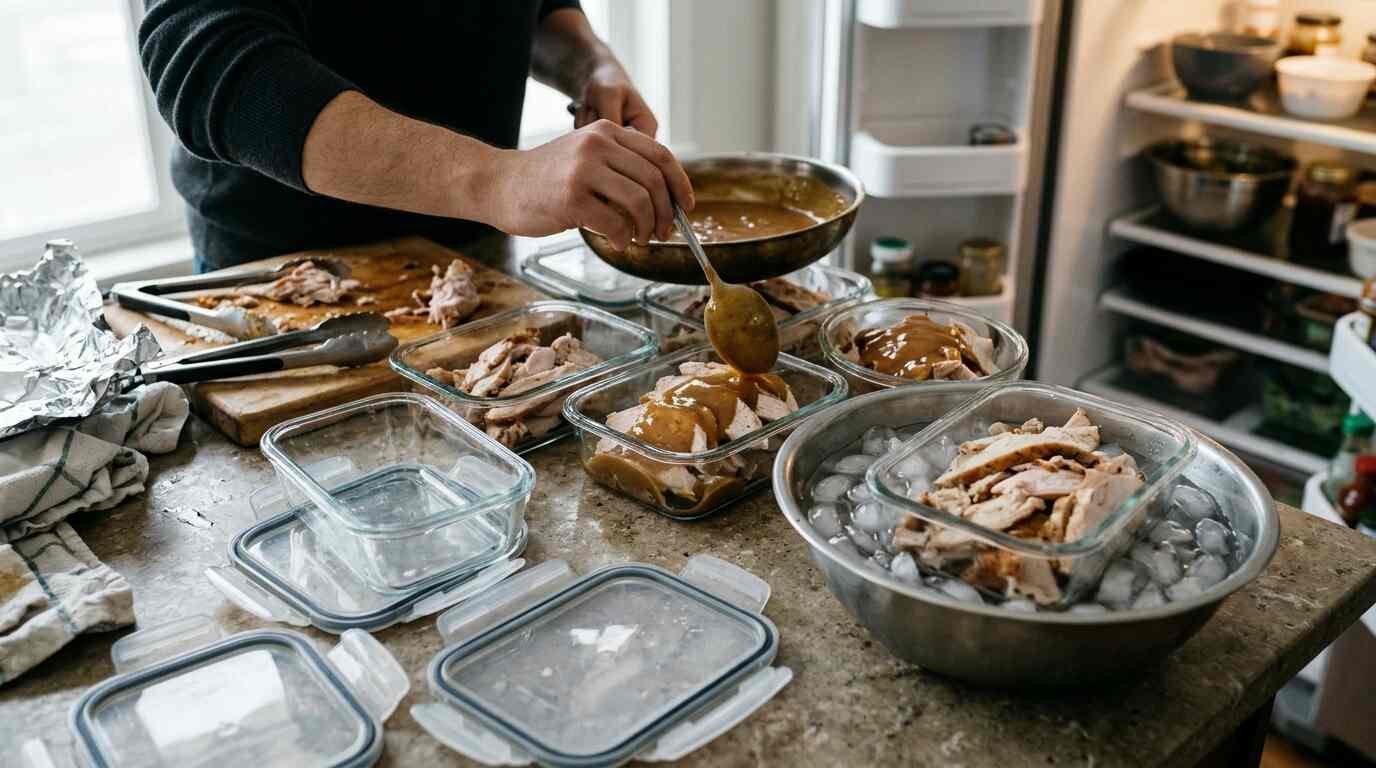
Plenty of kitchens still run on an old instinct: let the pot cool down on the stove before it goes in the refrigerator, so the hot food doesn’t strain the appliance or warm everything else inside. The USDA’s leftovers guidance cuts directly across that habit. “Hot food can be placed directly in the refrigerator,” FSIS states, and it suggests an ice or cold-water bath as a way to chill food quickly first.
There is a complication, though, and the two-hour rule does not cover it by itself. The rule says when food must be in the refrigerator. It says nothing about how long the food then takes to get cold once it is there. A deep stockpot of gravy or a whole turkey carcass placed in the fridge at the 1-hour-59-minute mark has technically obeyed the clock while its center may still be warm.
Geometry is the USDA’s answer. Its leftovers page tells readers to divide large amounts of food into shallow containers so that they cool faster. A slab two inches deep and a pot ten inches deep have very different distances between their centers and the cold air around them; heat has to travel out through all that food, the way water drains slowly through a long, narrow pipe and quickly through a short wide one. Slicing the meat off the bone and spreading the gravy into shallow containers is not fussiness. It shortens the pipe.
Commercial kitchens are held to a cooling deadline as well. Nebraska’s extension page says proper cooling is needed to prevent spore germination and that foods must reach 41°F within 4 hours. Home cooks are not inspected against that number, but it shows the shape of the thinking: the question is not merely whether food went into the cold, but how fast it got there.
Regulators also think about this germ in multiples of ten rather than in yes-or-no terms. The FSIS risk assessment describes the federal performance standard for cooling ready-to-eat products as limiting the multiplication of C. perfringens to a maximum of 1-log10, a factor of ten. At that level, the agency estimated approximately 79,000 illnesses per year in the United States from those products. Allowing more growth, the assessment found, would raise the expected illness count. The lesson for a home kitchen is uncomfortable. Safe and unsafe are not two rooms with a door between them; they are points on a slope, and every warm hour moves the food a little further down it.
Four days in the fridge, 165 degrees on the way out
The second half of the rule is the part people forget by Saturday.
Once leftovers are cold, the clock changes. FSIS says they can be kept in the refrigerator for 3 to 4 days or frozen for 3 to 4 months (FSIS). Thanksgiving falls on a Thursday, so by that count the refrigerator turkey runs out its welcome somewhere around Sunday or Monday. That puts a real deadline on the eight ways to use leftover turkey, and a strong argument for freezing some of the meat the first night rather than the fourth.
Reheating has a number too. FSIS says leftovers should reach 165°F, checked with a food thermometer, and the CDC repeats the 165°F target for reheated food before serving. Gravy deserves particular attention, since the CDC names it alongside meat and poultry. Anyone who followed a roux timeline for lump-free turkey gravy or made a batch from scratch, with or without drippings has a sauce worth protecting, and the way to protect it is to bring it back to a full, thorough heat rather than a gentle warm-through.
Frozen leftovers need a plan for thawing. FSIS notes that refrigerator thawing takes the longest, but the leftovers stay safe the entire time. Cold-water and microwave thawing are faster alternatives on the same page.
None of this is exotic. It is the logic of any hot line: hot stays hot, cold stays cold, and the space in between gets crossed quickly or not at all. A hot turkey sandwich, after all, is a plate built from exactly the two foods the CDC names, cooked turkey and gravy, and it is only as good as the temperatures at both ends of its life.
The harder part is social, not scientific. Two hours after the turkey comes out of the oven, most families are still at the table, and the person who gets up to box the leftovers is interrupting something. The germ has no such manners. In most houses, who is the one who finally stands up?
You Might Also Like
- A Thanksgiving Timeline for a Small Kitchen, Counted Backward From the Table
- Why Sprouts Keep Making People Sick: Idaho in 2026, Germany in 2011
- A Sick-Day Chicken Noodle Soup You Can Make From One Pot
General food-safety information drawn from federal and university sources; not medical advice. Anyone with severe or persistent symptoms should contact a health care provider.
Sources
- Centers for Disease Control and Prevention, “About C. perfringens food poisoning”: https://www.cdc.gov/clostridium-perfringens/about/index.html
- Centers for Disease Control and Prevention, C. perfringens prevention page: https://www.cdc.gov/clostridium-perfringens/prevention/index.html
- USDA Food Safety and Inspection Service, “Leftovers and Food Safety”: https://www.fsis.usda.gov/food-safety/safe-food-handling-and-preparation/food-safety-basics/leftovers-and-food-safety
- USDA Food Safety and Inspection Service, Risk Assessment for Clostridium perfringens in Ready-to-Eat and Partially Cooked Meat and Poultry Products, Executive Summary (September 2005): https://www.fsis.usda.gov/sites/default/files/media_file/2020-07/CPerfringens_Risk_Assess_ExecSumm_Sep2005.pdf
- University of Nebraska–Lincoln, Nebraska Extension Food, “Clostridium perfringens”: https://food.unl.edu/clostridium-perfringens/
Suggested category: Food & Dining
Leave a Reply