Consider the turkey. Every morning for a thousand days, it is fed, cared for, and allowed to roam. Each sunrise confirms what came before. The data is consistent, the sample large, the pattern unambiguous. From the turkey’s vantage point, the logic is airtight: the farmer is benevolent, the future mirrors the past, and tomorrow will resemble today. Then Thanksgiving arrives.
Nassim Nicholas Taleb borrowed this parable from Bertrand Russell to illustrate something far more unsettling than a holiday meal — he used it to expose the deepest architectural flaw in how human beings, and the models they build, understand the future. But the problem did not begin with Taleb. It began in Edinburgh in the eighteenth century, in the mind of a Scottish philosopher named David Hume, who looked at the machinery of human reasoning and found something alarming: we have no rational grounds for believing that the future will resemble the past. None whatsoever.
This was not a quirky philosophical footnote. It was, as C.D. Broad famously put it, simultaneously “the glory of Science” and “the scandal of Philosophy.” And nearly three centuries after Hume first articulated it, his problem of induction continues to quietly undermine the foundations of every predictive statistical model ever built — from hedge fund risk assessments to machine learning algorithms to the epidemiological models that guided pandemic policy. The problem has never been solved. It has only been worked around, dressed up in mathematical confidence, and largely forgotten — until a Black Swan lands.
What Hume Actually Said
David Hume published A Treatise of Human Nature in 1739 and later refined his argument in An Enquiry Concerning Human Understanding (1748). His target was inductive inference: the process by which we observe particular instances and draw general conclusions that extend beyond those observations into the future.
The argument is deceptively simple. Every time you observe that fire produces heat, you add another data point to a chain of constant conjunctions. You observe fire. You observe heat. You observe fire again. Heat again. A thousand times. A million times. And from this, you conclude: fire causes heat; fire will always produce heat; the next fire you encounter will be hot. But Hume asks: what is the logical bridge between what you have observed and what you have not yet observed? There is none. The passage from “has been” to “will be” requires an assumption — an assumption that nature is uniform, that the future will resemble the past, that the patterns we’ve catalogued will persist. And crucially, the only way to justify that assumption is inductively — which is to say, circularly. You cannot use induction to justify induction without arguing in a loop.
Hume argued that we cannot claim it is even “more probable” that the past predicts the future, because this still requires the assumption that the past predicts the future. The trap is elegant and airtight. Hume’s argument is not merely that various promising routes to justifying induction have failed; it purports to exclude every possible route to justifying induction.
What Hume concluded — and this is the part that most people miss — is not that we should stop reasoning inductively. He recognized that we cannot survive without it. We are, he argued, creatures of habit. We believe the sun will rise tomorrow not because logic demands it but because biology and custom compel us. Hume allowed that we can still use induction to function on a daily basis, as long as we recognize the limitations of our knowledge. The problem is that we almost never do.
Popper’s Attempted Escape
A century and a half after Hume, Karl Popper attempted to dissolve the problem rather than solve it. His move was elegant: if induction cannot be justified, then science should not be built on induction at all. Instead of confirming theories through accumulated positive evidence, Popper argued that science advances through falsification — through the bold proposal of testable conjectures and the rigorous attempt to destroy them. A theory that survives every attempt to refute it is not proven, but it is corroborated.
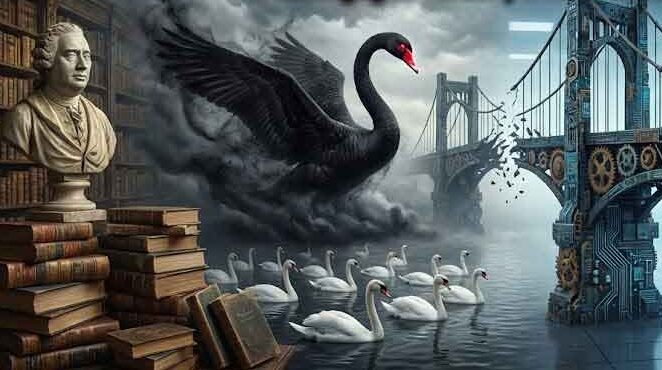
Popper agreed with David Hume that there is often a psychological belief that the sun will rise tomorrow, and that there is no logical justification for this supposition simply because it always has in the past. But where Hume ended with a shrug toward instinct, Popper erected a methodology: don’t confirm, falsify. The observation of a single black swan, he famously noted, destroys the theory that all swans are white — no matter how many white swans preceded it.
Popper’s solution was influential, but it was not universally accepted. Despite massive efforts by philosophers over generations, no response to Hume’s problem has received widespread acceptance. Inductive reasoning remains the glory of Science and the scandal of Philosophy. Critics pointed out that falsificationism doesn’t actually eliminate induction — it merely relocates it. Choosing which theories to test, which anomalies to take seriously, which background assumptions to hold fixed: all of these require inductive judgment. Science is thriving in a way that depends essentially on the use of inductive inference, and the falsificationist model fails to describe the evidential practices of actual science in many cases.
The philosophical scaffolding remains incomplete. And into that incompleteness, the quantitative revolution of the twentieth century marched with supreme confidence.
The Statistical Model as a House Built on Sand
Modern statistical and machine learning models are, at their core, industrialized induction. They observe patterns in historical data and extrapolate those patterns forward. A credit risk model trains on decades of loan performance. A weather model trains on a century of atmospheric readings. A financial risk model trains on years of market behavior. The assumption baked into every one of them — whether acknowledged or not — is precisely the one Hume exposed as groundless: that the future will resemble the training data.
In economics, the problem of induction underscores the difficulties in making accurate predictions based on past market trends and suggests the need for caution and humility in economic forecasting. In artificial intelligence and machine learning, the problem of induction is relevant to the generalization from training data to real-world applications, highlighting the importance of diverse and representative datasets and the limitations of predictive models.
Within machine learning, this failure mode has a technical name: overfitting. Overfitting occurs when too rich a space of hypotheses is used to represent a data set. There is then no expectation that such a model will make good predictions on new data points. But overfitting is merely the local expression of a deeper problem. Even a well-regularized, elegantly parsimonious model is subject to the Humean challenge: the validity of its out-of-sample predictions depends entirely on the assumption that the generating process observed in the training data will continue to hold. When it does not — when the regime shifts, when the world re-orders itself — the model does not gradually degrade. It catastrophically fails.
The No-Free-Lunch theorems formalize this mathematically: no model that performs well across all possible data distributions can exist. Every learning algorithm, however sophisticated, encodes prior assumptions about which regularities are likely to hold. Although the considerations first raised by Hume, and later instantiated in the No-Free-Lunch theorems, preclude any universal model-independent justification for learning algorithms, they do not rule out partial justifications in the form of general a priori model-relative learning guarantees. In other words: your model may be excellent for the world it was trained on. It has no guarantee of functioning in a world it has never seen.
Taleb’s Black Swans and the Architecture of Fragility
Nassim Nicholas Taleb did not discover the problem of induction. He weaponized it. In The Black Swan (2007) and the broader Incerto series, Taleb translated Hume’s philosophical problem into a practical indictment of modern finance, risk management, and institutional decision-making.
Taleb’s concept concerns a phenomenon with specific statistical properties — his “fourth quadrant” — where knowledge is uncertain and consequences are large, requiring more robustness. The philosophical problem is about the decrease in knowledge when it comes to rare events, because these are not visible in past samples and therefore require a strong a priori theory; predictions of events depend more and more on theories when their probability is small.
The central distinction Taleb draws is between Mediocristan and Extremistan. In Mediocristan — the domain of human heights, shoe sizes, local restaurant revenues — extreme outliers exist but cannot dominate the aggregate. The supreme law of Mediocristan: when your sample is large, no single instance will significantly change the aggregate or the total. In Extremistan, inequalities are such that one single observation can disproportionately impact the aggregate or the total. In such cases, the traditional tools of probability and statistics are irrelevant, and it is hard if not impossible to predict Black Swan events from past experience.
The catastrophic error, Taleb argues, is that modern institutions — banks, hedge funds, government agencies, insurance companies — habitually apply Mediocristan tools to Extremistan problems. The reliance on Gaussian bell curves and normal distribution models in financial systems and risk assessment is a particular point of contention. These models assume a world of Mediocristan, failing to account for the outliers that dominate the landscape of Extremistan. This misapplication of statistical tools leads to a dangerous underestimation of risk and a pervasive illusion of control and predictability.
The 2008 financial crisis was perhaps the most expensive real-world demonstration of this error in modern history. Leading up to the 2008 crisis, conventional financial models were unable to predict the collapse of major financial institutions and the ensuing global economic downturn. The sudden and severe impact of this crisis highlighted the limitations of traditional risk assessment models. The models had been trained on years of historical data during which housing prices, across the United States as a whole, had never declined simultaneously. The assumption that they wouldn’t was not explicitly encoded — it was assumed by the absence of contrary evidence. It was, in other words, induction at its most naked and its most expensive.
Long-Term Capital Management, the hedge fund whose 1998 collapse required a Federal Reserve-orchestrated bailout, presents an equally instructive case. The firm employed Nobel Prize-winning economists and deployed models of breathtaking mathematical sophistication. Their risk algorithms were trained on decades of bond spread data. What those algorithms could not model — what no algorithm trained on past data can model — was a sequence of events genuinely outside the historical distribution: Russia’s debt default triggering cascading correlations that the models treated as independent. The turkey, fed for a thousand days. The Thanksgiving it never saw coming.
The Narrative Fallacy and Retrospective Prophecy
One of Taleb’s most penetrating observations extends Hume’s problem into the domain of human psychology. He calls it the narrative fallacy: our compulsive need to retrofit Black Swan events into coherent causal stories after they occur. We look at the 2008 crash, the rise of the internet, the September 11 attacks, and we construct retrospective narratives that make these events feel inevitable — even predictable. We find the signals we missed. We identify the warning signs that were there all along. And in doing so, we convince ourselves that we are better forecasters than we are.
This is the induction problem wearing a psychological mask. The Black Swan is, by definition, an event that falls outside the training distribution. No model trained on pre-event data will assign it a meaningful probability. But once the event has occurred, our pattern-matching machinery immediately incorporates it into a new model — one that now “predicts” the past perfectly but has learned nothing trustworthy about the future.
Taleb’s book focuses on the extreme impact of rare and unpredictable outlier events and the human tendency to find simplistic explanations for these events retrospectively. A central idea is not to attempt to predict Black Swan events, but to build robustness to negative events and an ability to exploit positive events.
The practical implication is radical. It is not that forecasting is useless. It is that forecasting is reliable only within the narrow band of well-understood, slowly-changing, Mediocristan domains — and dangerously overconfident everywhere else. Taleb contends that banks and trading firms are very vulnerable to hazardous Black Swan events and are exposed to unpredictable losses. The non-computability of the probability of consequential rare events using scientific methods is a core concern.
The Barbell Against the Abyss
So what is to be done? If Hume is right — and no philosopher has convincingly proven otherwise in three hundred years — and if Taleb’s extension of Hume into the domain of extreme events is correct, then the appropriate response is not paralysis but structural humility.
Taleb proposes the barbell strategy: allocate the vast majority of exposure to the most robust, antifragile positions, and a small allocation to highly asymmetric opportunities where potential upside is uncapped. The middle — the zone of medium risk managed by sophisticated models trained on historical data — is where catastrophe lives. It is the zone where you are most likely to behave like Taleb’s turkey, extrapolating continuity from a sample whose terminal boundary you cannot see.
This has implications far beyond finance. In medicine, it suggests that clinical models trained on historical populations may fail catastrophically when applied to novel pathogens or genetic subgroups not represented in the training data. In AI, it is the central unresolved challenge of generalization: a language model trained on the corpus of human writing as of a given date has no principled basis for predicting what humans will write — or need — in a genuinely novel situation. The Humean gap persists, dressed in different mathematics.
There is a broader epistemological posture implied here — one that Hume himself would have recognized. It is the posture of the genuine empiricist: not the naive empiricist who treats accumulated observations as confirmation of universal law, but the skeptical empiricist who understands that every model is a map, and every map omits the territory that will eventually swallow it. The confidence we place in predictive models should scale inversely with the rarity and magnitude of the events those models are meant to manage. Where the stakes are highest, our confidence should be lowest — and our structural robustness highest.
I’ve spent twenty-five years running The Heritage Diner on the North Shore, and every restaurateur who has lasted more than a decade will tell you something similar in practical terms: the threats that destroyed your competitors were never the ones they modeled. It wasn’t the expected cost increases or the predictable slow seasons. It was the pandemic they didn’t build reserves for. The freak storm that collapsed a roof. The supply chain rupture that no menu-pricing algorithm anticipated. The Black Swans. And the operators who survived were not the ones with the most sophisticated forecasting tools — they were the ones who had built enough structural slack into their operations to absorb what they could not predict. That is antifragility in practice. That is the operational wisdom that maps, more precisely than most people recognize, onto Hume’s philosophical insight and Taleb’s quantitative framework.
The Limits of the Algorithm
We are living through a moment of extraordinary confidence in predictive models. Large language models predict the next word with stunning accuracy. Recommendation engines predict behavior with unsettling precision. Financial models, epidemiological forecasts, and climate projections drive policy decisions affecting hundreds of millions of people. The prestige of the algorithm has never been higher.
And yet the Humean foundation of all of it remains exactly as shaky as it was in 1739. Every one of these models extrapolates from observed patterns into unobserved futures. Every one of them assumes, implicitly or explicitly, that the generating process that produced the training data will continue to hold. None of them can assign a meaningful probability to a genuinely unprecedented event — because an event that is genuinely unprecedented has no representation in the training distribution.
Hume’s challenge reminds us to be cautious about making broad generalizations based on limited personal experiences. In artificial intelligence and machine learning, the problem of induction highlights the importance of diverse and representative datasets and the limitations of predictive models.
The right response to this is not to abandon statistical modeling. The models work. They work remarkably well within their domains of validity. The problem arises when we forget that every model has a domain of validity — and that the boundary of that domain is drawn by the distribution of the training data, which is a sample from the past, not a census of the future. Popper was right that science is fundamentally about conjecture and refutation, not confirmation. The best predictive models in practice are the ones built with this spirit: models that are continuously tested against out-of-sample data, that explicitly quantify their own uncertainty, that are designed to fail gracefully rather than catastrophically, and that are embedded in decision systems robust enough to absorb their inevitable failures.
The turkey’s tragedy was not that it lacked data. It had a thousand days of data. Its tragedy was that it had no model for the category of events it had never experienced — and no institutional structure designed to survive the day its model failed.
That is not a poultry problem. It is a human one.
The Heritage Diner — 275 Route 25A, Mount Sinai, NY — has been a North Shore institution since 2000. Follow the blog at heritagediner.com/blog.
Sources
- Hume, David. An Enquiry Concerning Human Understanding. London, 1748.
- Taleb, Nassim Nicholas. The Black Swan: The Impact of the Highly Improbable. Random House, 2007. Wikipedia summary
- Taleb, Nassim Nicholas. Fooled by Randomness. Random House, 2001.
- Popper, Karl. The Logic of Scientific Discovery (Logik der Forschung). Hutchinson, 1959 (original 1934).
- Broad, C.D. Scientific Thought. Harcourt, Brace and Co., 1923.
- Stanford Encyclopedia of Philosophy: “The Problem of Induction.” https://plato.stanford.edu/entries/induction-problem/
- Internet Encyclopedia of Philosophy: “Popper, Karl: Philosophy of Science.” https://iep.utm.edu/pop-sci/
- Encyclopædia Britannica: “Problem of Induction.” https://www.britannica.com/topic/problem-of-induction
- Wikipedia: “Black Swan Theory.” https://en.wikipedia.org/wiki/Black_swan_theory
- Corfield, D., Schölkopf, B., and Vapnik, V. “Falsificationism and Statistical Learning Theory: Comparing the Popper and Vapnik-Chervonenkis Dimensions.” Journal for General Philosophy of Science, 2009. https://link.springer.com/article/10.1007/s10838-009-9091-3
- Norton, John D. “The Rise and Fall of Karl Popper’s Anti-inductivism.” University of Pittsburgh. https://sites.pitt.edu/~jdnorton/papers/Popper_anti-inductivism.pdf
- Howson, Colin. Hume’s Problem: Induction and the Justification of Belief. Oxford University Press, 2000. https://joelvelasco.net/teaching/120/howson-Hume.pdf
- Horizons of Reason: “Hume Arguments for the Problem of Induction.” https://horizonofreason.com/culture/problem-of-induction/