Long Island does not advertise its history. That’s part of the problem. You drive Route 25A past strip malls and nail salons and the occasional colonial-era cemetery squeezed between a CVS and a deli, and nothing tells you that the ground underneath you changed the course of American democracy, American aviation, American maritime law, and American espionage. The island keeps its secrets the way old houses do — in the walls, under the floorboards, in the silence of places that haven’t been asked the right question in a long time.
This is a different kind of list. Not a tourist checklist. Not a trivia deck for a Long Island history quiz. What follows are twenty moments — some catastrophic, some quiet, some practically forgotten — where the island itself was the reason things happened the way they did. The geography mattered. The water mattered. The distance from Manhattan mattered. Long Island wasn’t just the backdrop. It was the condition.
1. The First People: The Lenape, the Matinecock, and the Land Before the Deed
Before any of this, the island had people. Thirteen distinct Indigenous nations — including the Matinecock on the North Shore, the Shinnecock on the East End, and the Montaukett at the tip — lived on, fished, farmed, and named this land for thousands of years. The island’s shape, its estuaries, its pine barrens, its coastal marshes: all of it was understood and managed long before a single English patent was drawn up. The Lenape called the larger region Metoac. The colonists called it a blank slate. It was neither. The erasure of that knowledge is the original historical act that makes everything else on this list possible.
2. The English Purchase and the Division That Stuck
In 1640, English settlers founded Southampton. By 1664, the English had formally seized control of the entire island from the Dutch. What happened next shaped every political, cultural, and economic map that followed: the island was divided. The western end — closer to Manhattan, more urban, more connected — developed one way. The eastern end — longer, isolated, slower — developed another. That east-west tension never fully resolved. It still hasn’t. Every conversation about “which Long Island” someone means is a ghost of the 1664 partition.
3. The Battle of Long Island (1776) — The War’s Worst Morning
On August 27, 1776, George Washington’s Continental Army suffered its worst single-day defeat of the entire Revolutionary War on the hills and farms of what is now Brooklyn and Queens. The British outflanked Washington’s positions through the Jamaica Pass, and nearly trapped the entire American force. What followed — the overnight evacuation across the East River in fog and silence — is one of the great tactical retreats in military history. Washington got his men out. Barely. Long Island was occupied by British forces for the next seven years, and that occupation shaped everything that came after it — including the spy network that rose to fight it.
4. The Culper Ring of Setauket — History’s Most Effective Spy Network
The British occupation didn’t silence Long Island. It activated it. Out of Setauket on the North Shore came the Culper Spy Ring — a network of ordinary citizens who passed intelligence about British troop movements back to Washington through a chain of couriers, invisible ink, and coded laundry signals hung on a clothesline. The operation ran from 1778 to 1783 and is widely credited with saving the Continental Army on multiple occasions. It worked precisely because of Long Island’s geography: close enough to occupied New York to gather intelligence, separated enough by the Sound to route information north without British interception. Read the full story of the Culper Ring of Setauket.
5. The Raid on Fort St. George (1780) — Eighty Men and Eight Whaleboats
Two years into the Culper network’s operation, the war produced one of Long Island’s most audacious military moments. Major Benjamin Tallmadge — Washington’s spymaster, the man who ran the Culper Ring — led a raiding party across the Sound from Connecticut in eight whaleboats, struck the British fort at Mastic on the South Shore, seized critical supplies, and made it back across the water without losing a man. The raid was a masterpiece of timing, local knowledge, and nerve. The whaleboats themselves were Long Island instruments — the same vessels used by the island’s seafaring men for generations, turned to war. Read the full account of the Raid on Fort St. George.
6. The Tallmadge Coram Raid (1780) — Fire Across the Island
The same autumn, Tallmadge led a second strike — this one deeper into Long Island, targeting British forage parties near Coram. The raid destroyed a massive stockpile of hay that would have fed British cavalry horses through the winter. On the scale of the Revolution, that’s not a skirmish — that’s logistics sabotage of the first order. Coram, a quiet hamlet in the middle of the island that most Long Islanders pass through without thinking about, was briefly the site of an action that shaped the winter capacity of British forces in North America. Read the full story of Tallmadge’s 1780 Raid on Coram.
7. The Witch Trial Before Salem — Setauket, 1658
Salem gets the name recognition. Long Island had the original. In 1658, Elizabeth Garlick of East Hampton was put on trial for witchcraft — predating Salem by thirty-four years. She was ultimately acquitted, but the trial established a precedent, revealed the colony’s existing terror infrastructure around women who didn’t fit the social mold, and opened a legal and cultural fault line that Salem later cracked wide open. The trial happened here, on this island, in a community that had been English for less than two decades. Fear traveled fast. Read the full story: Before Salem — The Witch Trial That Defined Long Island’s Soul.
8. The Whaling Barons of Sag Harbor — When a Fishing Village Lit the World
By the early 1800s, Sag Harbor was the third largest port in New York State and among the busiest whaling ports on the Atlantic. The industry that launched from this East End harbor sent ships into the Pacific and Arctic and returned with whale oil that lit the lamps of cities across America and Europe. Sag Harbor rivaled Nantucket. That is not an overstatement. The fortunes it generated, the global networks it established, and the multi-ethnic crews it assembled — including significant numbers of Shinnecock men — made this quiet harbor one of the most consequential commercial nodes in 19th-century America. Read the full story of the Whaling Barons of Sag Harbor.
9. The Wreck of the HMS Culloden (1781) — A Warship on the Rocks of Montauk
During the Revolutionary War, the British 74-gun warship HMS Culloden ran aground on the rocky shoals off Fort Pond Bay at Montauk. The crew survived. The ship did not. The British stripped what they could and scuttled the rest — but the wreck remained, and for years it served as a navigational marker for other vessels rounding the point. The cannons are still there, submerged in the waters off Montauk. One of the most powerful warships of the British Navy reduced to a reef by Long Island’s geography. Read the full story of the Wreck of the HMS Culloden.
10. The Wreck of the Lexington (1840) — The Fire That Rewrote Maritime Law
On a January night in 1840, the steamship Lexington caught fire in Long Island Sound and sank with the loss of more than 130 lives. The disaster — driven by a cotton cargo fire that spread faster than anyone could contain — exposed catastrophic gaps in American maritime safety regulation. The public outcry that followed directly accelerated federal legislation on steamship safety. Artist Nathaniel Currier produced a lithograph of the burning vessel that became one of the first mass-media disaster images in American history, selling 70,000 copies. The island’s waters were the stage. The country watched and changed its laws. Read the full story of the Wreck of the Lexington.
11. The Port Jefferson Shipbuilding Empire — Mather Family and the Wooden Leviathans
While Sag Harbor was sending ships across the world’s oceans, Port Jefferson was building them. The Mather family’s 19th-century shipyard turned a quiet North Shore bay into one of the most productive maritime industrial hubs on the East Coast. The wooden ships launched from Port Jefferson’s yards sailed global trade routes — their timber cut from Long Island forests, their hulls shaped by local hands. The shipbuilding industry built the town, funded its institutions, and then collapsed when steel replaced wood and steam replaced sail. The harbor is beautiful now. Most people eating lunch in Port Jefferson have no idea what that waterfront used to sound like. Read the full story of the Wooden Leviathans of Port Jefferson.
12. Sagamore Hill — The Summer Capital of the American Empire
Theodore Roosevelt built his home at Oyster Bay on the North Shore and called it Sagamore Hill. From 1901 to 1909, the presidency functioned from here during the summer months — foreign dignitaries arrived, treaties were negotiated, policy was set. The Portsmouth Peace Treaty ending the Russo-Japanese War, which won Roosevelt the Nobel Peace Prize, was brokered from this address. The island was, for nearly a decade, the summer capital of American foreign policy. If you want to understand what the North Shore was at the height of the Gilded Age, Sagamore Hill is the clearest possible answer. Read the full story of Sagamore Hill.
13. The 1699 Stony Brook Grist Mill — Where Commerce Began on the North Shore
Commerce on Long Island’s North Shore was not built on grand schemes. It was built on grain. The Stony Brook Grist Mill, operating since 1699, was the economic engine of the surrounding communities for over a century — grinding corn and wheat for farms across the region and functioning as the commercial hub around which the North Shore’s early markets organized themselves. The mill still stands. It still operates. It is one of the oldest continuously operating grist mills in the United States and a direct, physical connection to the agricultural economy that preceded everything else on this list. Read the full story of the 1699 Stony Brook Grist Mill.
14. Rum Row and the Freeport Bootleggers — Prohibition on the Water
When Prohibition went national in 1920, Long Island’s coastline became one of the most valuable pieces of real estate in the country. Rum Row — a chain of vessels anchored just beyond the three-mile legal limit — sat offshore and supplied a steady stream of bootlegged liquor to shore operators who ran it inland through a network of speedboats, bribed officials, and hidden warehouses. Freeport on the South Shore was a central node. The operation involved ordinary Long Islanders, organized crime figures, Coast Guard officers looking the other way, and more money than most people in the county had ever seen. Read the full story of Rum Row and the Freeport Bootleggers.
15. Mount Sinai Harbor and the Rum-Running Corridors
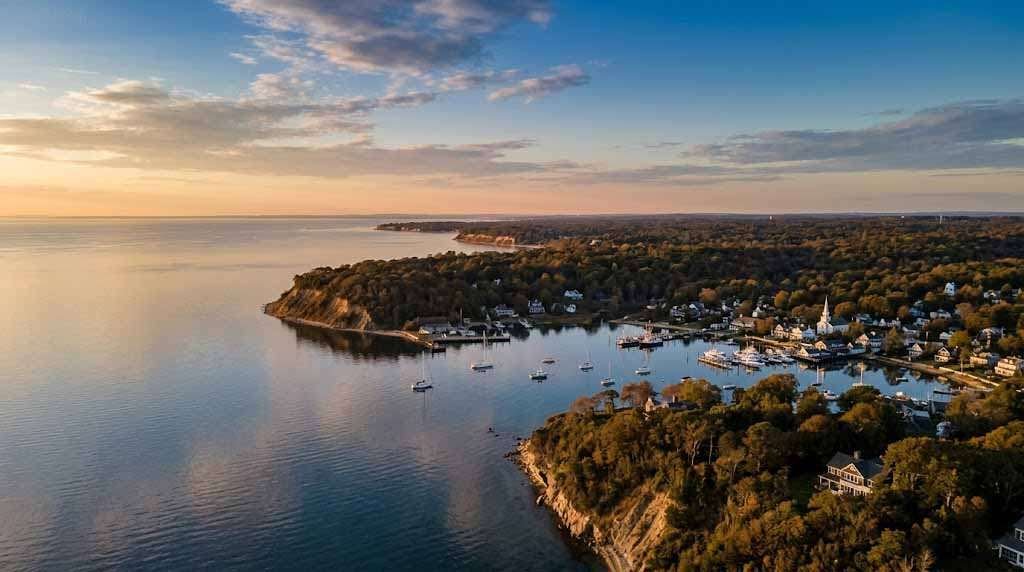
The same Prohibition-era geography that made Freeport a hub made Mount Sinai Harbor a corridor. The harbor’s natural concealment — its narrow mouth, its protective bluffs, its distance from major Coast Guard stations — made it one of the quietest and most efficient rum-running channels on the North Shore. Small boats ran loads ashore in the dark and moved the cargo inland along back roads before dawn. The community knew. The community kept quiet. Read the full story of Mount Sinai Harbor’s Rum-Running past.
16. Nikola Tesla’s Wardenclyffe Tower — The World He Almost Built at Shoreham
In 1901, Nikola Tesla broke ground on a wireless transmission tower in Shoreham, on Long Island’s North Shore, that he believed would transmit electricity and information across the Atlantic without wires. The Wardenclyffe Tower was his most ambitious project — a 187-foot structure sitting above a 120-foot shaft driven into the ground, designed to use the earth itself as a conductor. J.P. Morgan funded it, then pulled the funding when he understood what it actually was: a system that couldn’t be metered, monitored, or monetized by conventional means. The tower was demolished in 1917. The site still exists. What was built there, and what was stopped there, remains one of the strangest inflection points in American technological history. Read the full story of Tesla’s Wardenclyffe Tower.
17. Roosevelt Field and Lindbergh’s Takeoff (1927)
On the morning of May 20, 1927, Charles Lindbergh lifted off from a muddy airfield in Garden City and flew 33.5 hours to Paris, becoming the first person to complete a solo transatlantic flight. The plane was overloaded. The field was short. The weather was wrong. He went anyway. Roosevelt Field — named for Theodore Roosevelt’s son Quentin, killed in World War I — had been a hub of aviation testing and record attempts for years. Long Island’s flat terrain and proximity to the Atlantic made it the natural launching point for transatlantic ambitions. What happened there on that morning did not just make Lindbergh famous. It opened the age of commercial aviation. Read the full story of Roosevelt Field and Lindbergh’s Takeoff.
18. Whisper the Bull and the Legend of Smithtown
Long Island’s most persistent founding myth belongs to Smithtown: Richard Smythe, granted as much land as he could encircle in a single day on a bull. He rode the bull. He claimed the land. The story is almost certainly embellished — the legal record is considerably more complicated than a bull ride — but the mythology embedded itself in the town’s identity so deeply that a bronze bull still stands at the center of Smithtown today. What matters historically is what the myth reveals: the original land claims on Long Island were exercises in audacity, leverage, and creative record-keeping, and the towns that grew from them carry the character of their founding whether they know it or not. Read the full story of Whisper the Bull and the Legend of Smithtown.
19. The Old Field Point Lighthouse — The Conscience of Long Island Sound
Built in 1823 and rebuilt in 1868, the Old Field Point Lighthouse at the mouth of Port Jefferson Harbor is one of the oldest continuously operational lights on the Sound. It marked the entrance to one of Long Island’s most active harbors during the height of the shipbuilding era, guided vessels through the Sound’s unpredictable currents and weather, and survived more than a century of storms intact. The lighthouse is not a monument to tragedy. It is a monument to the people who kept the light burning — the keepers, their families, and the unglamorous work of preventing catastrophe night after night. Read the full story of the Old Field Point Lighthouse.
20. The Vaudeville Colony of St. James — When Broadway Came to the North Shore
In the late 19th and early 20th centuries, the North Shore hamlet of St. James became an unlikely gathering point for the giants of American stage and early screen. Vaudeville performers, Broadway stars, and their families built summer homes here — drawn by the quiet, the farmland, and the distance from the city’s noise. What assembled in St. James was not a resort colony for the wealthy in the Hamptons sense. It was a working artist community, full of people who performed for a living and came here to stop performing for a few months. The cultural weight of what passed through that hamlet — the influence those artists carried back to the stage and eventually to early film — is larger than St. James’s current reputation suggests. Read the full story of the Vaudeville Summer Colony of St. James.
The Island Keeps Going
Twenty moments is not the whole story. It’s barely the beginning. The Heritage Diner blog has been covering Long Island history at this level for years — individual deep dives into moments that most local history surveys skip entirely: the wreck of the HMS Culloden off Montauk, the eel spearing traditions of the Peconic Estuary, the Miller Place Academy, and the folklore and LiDAR science behind Long Island’s legendary walls and sunken geography.
The island has been carrying this history the whole time. Most of it just hasn’t been asked about.
You Might Also Like
- The Ride Down 25A: A Historic Motorcycle Journey Along Long Island’s North Shore to The Heritage Diner
- The Forgotten Montauk Surfman’s Chowder: Cooking with Seawater at the 1800s Life-Saving Stations
- Hardtack and Sea Biscuits: The 19th-Century Whaler’s Diet Out of Sag Harbor
Sources
- Pennypacker, Morton. General Washington’s Spies on Long Island and in New York. Long Island Historical Society, 1939.
- Ross, Peter. A History of Long Island: From Its Earliest Settlement to the Present Time. Lewis Publishing, 1902. https://archive.org/details/historyoflongis00rossgoog
- Hefner, Robert J. Whaling in the Wake of the Moby Dick. Suffolk County Historical Society, 1986.
- National Park Service — Sagamore Hill National Historic Site. https://www.nps.gov/sahi/index.htm
- National Park Service — Wardenclyffe / Tesla Science Center. https://teslasciencecenter.org/
- Lindbergh, Charles. The Spirit of St. Louis. Scribner, 1953.
- Currier & Ives — The Lexington Disaster (1840 lithograph). Library of Congress. https://www.loc.gov/item/2003666564/
- Stony Brook Grist Mill Historical Records. Three Village Historical Society. https://www.tvhs.org/
- Suffolk County Historical Society — Long Island History Archive. https://www.suffolkcountyhistoricalsociety.org/