Forty years of critics calling Nighthawks a meditation on urban loneliness. Art historians who’ve never wiped down a counter at 2 A.M. projecting their own existential dread onto a painting about people who are just tired.
I’ve been behind that counter. Not in Hopper’s corner diner on Greenwich Avenue, but behind a counter on Route 25A in Mount Sinai that looks more or less the same when the last booth clears out and the coffee’s been hot for four hours with nobody ordering it. I know what those people in the painting are feeling. And it isn’t loneliness.
It’s exhaustion. The specific, bone-deep kind that doesn’t announce itself. It just sits there, behind your eyes, in the particular stillness of a body that has been moving since before sunrise and knows it has to move again before the next one.
What the Critics Miss
Edward Hopper painted Nighthawks in 1942, just after Pearl Harbor, and everyone’s been loading the painting with symbolism ever since. Disconnection. Alienation. The cold geometry of modern American life. Roger Ebert once called it “the most evocative painting of American loneliness ever made.” That’s a great line. It’s also wrong — or at least, it’s only half the story, and it’s the half that belongs to the person looking at the painting, not the people inside it.
The man who famously said “I didn’t see it as particularly lonely. Unconsciously, probably I was painting the loneliness of a large city” — that was Hopper himself, acknowledging that the loneliness was unconscious. Something he put in without fully meaning to. That’s different from what the critics made of it afterward, which is a whole philosophy of alienation built on four people who are probably just finishing a shift or can’t sleep and came in for eggs.
The Man Behind the Counter
Start there. The counterman.
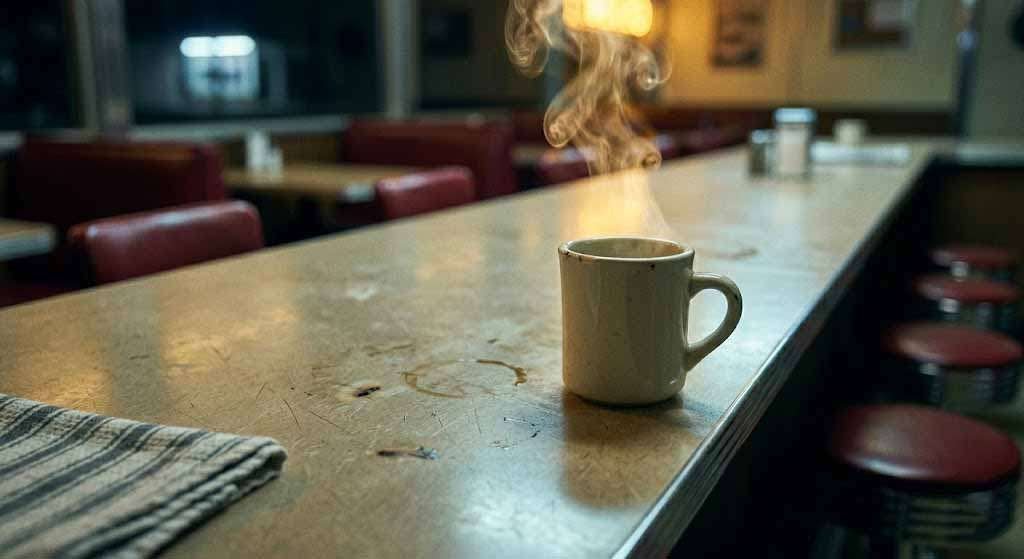
He’s got his back turned to the couple. White uniform, working. Not brooding — working. Anybody who reads that posture as existential distance has never spent a night service on their feet. You turn your back because there’s something to do. There’s always something to do. A bus to clear, a container to refill, a surface that isn’t quite clean enough. You develop a physical relationship with the counter that is separate from whatever is happening socially. The counter is yours. You tend it the way a carpenter tends his bench.
I’ve been that man. Many times. The body moves on its own after a certain hour. You stop thinking about it. The hands know where the cloth goes, where the mug goes, which burner needs adjusting without you looking at the dial. That’s not alienation. That’s competence after twenty-five years. It looks lonely from the outside. From the inside, it’s the only peace you get in a twelve-hour day.
The Couple at the Corner
Then there’s the couple. Or the man and the woman who are sitting together at the curve of the counter, the focal geometry of the whole painting. She’s got red hair. He’s in a dark suit. Their fingers are close together — she’s holding something, he’s reaching, or almost reaching. Critics have spilled a lot of ink on whether they’re together or strangers.
I think they’re together. And I think they’re not talking because they don’t need to.
That’s the thing about people who’ve been together long enough: silence stops being empty. It fills up with all the previous conversations. You’re at the diner at midnight not because you’re alienated from each other but because sometimes you need coffee and fluorescent light and a place that’s open. They’re comfortable. The silence isn’t a symptom. It’s a condition of comfort.
My father and I used to open the Heritage together in the early years. We’d do the whole first hour without saying much. Coffee. Flatware. Checking the cooler. The sound of the place warming up around us. That wasn’t loneliness. That was two people who knew what needed doing and got it done.
The Lone Man
Alright. The man sitting alone at the other end of the counter, his back to us, hat on, no companion.
He might be lonely. Probably is, actually. 2 A.M. alone at a diner is a particular condition, and I’m not going to pretend otherwise. Some of the people who’ve sat at my counter in the middle of the night were working through something. You can tell. They order slowly. They don’t look at the menu so much as through it.
But lonely and alienated are different things. Lonely is human. Lonely is what happens when the night gets long and you don’t have anywhere better to be. Alienated — in the philosophical sense the critics mean — implies that something structural has severed you from the world, that the city has consumed your capacity for connection. That’s a different diagnosis.
The man in the hat looks tired. He could’ve come off a double. He could be waiting for a train. He could be a widower who can’t sleep in his apartment because it still smells like someone else. Hopper doesn’t tell us, and the critics are too busy making him a symbol to wonder about the specific weight he’s carrying.
What Hopper Actually Did
Here’s what I think Hopper got right that nobody gives him credit for.
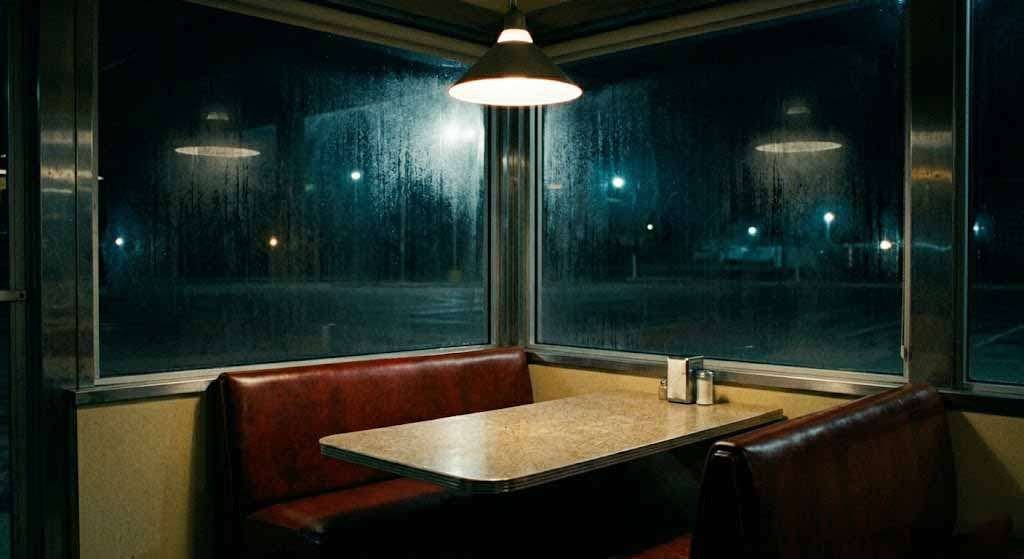
He painted the inside of the diner as brighter than the street. That’s not arbitrary. Every diner at that hour is the brightest thing on the block. The light falls out through the glass and onto the sidewalk and the empty storefronts and the pavement. The world outside is dark. The world inside is lit. And that light attracts people the same way any warmth attracts people who are cold.
The diner as refuge. Not as symbol of alienation, but as its antidote.
He also painted no door. Critics love this. No visible entrance — the characters are almost sealed inside the composition, no escape route. But I look at that differently. A diner with no visible door just means you’re already inside. You’ve already made it in. You found the place. You’re under the lights. Whatever’s outside can wait.
Hopper’s wife, Jo, who kept meticulous records of his work and often modeled for his female figures, said he loved diners and all-night restaurants. He ate in them. He wasn’t documenting an alien world — he was painting somewhere he went.
The 2 A.M. Shift That Isn’t Romance
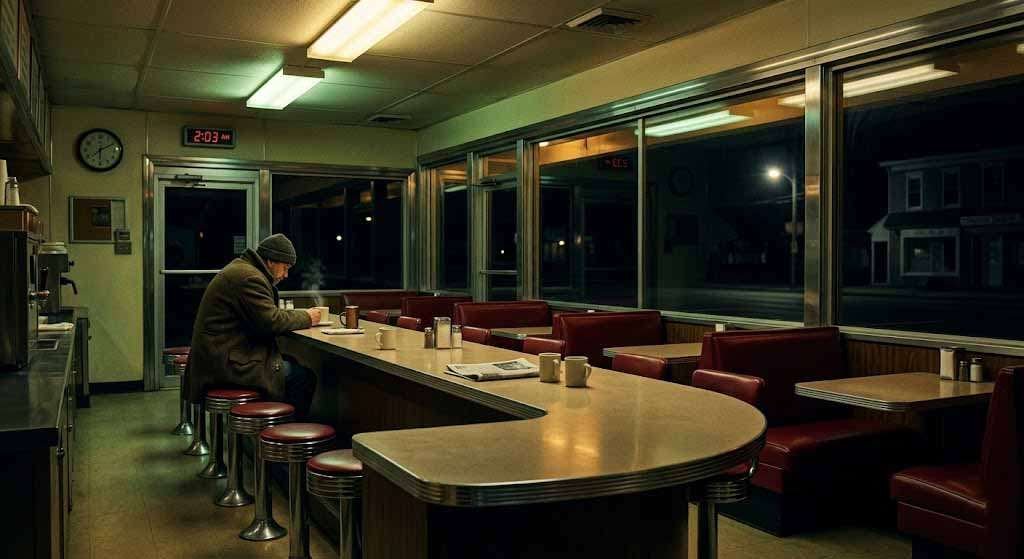
Let me tell you what actually happens at 2 A.M. in a diner, since apparently it needs saying.
The coffee has been on too long. You’ve made it twice already, dumped it, made it fresh, but there’s a staleness that sets in around midnight that no amount of fresh grounds fully defeats. The pie case has gaps in it. There are three slices of apple, one lemon meringue that’s been there longer than it should be, and the coconut cream that never moves but never gets thrown out either.
The kitchen is quieter than you’re used to. Maybe one guy back there, covering the basics. You don’t need the full line at 2 A.M. You need someone who can do eggs, can do a burger, can heat soup without burning it. The sounds of the place are different — lower, slower, the ambient clatter reduced to something almost meditative.
And the people who come in — they’re tired. They want to be warm, they want something hot, and they want to be left alone to process whatever the night has handed them. You learn to read that fast. Some people want you to talk to them. A lot don’t. The ones who don’t will sit in Hopper’s painting forever, and you’ll give them their coffee and keep your distance and they’ll appreciate it more than you know.
That’s not alienation. That’s the social contract of the late-night diner. Everybody in that room has made a tacit agreement: we are here together and we are not going to demand anything of each other. It’s one of the most civilized arrangements I’ve ever been part of.
Why Hopper Was a Working Painter
Hopper wasn’t painting from theory. He was painting from observation. He walked around the city, he sketched, he went back to places and looked again. His output was careful and slow — he produced relatively few finished canvases because he wasn’t in the business of manufacturing product. He was in the business of getting it right.
That I respect. It’s the same instinct that makes you spend six months on a leather briefcase when you could ship something faster. The result isn’t a shorter timeline. The result is a thing that holds up, that other people stand in front of and feel something they can’t quite name.
Nighthawks has been on postcards, in movies, in graduate dissertations, and on the walls of every college dorm room since 1975. It holds up. You can stand in front of the original at the Art Institute of Chicago and still feel like you’ve seen something true, not just something famous. That’s the difference between a painting made from looking and a painting made from a concept.
What Hopper looked at was the American interior — the fluorescent-lit room, the hour when the city stops performing and starts just being. He got that right. The critics got the interpretation wrong.
The Counter as the Real Subject
Here’s the harder thing I’ve come to believe about Nighthawks: the painting isn’t really about the people. It’s about the counter.
That long arc of marble or formica or whatever Hopper imagined it made of — that’s the spine of the composition. Everything is organized around it. The counterman exists to tend it. The couple exists to sit at it. The lone man exists at its far end. The counter is what the diner is. It’s where the exchange happens: you put the cup down, I fill it, you put the money there, I make change. Transaction as ritual. Sustenance as social contract.
I’ve been on both sides of that counter. When I was a kid, my parents’ table in Brooklyn wasn’t so different from a diner counter — Greek immigrants, food always moving, people always eating, the kitchen as the center of the whole operation. Then I crossed to the other side of it, the working side, and stayed there for twenty-five years.
The people in Nighthawks aren’t symbols of anything. They’re just people at a counter, late, holding on until morning.
That’s the whole painting. That’s all of it. And somehow it’s enough.
You Might Also Like
- Jacques-Louis David’s The Death of Socrates — Conviction, Hemlock, and the Price of the Examined Life
- Rembrandt’s Aristotle with a Bust of Homer — A Portrait of the Mind in Conflict
- Deserve’s Got Nothing to Do with It: Why Unforgiven Is the Greatest American Western Ever Made
Sources
- Edward Hopper, quoted in Brian O’Doherty, “Portrait: Edward Hopper,” Art in America (1964): artinamerica.com
- Art Institute of Chicago, Nighthawks collection entry: artic.edu
- Gail Levin, Edward Hopper: An Intimate Biography (University of California Press, 1998)
- Deborah Lyons, ed., Edward Hopper: A Journal of His Work (W.W. Norton, 1997)
- Roger Ebert, review of Pennies from Heaven (1981): rogerebert.com