This post presents an intellectual comparison and does not endorse or refute either worldview. The reconstruction of a dialogue between figures who never directly engaged is speculative framing for analytical purposes. Readers should consult primary sources and form independent conclusions.
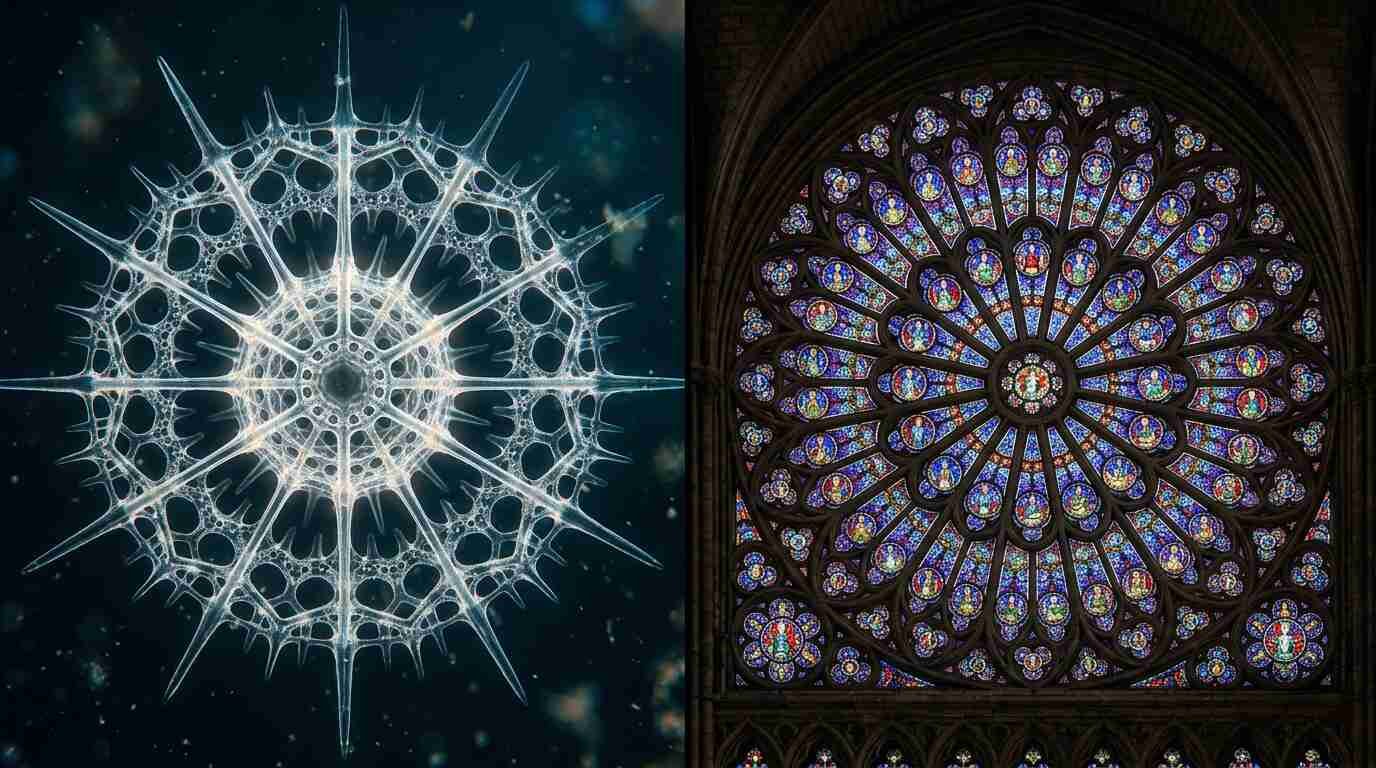
There is a drawing of a radiolarian — a single-celled marine organism — in Ernst Haeckel’s Kunstformen der Natur (1904) that stops you cold. It looks like a cathedral window made of glass that has never been touched by human hands. Twelve-pointed. Symmetrical to a degree that seems to violate probability. The spines radiate outward with a mathematical precision that, if you encountered it in a human building, you would assume was designed.
Haeckel assumed no such thing.
He drew it because the form was enough. Because the form was the argument — that nature generates beauty through mechanism, through the blind ratcheting of selection and structural constraint, without a witnessing eye, without a purpose, without anything that could be called direction. The radiolarian existed for 542 million years before a German biologist gave it a name. The cathedral window was always there. Nobody was looking.
Half a century later, a French Jesuit paleontologist named Pierre Teilhard de Chardin looked at the same kinds of forms — the deep structures of biological life, the arc of evolutionary history — and saw something categorically different. Not accident. Arrow. Not radiant form without a maker, but form as the very syntax of a maker’s unfolding grammar.
Two men. The same abyss. Opposite conclusions.
Haeckel and the Aesthetics of the Blind
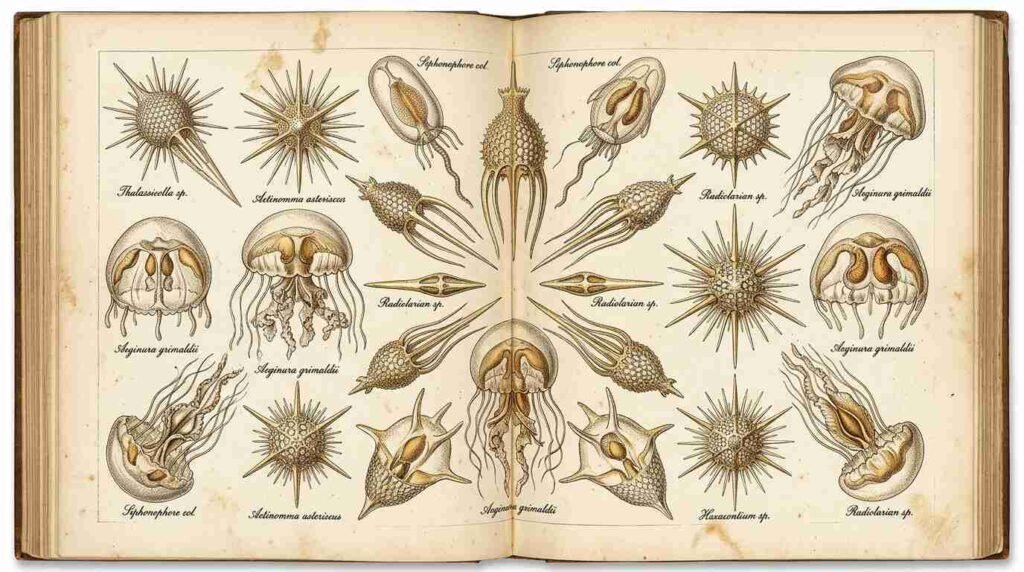
To understand what was radical about Kunstformen der Natur, you have to understand what Haeckel was doing with those 100 lithographic plates. He was not illustrating nature. He was making an argument in the only language that could survive the counter-arguments: visual beauty.
Darwin’s mechanism could be contested philosophically, mocked religiously, dismissed politically. But no one could look at a plate of Haeckel’s medusae — the sea jellies floating against black backgrounds, their trailing filaments arranged in patterns that human designers still copy today — and say that nature was a lesser artisan than God. If anything, the argument ran the other way. These forms were more complex, more precise, more breathtaking than anything in a cathedral. And they had arrived through entirely impersonal means.
Haeckel was a committed monist — he believed that mind and matter were the same substance, that the universe did not need a spiritual dimension to be what it was. He saw biological form as self-sufficient aesthetic law. The beauty of a radiolarian was not evidence of design; it was evidence that matter, given enough time and pressure, generates beauty on its own. This was not a small claim. It was a complete metaphysical position, made through images rather than theology.
The Ernst-Haeckel-Haus in Jena, Germany, where his archives are held, contains his field drawings and correspondence. What you find there is not a cold mechanist but a man in thrall to what he was seeing — which makes his insistence on an unmade universe all the more striking. He loved what he believed was made by nothing. His reverence had no object.
Teilhard and the Arrow Inside the Accident
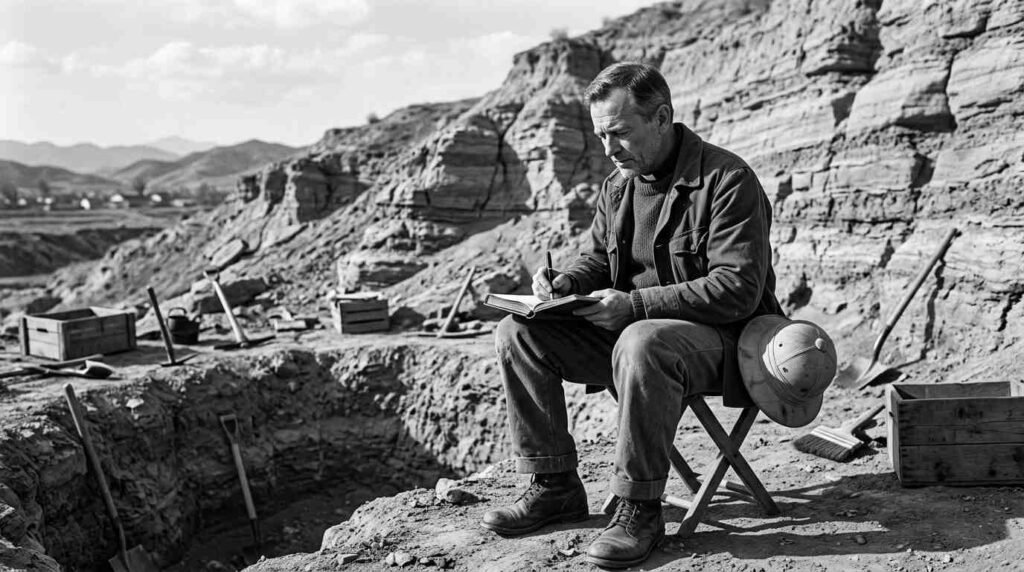
Teilhard de Chardin arrived at his position from a different direction entirely — literally. As a Jesuit priest and paleontologist, he spent years in China working on the Peking Man fossil site, the Zhoukoudian cave complex near Beijing that yielded some of the most significant Homo erectus remains ever found. He was, by any measure, a working scientist. He understood stratigraphy. He read the record in rock.
And what he read there was not randomness. Or rather, he read randomness that seemed to him to have a shape — an arrow embedded in the accident. Le Phénomène Humain, completed by the late 1930s but suppressed by the Vatican and published only posthumously in 1955, is his attempt to articulate what that shape is.
The argument runs roughly as follows: matter has always been organized toward increasing complexity. Evolution is not simply a process of variation and selection — it is a process of complexification, with consciousness as its leading edge. As organisms become more complex, they become more conscious. As they become more conscious, they converge — toward what Teilhard called the Omega Point, a terminal state of maximum complexity and consciousness that he identified with the cosmic Christ of Christian theology.
This is where scientists have always had trouble with Teilhard. The Omega Point is not a scientific hypothesis. It cannot be falsified. It does not make predictions. Peter Bowler’s Monkey Trials and Gorilla Sermons (Harvard University Press, 2009) places Teilhard squarely within a tradition of Catholic evolutionary thinkers who tried to absorb Darwinism into theology — a tradition with genuine intellectual seriousness and genuine scientific liabilities.
But Teilhard’s core observation — that evolution produces increasing complexity, and that complexity produces something we call consciousness — is not easily dismissed. It is the shape of the record as we have it.
Cold Spring Harbor’s Long Shadow
There is a Long Island thread that runs through this debate that rarely gets named.
Cold Spring Harbor Laboratory, on the North Shore of Long Island, has been a site of biological controversy since the early twentieth century. The Eugenics Record Office, established on its grounds in 1910 with funding from Mrs. E.H. Harriman, became one of the most active nodes in the American eugenics movement — the misappropriation of Darwinian thinking in service of racial hierarchy. Charles Davenport, its director, understood himself to be applying evolutionary science to human populations. What he was actually doing was using the prestige of Darwinian mechanism to launder social prejudice.
This history matters for the Haeckel-Teilhard debate because it illustrates what happens when biological mechanism is applied without a telos — a direction, a purpose, a limiting principle. Haeckel’s monism, carried to its logical extreme by lesser minds, became eugenics. The idea that nature is self-sufficient, that beauty arises through mechanism without any supervening value, does not by itself prevent that mechanism from being hijacked for monstrous ends.
Teilhard’s critics would say he went too far in the other direction — that attaching an Omega Point to evolution smuggles in theological conclusions that the evidence does not support. His Roman Catholic superiors agreed: his works were suppressed, banned from Jesuit libraries in 1957, and subjected to a formal Holy Office warning in 1962. He died in New York City on April 10, 1955, the year his masterwork was finally published, having spent his final years in the American Northeast, engaging East Coast Catholic intellectual circles who found in his thought an exciting rapprochement between faith and science.
What the Drawings Actually Argue
Return to the radiolarian.
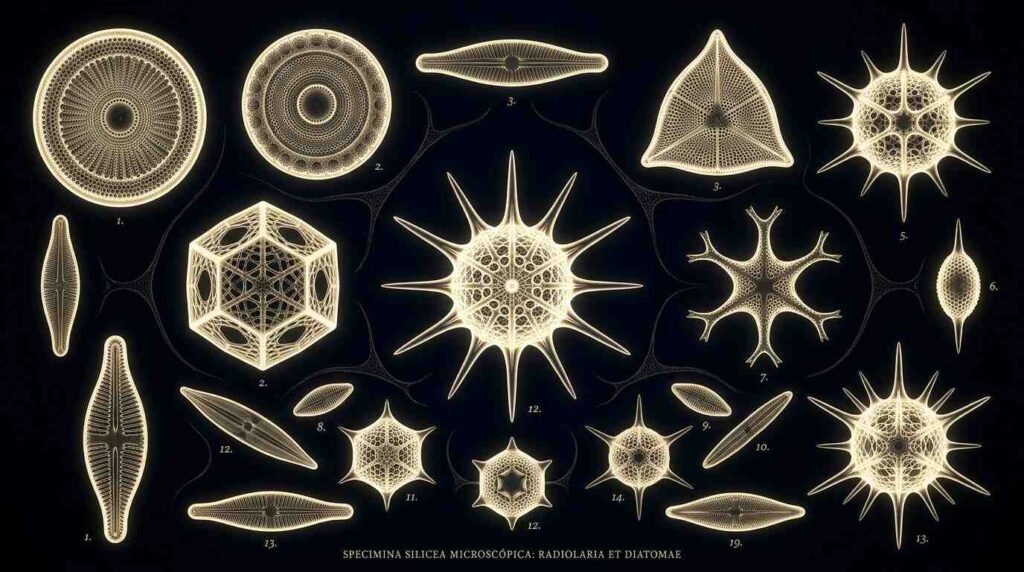
Haeckel’s visual argument is still the strongest thing he produced. A radiolarian is not like a cathedral window. It is a structural solution to the engineering problem of building a shell from silica while remaining buoyant in open water. The symmetry is not decorative — it is functional. The beauty is a byproduct of a solution. This is what the biologist who reads Haeckel feels in the bones: that form follows function so precisely, and the solution space is so constrained, that the same shapes appear again and again across wildly divergent lineages. It is convergent evolution made visible.
Teilhard would look at this and say: exactly. The same solutions appear because evolution is not wandering — it is navigating. The constrained solution space is the fingerprint of direction. When marsupials in Australia independently evolve eyes nearly identical to vertebrate eyes in the northern hemisphere, that is not accident — that is the universe finding its way to the same answer through different paths. The eye is not designed. But the fact that the eye is the answer — that vision is what complexity converges toward — is, for Teilhard, the signature of the Omega Point.
Haeckel would reply: the universe finding the same solution through multiple paths is precisely what we would expect from mechanism operating under physical constraints. You don’t need a destination to explain convergence. You need physics and time.
This exchange — which never happened between these two men but has been happening in evolutionary biology ever since — has no clean resolution. I have written about the demarcation problem before: the question of where science ends and metaphysics begins is not itself a scientific question. Haeckel’s monism and Teilhard’s Omega Point are both positions that reach beyond the evidence, in opposite directions.
The Question of Beauty
There is one place where the debate becomes genuinely interesting rather than just philosophically contentious, and it is the question that Haeckel’s drawings pose directly: what do we make of the beauty?
Haeckel did not have to draw radiolarians the way he drew them. He could have produced accurate scientific illustrations — functional, precise, stripped of the aesthetic charge. He chose instead to render them as objects of contemplation, surrounded by negative space, lit from within. He made them into art. And in doing so, he was making an implicit claim that exceeded his stated monism: that the beauty matters. That the form is not just mechanically produced but worth attending to. That there is something in the experiencing of it — the catch of breath when you turn the page — that requires explanation.
Teilhard would have found nothing surprising in this. For him, the experience of beauty in biological form was precisely evidence of the noosphere — the sphere of consciousness that evolution had produced and was continuing to develop. The breath-catch is not incidental to the evolutionary story. It is the evolutionary story, at its most recent chapter.
Haeckel, by contrast, had no account of the experience. He had the mechanism. He had the form. The catch of breath was just neurons. And yet — the drawings exist. He made them. He kept making them. Something in the experiencing of deep biological form drove him to produce one of the most beautiful scientific documents in the history of science.
Perhaps, in the end, the most honest position is to say that neither man fully explained what the other’s drawings prove. Haeckel’s radiolarians demonstrate that radical beauty is possible without a maker. Teilhard’s Omega Point offers an account of why we find them beautiful that Haeckel’s mechanism never quite provides.
The radiolarian has been making its silica window for 542 million years. It doesn’t know which of them is right. And in a universe this old, that kind of patience seems, in itself, like a kind of argument.
I have been sitting with these questions for a long time — they run through my graduate work at The New School, where I focused on evolutionary theory and the mechanics of cultural transmission. The gap between what mechanism explains and what experience demands has never fully closed for me. It may be the most honest thing I can say about it.
You Might Also Like
The Extended Phenotype: How Your Genes Build Structures Beyond Your Body
Dialogues Concerning Natural Religion by David Hume — The God Darwin Couldn’t Quite Kill
The Demarcation Problem: Karl Popper, Falsifiability, and the Boundary Between Science and Pseudoscience
Sources
Haeckel, E. (1904). Kunstformen der Natur. Biodiversity Heritage Library
Teilhard de Chardin, P. (1955). Le Phénomène Humain (English trans: The Phenomenon of Man, Harper & Row, 1959).
Bowler, P.J. (2009). Monkey Trials and Gorilla Sermons. Harvard University Press.
Cold Spring Harbor Laboratory — Eugenics Record Office history
American Teilhard de Chardin Association Archives, Georgetown University: Georgetown Finding Aids
Wikipedia: Pierre Teilhard de Chardin
Encyclopedia.com: Pierre Teilhard de Chardin