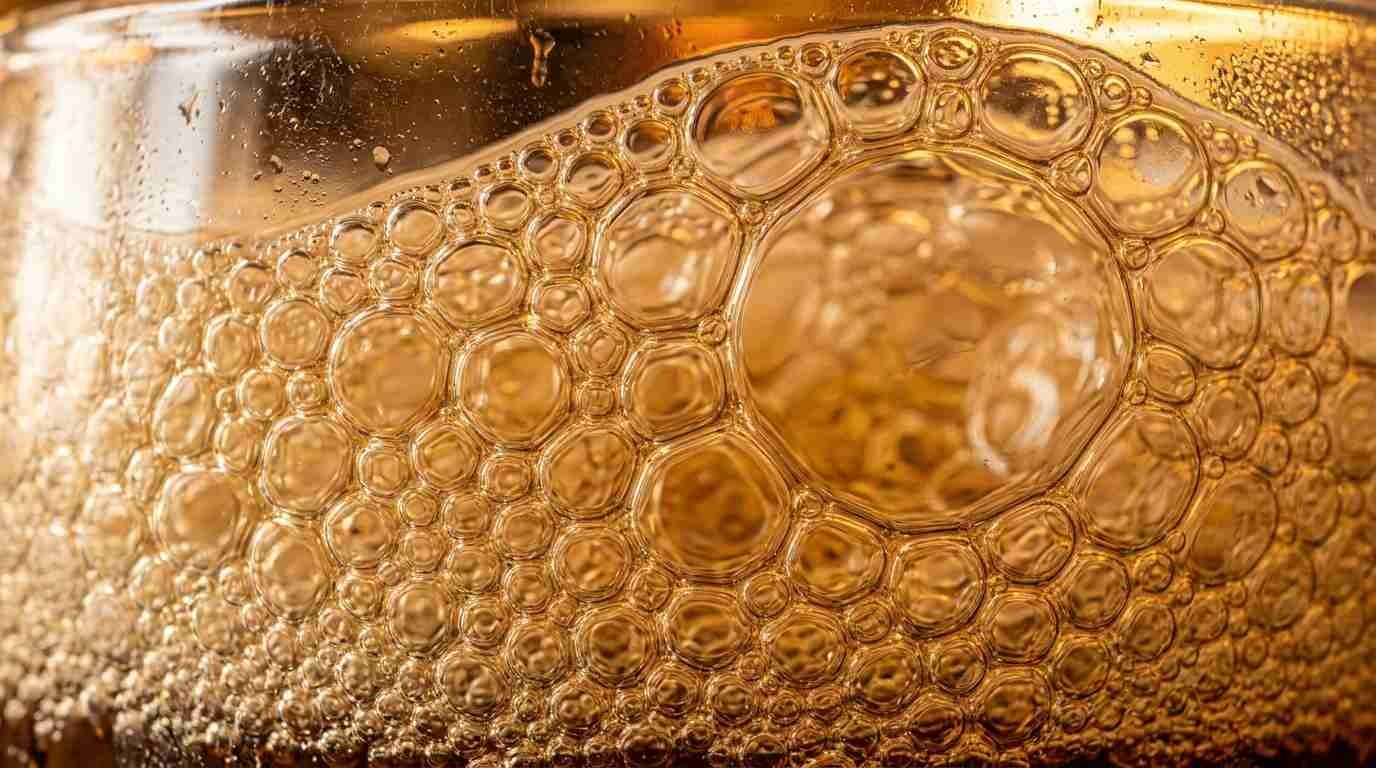
Pour a beer wrong and the evidence sits right on top, collapsing within a minute into a thin scum of broken bubbles. Pour it right and the head holds its shape for the length of the conversation, a white cap dense enough to leave lace rings on the glass as it slowly recedes. Bartenders learn to tell the difference by feel — tilt the glass, slow the stream near the top, know when to stop — but what they’re actually managing, whether they’d put it this way or not, is a genuinely unresolved problem in fluid dynamics. Foam scientists have been publishing peer-reviewed papers on beer head stability for decades, and the honest state of the field is that nobody has fully modeled why some pours hold and others don’t.
The Bubble’s Entire Life Is a Fight Against Physics
A bubble of carbon dioxide forming in a glass of beer is already under siege the moment it exists. Surface tension wants to collapse it into the surrounding liquid as fast as possible, because a sphere of gas trapped in liquid is a high-energy state that the system is constantly trying to escape. Left alone, dissolved CO2 would simply want to stay dissolved, or rise and vanish at the surface without ceremony — flat soda, essentially, in beer’s clothing. What keeps a head of foam standing on top of a pint, for the ninety seconds or ten minutes it manages to survive, is a set of molecules fighting that collapse at the bubble’s surface, one bubble wall at a time.
Those molecules are mostly proteins pulled from malted barley during brewing, plus bittering compounds from hops, and together they form what food scientists call a surfactant layer — a molecular scaffold that coats each bubble and resists the thinning and popping that surface tension is constantly trying to accomplish. A 2022 review in the European Food Research and Technology journal walked through just how layered this chemistry actually is: protein-polypeptide complexes, isohumulone acids from hops, and even trace metal ions all interact to determine whether a bubble wall stays elastic enough to survive a jostle or snaps the instant a neighboring bubble bursts nearby and sends a shockwave through the foam.
Nitrogen Cheats the System, and Everyone Knows It
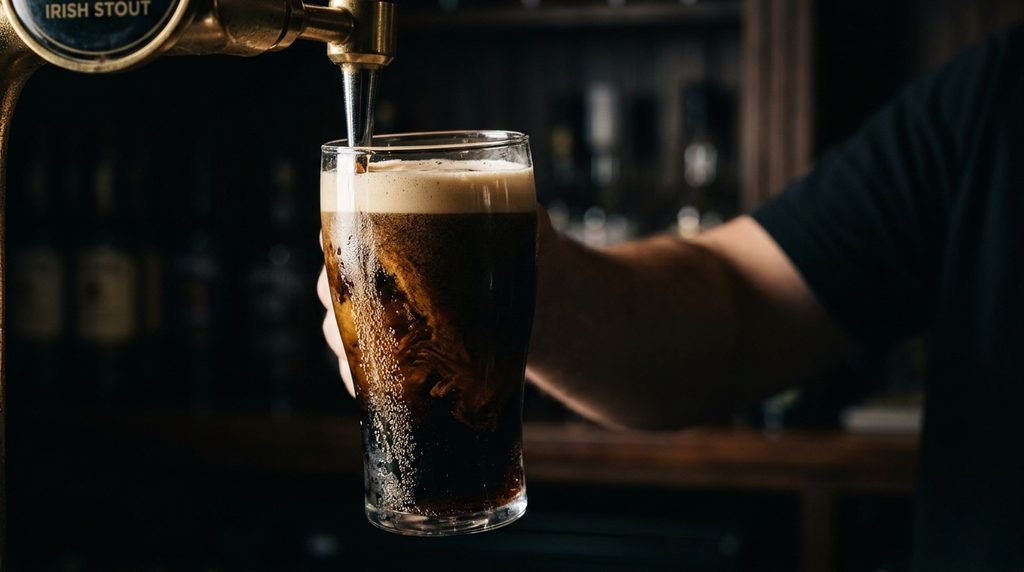
Not every beer plays this game with the same gas. Stouts poured with a nitrogen-CO2 mixture — the widget-and-nitro approach popularized by Guinness — produce a foam that behaves almost unfairly well compared to a straight carbonic pour, and the physics explains why. Nitrogen is far less soluble in liquid than carbon dioxide, which means nitrogen bubbles form smaller and more uniformly, and they don’t continue dissolving and reforming at the surface the way CO2 bubbles do. The result is the famously dense, almost solid-looking cascade that settles inside a glass of stout, a visual effect striking enough that researchers have written entire papers modeling the bubble nucleation and cascading flow inside a settling pint, treating it as a legitimate problem in multiphase fluid mechanics rather than a bar trick.
The tradeoff is that nitrogen alone can’t replicate a lager’s bite, because carbon dioxide is also what gives beer its perceived sharpness and most of its aroma lift — CO2 escaping at the surface carries volatile hop and malt compounds up into the drinker’s nose with every sip. A nitro pour trades some of that aromatic intensity for stability and mouthfeel, which is a real chemistry tradeoff, not a matter of taste alone. Brewers choosing a dispensing method are choosing, whether they frame it this way or not, which physical property of the beer they want to foreground and which one they’re willing to mute.
The Glass Is Doing More Work Than the Drinker Assumes
A clean glass and a dirty glass will produce dramatically different foam from the exact same beer, and the mechanism is almost entirely about nucleation sites — the microscopic imperfections, residue, or rough patches on a glass surface where dissolved gas can first break out of solution and form a bubble. Oil residue from improperly rinsed glassware, commonly left behind by certain detergents or a lingering film from lip balm or lipstick, actively suppresses foam by destabilizing the bubble walls before they can even form properly, which is why professional beer glass cleaning protocols are stricter than ordinary dishwashing and why some bars keep dedicated, detergent-free glassware specifically for beer.
Shape matters almost as much as cleanliness. A glass with a slight outward taper near the rim, or an etched ring at the base — a trick some European breweries have used for decades — deliberately creates nucleation points that generate a steady stream of bubbles rising through the beer, continuously replenishing the head from below even as the top layer slowly breaks down. It’s a small piece of applied surface engineering hiding inside what looks like ordinary glassware, and it changes the foam’s lifespan measurably, not subtly, in side-by-side pours of identical beer.
Pour Technique Is Where the Theory Meets the Hand
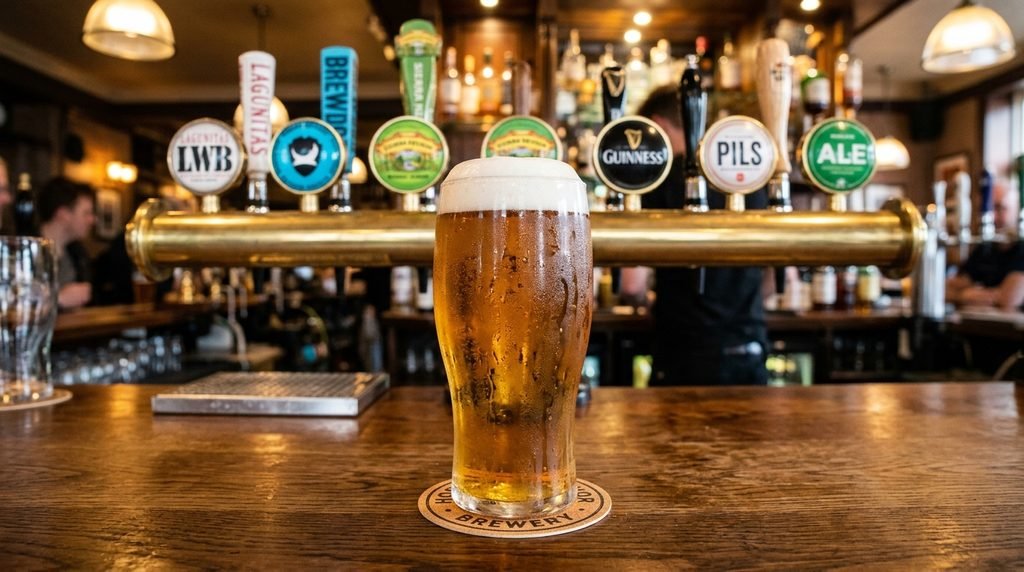
Everything above explains why foam exists and persists, but the pour itself still determines how much of that potential actually gets realized in the glass. Pouring straight down the center of a tilted glass, then straightening as it fills, controls how violently the beer agitates and therefore how much CO2 gets knocked out of solution at once — too gentle a pour under-releases gas and produces a flat, lifeless head, while too aggressive a pour over-releases it into a foam that rises fast, looks impressive for ten seconds, and then collapses just as quickly because the bubbles formed too large and uneven to hold structure.
This is the part bartenders actually learn through repetition rather than study, and it’s also the part where the UK’s long-running “full pint” debate gets genuinely contentious — CAMRA, the Campaign for Real Ale, has spent years arguing that a thick head served in a nonick glass can shortchange a customer on liquid beer while fully complying with the letter of pour-measurement law, since foam occupies volume that liquid otherwise would. It’s a consumer protection argument with a surprisingly direct line back to bubble nucleation theory: the same foam stability that brewers and glass designers spend so much effort engineering is, from a regulator’s chair, sometimes indistinguishable from getting less beer for the same money.
An Arxiv Paper Took the Guinness Cascade Seriously, and That Tells You Something
Perhaps the clearest evidence that this is real science and not bar-room pseudo-expertise is a physics paper, published through arXiv, that modeled the cascading bubble effect inside a settling glass of stout with the same mathematical seriousness normally reserved for weather systems or ocean currents. The researchers treated the descending bubbles — visually, beer appears to flow downward near the glass walls even as it’s actually carbonating upward through the center — as a fluid dynamics problem worth solving on its own terms, complete with the kind of boundary-condition modeling usually associated with aerospace or oceanography. That a pint of stout earned that level of attention from working physicists is the strongest possible argument that what happens in the two inches of foam on top of a beer is not decoration. It’s an actual, still only partially answered, problem in how gases, liquids, and the proteins suspended in them negotiate a truce that nobody has fully written down the rules for yet.