
Drive east on Route 25A from Mount Sinai and you will pass through the village of Cold Spring Harbor before you’ve gone twenty miles. The harbor opens on the right, glinting through the trees. There is a laboratory there — Cold Spring Harbor Laboratory, now world-famous for its role in the discovery of the double helix, for its Nobel laureates, for its work in cancer biology and neuroscience. It is a genuinely great scientific institution. It is also the site of one of the most consequential scientific disasters in American history, and the two facts cannot be separated.
From 1910 to 1939, the Eugenics Record Office operated on that same campus. It was not a fringe organization. It was funded by the Carnegie Institution of Washington, by Mary Harriman (widow of the railroad baron E.H. Harriman), and by the Rockefeller Foundation. It was directed by Charles Davenport, a Harvard-trained biologist who was president of the American Society of Zoologists. Its superintendent, Harry Laughlin, testified before Congress using ERO data, directly influencing the Immigration Restriction Act of 1924 — the Johnson-Reed Act — which used national-origin quotas to effectively slam shut immigration from Southern and Eastern Europe. The same data later served as a model for Nazi Germany’s sterilization law of 1933, which the ERO’s Eugenical News praised.
This is not ancient history in the abstract. It happened here, along this stretch of the North Shore. And the most important thing about it, for the purposes of understanding the relationship between science and moral reasoning, is not that it happened. It is who saw it coming — and when.
What Davenport and Laughlin Were Actually Claiming
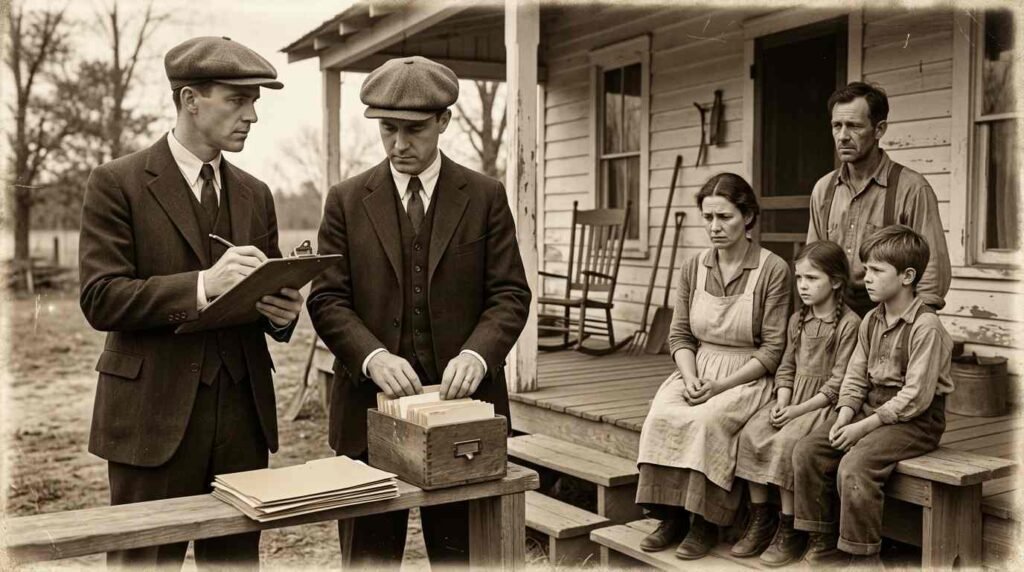
Charles Davenport published Heredity in Relation to Eugenics in 1911, and it is worth understanding what he thought he was doing. He believed he was applying the principles of Mendelian genetics — at that time a genuinely new and exciting framework — to the hereditary basis of human traits. He gathered pedigree data, trained field workers, and attempted to show that conditions like “feeblemindedness,” “criminality,” and “pauperism” were heritable in straightforward Mendelian fashion, like eye color or coat pattern in a mouse.
The scientific problems with this were fundamental. Mendelian inheritance describes the transmission of discrete genetic units across generations — it works well for single-gene traits with clear phenotypic expression. Davenport and Laughlin were applying it to complex behavioral and social traits that are influenced by dozens or hundreds of genes interacting with environmental factors in ways that simple pedigree analysis cannot disentangle. They were also collecting data through field workers who were looking for what they expected to find, using categories — “feeblemindedness,” “moral imbecility” — that were ideologically loaded rather than scientifically operationalized. The methodology was, from the perspective of contemporary genetics, indefensible. But it took a generation for the scientific community to say so clearly.
Laughlin’s congressional testimony is in the public record. He told the House Committee on Immigration and Naturalization that immigrants from Southern and Eastern Europe showed genetic evidence of inferiority. He did not disclose the deep problems with his data collection methods. The committee found him persuasive. The 1924 Act followed. The consequences were substantial: among the groups most severely restricted were Jewish immigrants from Eastern Europe, many of whom would otherwise have fled Nazi Germany in the following decade.
Chesterton’s Prescient Refusal
In 1922 — twelve years after the Eugenics Record Office opened, two years before the Immigration Restriction Act — G.K. Chesterton published Eugenics and Other Evils. Chesterton was not a scientist. He was a journalist, a novelist, a Catholic convert, and one of the most formidable polemicists of his era. And he was, on the record, among the earliest and most rigorous critics of the eugenic program at a time when that program was broadly considered progressive, forward-looking, and scientifically legitimate.
His objections were not primarily empirical. He was not claiming that Davenport’s genetics was wrong — he was not positioned to make that argument, and he was honest about the limits of his technical knowledge. What he argued was philosophical and moral. He pointed out that the eugenic program rested on assumptions that were not scientific conclusions but ideological premises: that the traits being selected for were genuinely desirable rather than merely conventional; that the state had the authority to make reproductive decisions on behalf of individuals; that the identification of “fitness” and “unfitness” could be made by technocratic experts without reference to the political interests of those experts; and that the biological language of breeding, when applied to human beings, represented a category error of the first order. Human beings, he argued, are not livestock, and treating them as such required not just bad science but a prior moral failure that no quantity of scientific data could correct.
He was mocked for it. The mainstream intellectual opinion of the 1910s and 1920s — across the political spectrum, from progressive reformers to conservative nationalists — treated eugenics as the obvious application of Darwinian insights to social policy. Chesterton was positioned as an obscurantist, a religious reactionary, someone who couldn’t follow the science.
He was right. They were wrong.
The Scientific Reckoning: Dobzhansky and the Modern Synthesis
The scientific demolition of eugenics did not come immediately, and it came from within science itself — which makes it more important, not less, for understanding the relationship between scientific practice and moral accountability. The key figure is Theodosius Dobzhansky, whose 1937 book Genetics and the Origin of Species — one of the founding documents of the Modern Synthesis that unified Mendelian genetics with Darwinian natural selection — established population genetics on rigorous mathematical and empirical foundations.
Dobzhansky was a Russian Orthodox Christian and an immigrant from Ukraine. He brought to genetics both scientific rigor and a personal stake in the question of what biological variation actually means. His work demonstrated that genetic variation in human populations does not sort cleanly into “fit” and “unfit” lineages, that the same genetic variants that are disadvantageous in one environment can be advantageous in another, that the heritability of complex behavioral traits is far more complicated than Davenport’s pedigree studies assumed, and that the scientific framework underpinning the ERO’s program was, in the light of actual population genetics, simply wrong.
He also argued, explicitly and on the record, that the misuse of genetics for social engineering was not just a scientific error but a moral one — that biology, properly understood, was one of the strongest arguments against racial hierarchy, not for it. His 1962 book Mankind Evolving extended this argument, insisting that human genetic diversity was a resource rather than a problem, that natural selection operated on populations rather than rankings, and that the eugenic imagination of a “fit race” was a biological fantasy with catastrophic political consequences.
By the time the ERO closed in 1939 — forced shut by the Carnegie Institution’s new president, Vannevar Bush, after a review found its research methods indefensible — the scientific community was beginning to say what Chesterton had said in 1922. The timing matters. There was a seventeen-year gap between the most coherent published moral refutation of eugenics and the scientific community’s formal withdrawal of support for the program. In that gap, the Immigration Restriction Act was passed. Sterilization laws spread to more than thirty states. Over 60,000 Americans were forcibly sterilized.
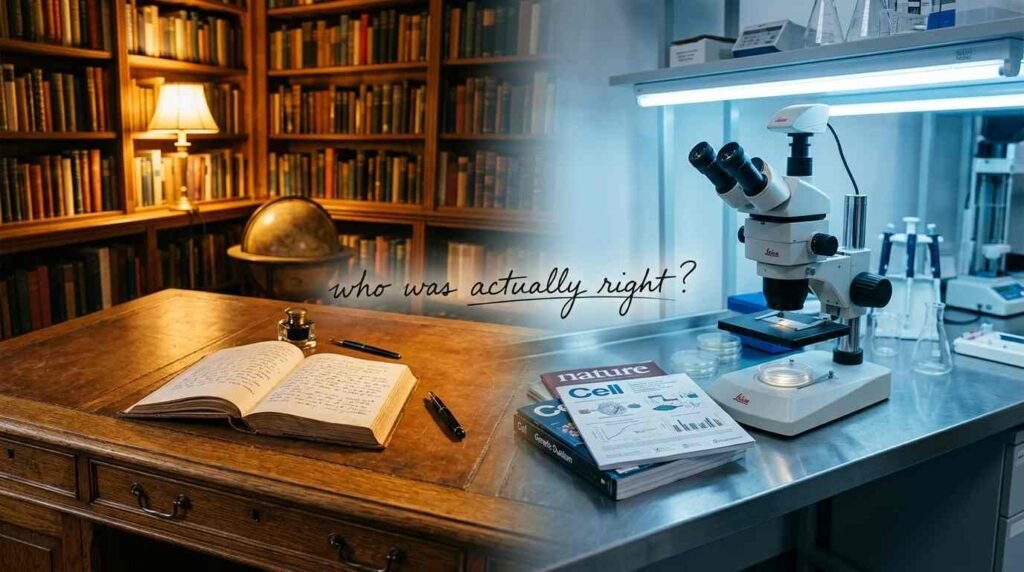
Who Was Actually Right, and Why
The question the Cold Spring Harbor story forces is an uncomfortable one, and it should be asked directly: in this case, who reasoned better — the secular scientists with the institutional backing and the empirical data, or the Catholic intellectual who rejected their conclusions on moral grounds?
The honest answer is Chesterton, and the reasons why are not comforting to either camp in the contemporary science-religion debate.
Chesterton was not right because religious intuition is a reliable guide to empirical truth. He was right because he identified the moral and philosophical premises embedded in a program that presented itself as purely scientific, and he subjected those premises to scrutiny that the scientific practitioners themselves were not performing. The scientists at the ERO were not bad at science because they were atheists or because they lacked religious feeling. They were bad at science because they allowed ideological commitments to determine their data collection, their categories of analysis, and their interpretation of results — and they did this in an institutional environment that provided no effective mechanism for challenge.
Chesterton had the advantage of standing outside that environment. He was also asking a different kind of question. The scientists were asking: what does the genetic data show? Chesterton was asking: what are we assuming when we decide which data to collect, and what are we permitted to conclude from it? These are not the same question, and the history of the Eugenics Record Office suggests that the second question is at least as important as the first.
Dobzhansky eventually provided the scientific answer that the ERO’s critics needed. But Dobzhansky’s moral clarity and his scientific rigor were not unrelated. He was a man who cared deeply about human dignity — shaped in part, by his own account, by his religious formation and by his experience as an immigrant — and that care made him a more careful scientist, not a less careful one. He looked harder at the data because he was unwilling to accept the conclusions that bad data seemed to support.
The CSHL DNA Learning Center has done extensive and admirable work in recent years making the history of the ERO publicly available, digitizing records and contextualizing the science within its historical moment. That institutional reckoning is ongoing. So is the broader question about what it means for science to be conducted without a moral framework adequate to its power. I’ve written elsewhere about the dynamics of scientific paradigm shifts and about the problem of demarcating genuine science from ideologically driven pseudoscience — the eugenics story is the most consequential American case study in what happens when that demarcation fails.
The laboratory is still there, twenty miles east on Route 25A. Worth knowing what happened on that ground.
You Might Also Like
- Before Salem: The Witch Trial That Defined Long Island’s Soul
- Dialogues Concerning Natural Religion by David Hume — The God Darwin Couldn’t Quite Kill
- On the Origin of Species by Charles Darwin
Sources
- Davenport, C.B. (1911). Heredity in Relation to Eugenics. Henry Holt.
- Chesterton, G.K. (1922). Eugenics and Other Evils. Cassell. Project Gutenberg
- Dobzhansky, T. (1937). Genetics and the Origin of Species. Columbia University Press.
- Dobzhansky, T. (1962). Mankind Evolving. Yale University Press.
- Black, E. (2003). War Against the Weak. Four Walls Eight Windows.
- Cold Spring Harbor Laboratory. Library & Archives. cshl.edu
- CSHL DNA Learning Center. Eugenics Archive. dnalc.cshl.edu
- American Philosophical Society. Eugenics Record Office Papers. amphilsoc.org
- National Park Service. “Cold Spring Harbor Laboratory and the Place of Science in U.S. History.” nps.gov
- CSHL ArchivesSpace. “Eugenics Record Office Collection.” archivesspace.cshl.edu
- STAT News. “How Long Island became the ‘eugenics capital of the world.'” (2023). statnews.com