Every steakhouse in America is counting on you not doing the math.
That filet mignon sitting at the top of the entrée page — the one printed in elegant serif type, positioned just above a slightly less expensive sirloin, flanked by the sommelier’s wine pairing suggestion and a romantic backstory about hand-selected USDA Prime — is not simply a cut of beef. It is the centerpiece of a carefully engineered psychological system designed to shape your perception of value before you’ve taken your first sip of water. Understanding how that system works doesn’t diminish the pleasure of a great meal. It sharpens it. And it reveals something honest about the economics of the restaurant business that most operators would prefer their guests never examined too closely.
The Anatomy of a Tenderloin’s Price Tag
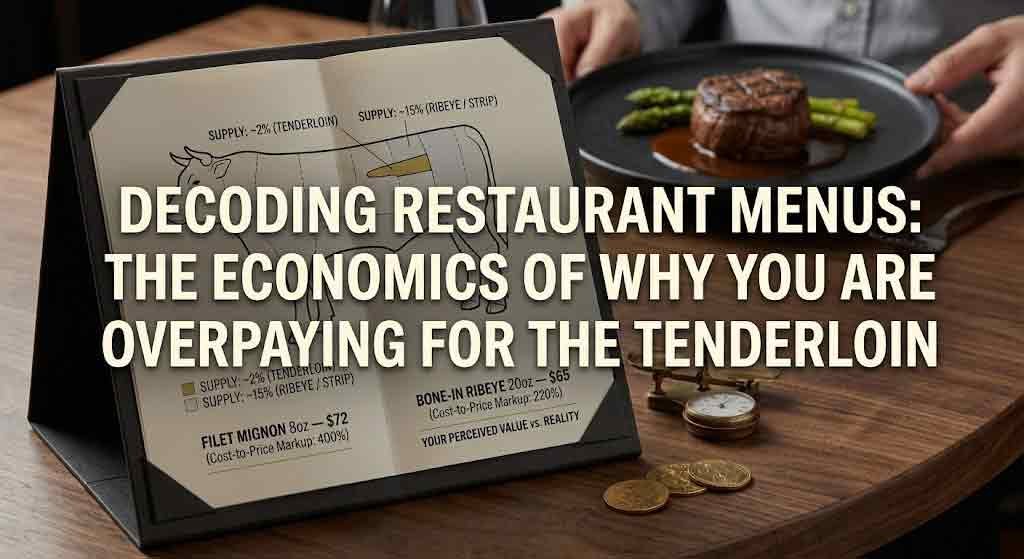
The beef tenderloin — the long, tapered muscle that runs along the spine of a steer — is among the most expensive cuts in the industry for a reason grounded in pure biology. From a 1,200-pound animal, a butcher typically recovers only eight to ten pounds of usable tenderloin. It is a non-weight-bearing muscle, which is why it achieves its signature texture: soft, fine-grained, with almost no connective tissue to break down. What you are paying for, in part, is scarcity by anatomical design.
At the wholesale level, a whole untrimmed USDA Choice beef tenderloin (known in the trade as a PSMO — peeled, side muscle on) was running in the range of $20 to $28 per pound through 2024 and into 2025, according to market tracking data from the USDA Agricultural Marketing Service. USDA Prime commands a premium of 25 to 40 percent over Choice. Pre-cut filet mignon steaks — already trimmed of silverskin, chain muscle, and excess fat — run from $30 to over $60 per pound at retail, with specialty butchers and fine grocer counters on the higher end.
Now consider the restaurant math. A standard 8-ounce filet mignon portion, pulled from a trimmed tenderloin that cost the restaurant approximately $28 to $35 per pound at the wholesale level, represents a raw protein cost of roughly $14 to $17 per plate. Add the Q factor — industry shorthand for condiments, garnishes, plating elements, bread, butter, and the inevitable sprig of something green — and a well-costed culinary school would place total ingredient cost for the plate somewhere between $17 and $21. At the industry-standard food cost target of 28 to 35 percent, that produces a menu price somewhere in the neighborhood of $48 to $75. And at fine dining establishments in metropolitan markets, that number climbs higher still (The Culinary Pro, 2024; mrgn.ai, 2025).
What you’re paying for beyond the ingredient cost is everything the ingredient doesn’t include.
The True Cost Hidden in the Price
Twenty-five years of operating a restaurant teaches you something that culinary school does not: the ingredient is almost never the expensive part. Labor is. Overhead is. The mortgage or lease on the dining room, the line cooks’ wages, the health insurance, the hood cleaning contractor, the POS system subscription, the linen service, the liability insurance — these costs are distributed, plate by plate, across every entrée that leaves the kitchen.
According to the National Restaurant Association, the average full-service restaurant in the United States operates on a net profit margin of 3 to 5 percent (Peppr POS, 2025). That means for every dollar you spend on a $65 filet mignon, less than four cents is profit for the house. The remainder is consumed by labor (typically 30 to 35 percent of revenue), overhead and occupancy (another 25 to 30 percent), and food cost. When critics complain that restaurant food is “overpriced,” they are measuring the plate against the raw ingredient and ignoring the entire ecosystem that surrounds it. The tenderloin on your plate represents the work of a purchasing manager who negotiated the protein price, a butcher who broke down a whole loin, a sous chef who portioned and seasoned it, a line cook who cooked it, a server who presented it, and a dishwasher who cleans what it left behind.
The markup is not exploitation. It is the cost of civilization.
Menu Engineering: The Architecture of Perception
Here is where the conversation moves from economics into psychology — and where it gets genuinely interesting.
Menu engineering is a formal discipline developed in the early 1980s by researchers at the Michigan State School of Hospitality, and it has never been more sophisticated than it is today. The core framework classifies every item on a menu along two axes: profitability and popularity. The resulting matrix produces four categories: Stars (high profit, high sales), Plow Horses (high sales, low profit), Puzzles (high profit, low sales), and Dogs (low profit, low sales). The entire design of a modern menu — its typography, photography, layout, and pricing architecture — is engineered to drive guests toward the Stars and away from the Dogs (NetSuite, 2025; Baker Tilly, 2025).
The tenderloin, in this framework, frequently functions as neither a Star nor a primary profit driver. It is often something more strategically valuable: an anchor.
Price anchoring is the practice of placing a high-cost item at the top of a category — or prominently in the “golden triangle” of the menu (center, top-right, top-left) — not necessarily to sell it in high volume, but to recalibrate the diner’s sense of what is reasonable. Once a guest has registered a $95 dry-aged Wagyu tenderloin, the $62 Prime filet below it feels comparatively modest. The $44 sirloin beneath that feels like restraint. The psychological manipulation is not subtle once you see it, but it is extraordinarily effective. Research cited by Restaurants USA found that a reengineered menu can improve restaurant profits by 2 to 10 percent — translating to as much as $100,000 annually for a restaurant doing $1 million in revenue (Burger Cravings / Kasavana & Smith, 2024).
The absence of dollar signs on upscale menus is deliberate. Studies consistently show that presenting prices without currency symbols reduces the psychological friction of spending. The difference between reading “$65” and “65” is measurable in ordering behavior — guests spend more when the symbol is removed. This is not folklore. It is documented consumer psychology deployed at scale, in every fine dining room in the country.
The Tenderloin vs. The Better Cut
There is a culinary argument that runs against the economics entirely, and it deserves to be made plainly: the filet mignon, for all its prestige and price, is not the most flavorful cut on the steer. It is the most tender. These are not the same thing.
Flavor in beef comes from fat — specifically from intramuscular fat, or marbling, and from the intermuscular connective tissue that renders during long, high-heat cooking. The tenderloin’s legendary texture comes precisely from its lack of work, its lack of fat, its lack of connective tissue. What you are paying a premium price for is the absence of the very things that create depth of flavor. A well-sourced ribeye, with its generous marbling and fat cap, delivers a more complex, more unctuous eating experience at a meaningfully lower price point — both on the menu and in the kitchen.
The ribeye is the working cut’s reward. The tenderloin is status signaling dressed as cuisine.
That is not a condemnation. Status signaling has a legitimate place in the human experience. There is something to be said for the ritual of ordering the most expensive, most delicate thing on the menu — for the occasion it marks, for what it communicates to a companion across the table. But the informed diner should understand what they are buying. They are buying scarcity, texture, and perception. They are not necessarily buying the best bite on the animal.
What the Restaurant Doesn’t Want You to Know About Food Cost Ratios
The economics of a restaurant menu are not uniform. Pasta costs the kitchen approximately 15 to 20 percent of its menu price. Pizza is in the same range. A plate of fried calamari or a basket of bread that arrives complimentary at your table represents some of the highest margin items in the building. The tenderloin, by contrast, can run food costs above 40 percent when wholesale protein prices spike — and in the current market, they have been spiking. The USDA reported that meat and veal prices jumped 7.7 percent between January 2023 and January 2024, and the trend has persisted (Toast, 2024).
This is why a menu is, at its core, a portfolio. A sophisticated operator doesn’t need every entrée to carry equal margin. A $7 bowl of pasta at 18 percent food cost subsidizes a $65 filet mignon running at 38 percent. The cocktail program, with its 20 percent food cost and high ticket prices, is often the most profitable revenue center in the building. The tenderloin sells the room. The cocktail pays the rent.
This dynamic is also why restaurant groups obsess over what is called the menu mix — the distribution of orders across categories. A steakhouse that sells too many filets on a high-wholesale-cost week can see its margins collapse. This is why 47 percent of restaurants raised menu prices in 2024, and why the most successful operators did so through tiered, strategic adjustments rather than across-the-board increases (Peppr POS, 2025).
Trim Loss and the True Cost of a Pound
There is one more layer of cost that rarely surfaces in any consumer-facing conversation about restaurant pricing, and it is the one that most radically changes the arithmetic: trim loss.
A whole PSMO tenderloin — purchased intact, with silverskin, chain muscle, and butt cap attached — loses 20 to 30 percent of its weight through butchering before a single portion is plated. If a restaurant purchases a seven-pound tenderloin at $28 per pound (a total cost of $196), and the working butcher recovers 5.2 pounds of usable product after trimming, the effective cost per pound of that usable beef climbs to roughly $37.70. This is before the cook’s time, before the shrinkage from searing, before the waste of the occasional overcooked return.
That $65 filet mignon is built on a foundation of math that most guests, sitting in a well-lit dining room with a glass of Cabernet, have no reason to examine. But the numbers are honest. They hold up. What they reveal is not a system designed to gouge diners — it is a system designed to survive, in an industry where survival is never guaranteed and four cents on the dollar is considered a good year.
The Informed Guest Has More Fun
None of this is a brief against the tenderloin. It is a brief for understanding what you’re eating and what you’re paying for — because that understanding changes the experience. When you order a $65 filet mignon, you are not overpaying for protein. You are paying for the scarcity of the cut, the labor of its fabrication, the engineering of the room around you, the training of the hands that cooked it, and the architecture of a pricing system sophisticated enough to make it all feel effortless. That is, on balance, worth the price.
But if you want the best bite of beef in the building, order the ribeye. And if you want to understand why the tenderloin is at the top of the menu, look at the table around you, not the plate in front of you.
Sources
- The Culinary Pro. (2024). Calculating Food Cost. https://www.theculinarypro.com/calculating-food-cost
- mrgn.ai. (2025). The Real Cost of That Steak: How to Price Your Dishes for Maximum Profit. https://mrgn.ai/the-real-cost-of-that-steak-how-to-price-your-dishes-for-maximum-profit/
- USDA Agricultural Marketing Service. (2024). National Retail Report – Beef. https://www.ams.usda.gov/mnreports/lswbfrtl.pdf
- Toast. (2024). How to Price Meat: How Much to Charge for Meat Menu Items. https://pos.toasttab.com/blog/on-the-line/how-to-price-meat
- Peppr POS. (2025). Restaurant Profit Margin Guide: 2025 Benchmarks & Strategies. https://www.peppr.com/blog/restaurant-profit-margin-guide-benchmarks-strategies
- NetSuite. (2025). Menu Engineering: Strategies for Creating a Profitable Restaurant Menu. https://www.netsuite.com/portal/resource/articles/business-strategy/menu-engineering-your-way-to-restaurant-profitability.shtml
- Baker Tilly. (2025). How to Use Menu Engineering and Design to Craft a Profitable Menu. https://www.bakertilly.com/insights/menu-engineering
- Kasavana, M. L., & Smith, D. L. (referenced in Burger Cravings, 2024). Menu Engineering (3rd ed.). Hospitality Publications.
- Eat Healthy 365. (2025). Your 2025 Guide to Beef Tenderloin Roast Prices. https://eathealthy365.com/your-2025-guide-to-beef-tenderloin-roast-prices/
- Margin Edge. (2024). Restaurant Plate and Menu Costing 101. https://www.marginedge.com/blog/restaurant-plate-and-menu-costing-101