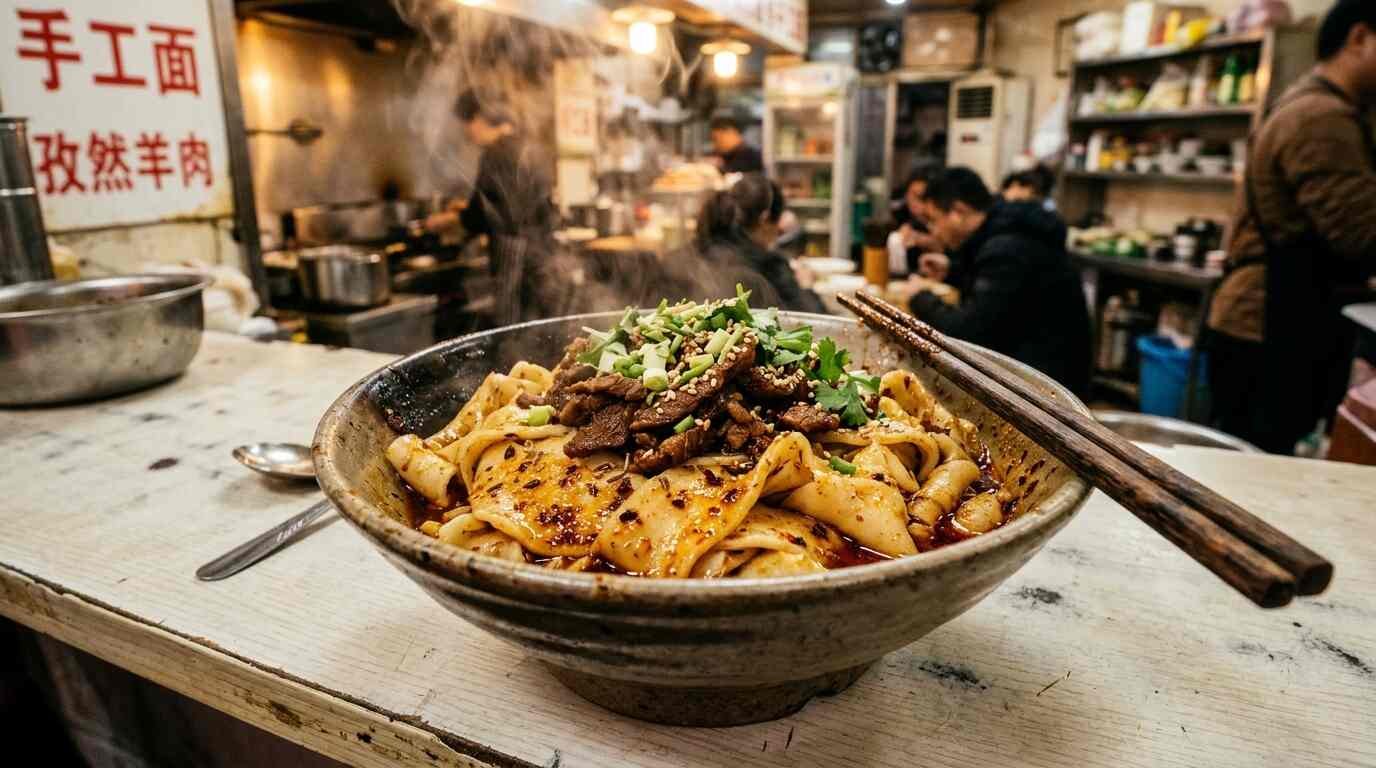
In the basement of the Golden Shopping Mall on Main Street, sometime late in 2005, a bubble tea shop stopped pretending to be a bubble tea shop. The side dishes had been outselling the drinks. So the family running it moved into a stall downstairs, renamed the operation Xi’an Famous Foods, and started selling hand-ripped noodles, liang pi cold-skin noodles, and cumin lamb sandwiches to people who already knew what those things were.
Manhattan would not get a location until 2010. Five years — a full presidential term — separates the founding of what became one of the most recognizable Chinese restaurant names in the city from the moment it appeared below the East River. That gap is not an anomaly. It is the pattern.
Two Migrations, Two Different Menus
The reason Flushing and Manhattan’s Chinatown taste different is not aesthetic. It is demographic history, and the timeline is documented.
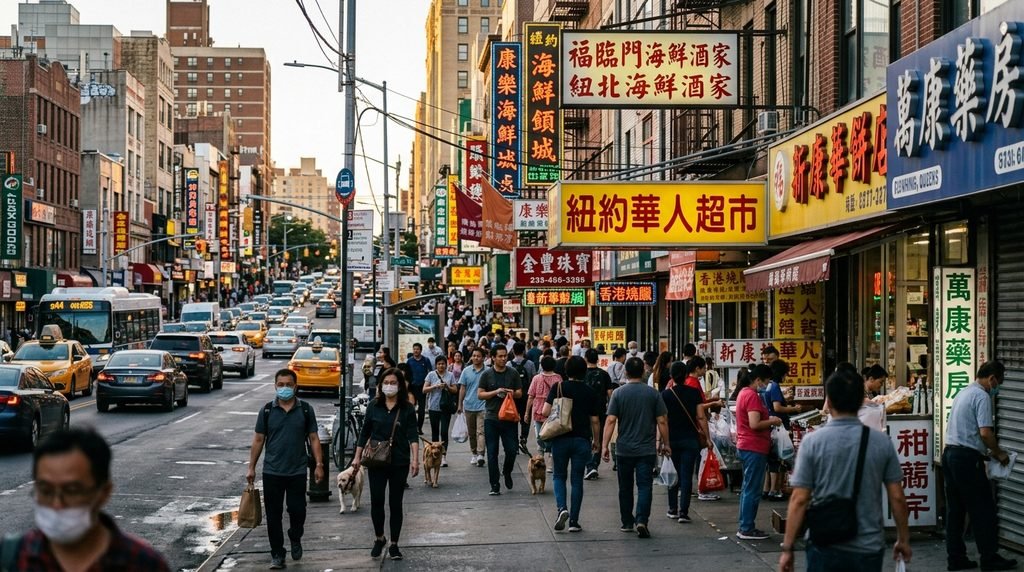
Manhattan’s Chinatown was built by an earlier wave. Chinese sailors began settling in lower Manhattan around the 1830s; hand laundries and restaurants followed; the community that consolidated there came overwhelmingly from Taishan and other parts of Guangdong Province. Cantonese and Taishanese cooking became the default because those were the kitchens that arrived. Chinese Exclusion, passed in 1882, then froze the composition of that community in place for more than eighty years.
The Immigration Act of 1965 reopened the door, and the people who came through it were not the same people. Queens College researchers documenting the two communities found that most Chinese residents of Flushing arrived from Taiwan after 1965, a group that included mainlanders who had gone to Taiwan after 1949. Later arrivals came from Sichuan, Shandong, Henan, Hunan, Dongbei, and beyond.
Flushing became Mandarin-dominant while Manhattan stayed Cantonese and Taishanese, and Sunset Park later developed as a largely Fuzhounese neighborhood. Three Chinatowns, three languages of daily life, three distinct sets of regional kitchens. Anyone treating “Chinese food in New York” as a single category is describing something that does not exist.
The growth curve is stark on its own. The 1980 census counted about 39,500 Chinese residents in all of Queens. By 1986 the Flushing Chinese Business Association was estimating roughly 60,000 in Flushing alone.
Rent as a Curatorial Force
Regional specificity is expensive to sustain and cheap to start.
A restaurant serving one province’s cooking — properly, without translation for outsiders — needs a customer base that already recognizes the food. In a neighborhood where that base exists and rents are low, the math works at small scale. A stall in a mall basement can survive on people who grew up eating exactly what it sells. It does not need to explain itself, hire a publicist, or dilute a menu to broaden appeal.
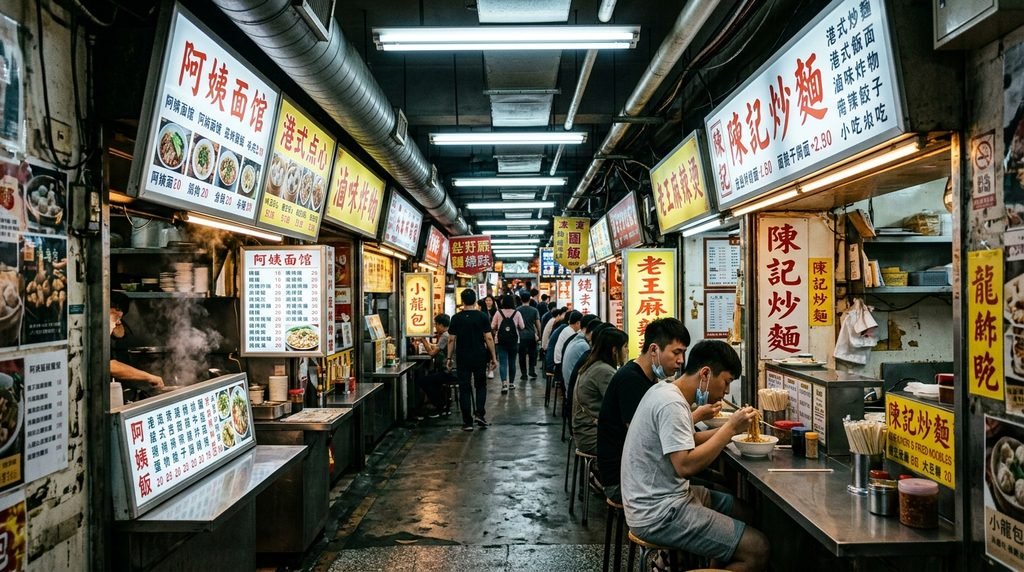
That is why the Golden Mall produced what it produced. Bone marrow soup, Wenzhounese snails, regional preparations from Tianjin to Sichuan, sold from adjacent stalls in a maze-like corridor that no casual passerby would voluntarily enter.
Manhattan’s Chinatown operates on a different property structure — generational ownership, slower turnover, a permanent tourist circuit — which stabilizes the businesses that exist there but slows the rate at which new regional kitchens can appear. Flushing’s higher churn was, for two decades, a feature.
That advantage is eroding. The Resy guide to Flushing Chinatown, assembled with people who eat there regularly, describes rising rents and development transforming the neighborhood from a working- and middle-class Chinatown into a dining destination with real swagger, where dollar-something duck buns now sit across the street from rooms where dinner clears fifty dollars a head. Both things are now true at once.
Why Long Island Points West
The connection between Long Island’s Chinese dining and Flushing is not a metaphor. It is a rail line.
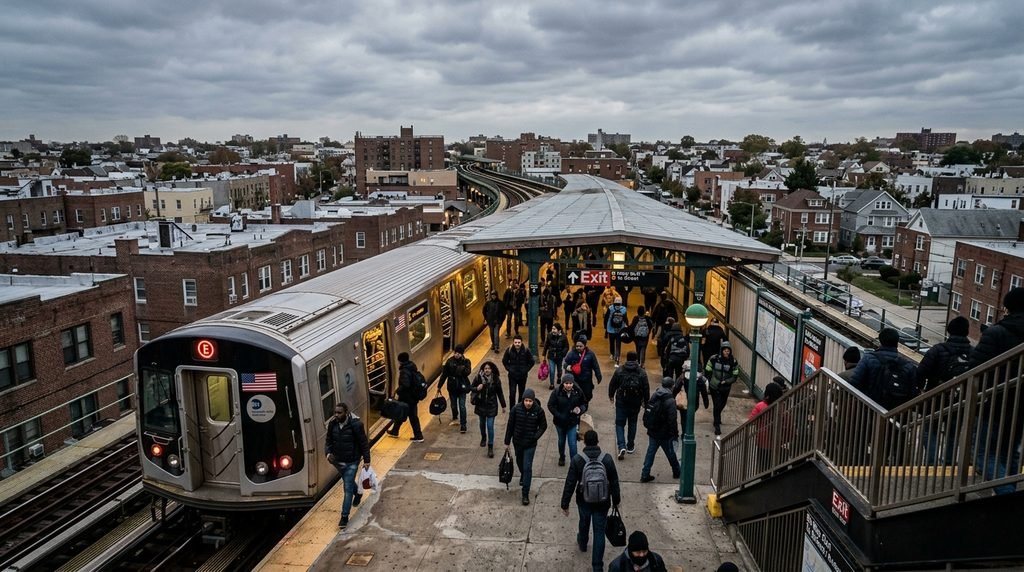
Flushing–Main Street sits on the Long Island Rail Road’s Port Washington Branch, which means a substantial portion of Nassau and western Suffolk can reach the largest Chinatown in New York City without transferring. For Long Island families sourcing ingredients, celebrating holidays, or simply eating well, Flushing is not a borough trip. It is the closest full-scale option.
The population data underneath that traffic is real. The Asian American Federation’s analysis of 2020 Census figures found that several towns in Nassau County posted among the highest numeric increases in Asian population of any locality in New York State, with North Hempstead approaching one-quarter Asian residents. USAFacts places Nassau’s non-Hispanic Asian share at roughly 13.9 percent as of 2024, well above the national figure.
Long Island restaurants do exist and do good work — I’ve written about a Chinese kitchen in Selden among others, and the broader regional scene keeps deepening, as the North Shore’s Korean rooms demonstrate. But the depth of regional Chinese cooking available within a forty-minute train ride is not replicated anywhere on the Island, and any honest guide to eating Chinese food out here has to say so.
The Guides Caught Up Late
For most of the period in which Flushing was doing the interesting work, the critical apparatus was pointed elsewhere.
Coverage existed — city guides, blog posts, the occasional feature — but the institutional attention that confers legitimacy arrived slowly. Xi’an Famous Foods became nationally famous only after its Manhattan expansion, and the story that stuck was the East Village story, not the mall-basement story. The pattern repeats: a regional kitchen establishes itself in Queens, survives on its own community for years, and gets discovered when a version of it opens somewhere with more foot traffic from the people who write about restaurants.
That has shifted. The Michelin Guide now carries Flushing addresses on their merits — Jiang Nan on 39th Avenue holds a Bib Gourmand, and DaXi Sichuan on the second floor of the New World Mall gets written up for a restrained approach to Sichuan cooking rather than a merely punishing one. The MTA publishes its own Flushing dining guide. The neighborhood is no longer a secret in any meaningful sense.
The lag still cost something, though.
What the Lag Actually Costs
A fifteen-year delay in critical attention is not a neutral event. It changes which restaurants survive.
Coverage drives traffic, traffic drives revenue, and revenue determines which rooms make it through a bad winter or a rent increase. Kitchens that closed in Flushing between 2005 and 2015 without ever being written about were not less good than the ones celebrated in Manhattan a decade later. They were less visible to the people whose visibility mattered.
It also distorts the record. When a cuisine’s arrival is dated to its Manhattan appearance rather than its actual appearance, the resulting history credits the wrong neighborhood, the wrong decade, and frequently the wrong people. Immigrant food economies get described as trends rather than as what they are — supply chains and labor systems that predate the interest in them, often by generations.
There is a counter-argument worth stating. Manhattan’s Chinatown was not standing still during these years; Fujianese and Henanese arrivals reshaped it from the 1980s onward, and the East Village has run a genuine Shanghainese pocket since roughly the same period. Regional cooking did not skip Manhattan. It simply did not concentrate there the way it concentrated in Queens, and the difference in density is what the geographic argument turns on.
The practical version is simpler than the historiographic one. If you want dim sum, Manhattan’s Chinatown has a deep and legitimate claim. If you want one neighborhood where the cooking of a dozen Chinese provinces is available within a few blocks of one subway terminal, there is one correct answer, and it has been the correct answer for twenty years.
The 7 train ends there. So does the argument.
You Might Also Like
- Trattoria L’incontro — 21-76 31st Street, Astoria, Queens
- Súp Vietnamese Phở & Grill — 1113 Route 25A, Stony Brook, NY 11790
- The Complete Guide to Dining on Long Island’s North Shore — From Diners to Fine Dining
Sources
- Chinese in Chinatown and Flushing — Asian/American Center, Queens College, CUNY
- Xi’an Famous Foods — company history
- The Golden Shopping Mall in Queens — Atlas Obscura
- The Resy Guide to Flushing Chinatown, By Those Who Love It Best — Resy
- A Guide to Dining Out in NYC’s Biggest Chinatown: Flushing, Queens — MTA Away
- Jiang Nan — MICHELIN Guide
- State of Change: Asian Populations Transform New York — Asian American Federation
- Nassau County, NY population and demographics — USAFacts
- NYC Micro Neighborhoods: Asian Food and Culture in Flushing, Queens — Untapped New York