Wagyu has become the most misunderstood word on a restaurant menu. It appears on everything from $12 smash burgers at fast-casual chains to $180-an-ounce slices of Japanese A5 served at omakase counters in Manhattan — and the distance between those two products is as vast as the Atlantic Ocean. The confusion is not accidental. It is the natural result of a grading system that most American diners have never been properly introduced to, a crossbreeding landscape that creates enormous variation in genetics and quality, and a marketing culture that exploits the prestige of a Japanese word without honoring its meaning.
What follows is a clear-eyed breakdown of how Wagyu is actually graded, what the numbers mean, how crossbreeding affects the eating experience, and how to decode what is in front of you before you order or buy.
What Wagyu Actually Is — and Where It Comes From
Wagyu is not a cut of beef. It is a breed of cattle. The word itself translates from Japanese as “Japanese cow” — wa (Japanese) + gyu (cow) — and refers to four distinct Japanese cattle breeds: Japanese Black (Kuroge Washu), Japanese Brown (Akage Washu), Japanese Shorthorn (Nihon Tankaku), and Japanese Polled (Mukaku Washu). Of these, Japanese Black accounts for the overwhelming majority of premium Wagyu beef, and its most celebrated sub-bloodline is the Tajima strain, which forms the genetic foundation of authentic Kobe beef.
What makes these cattle extraordinary is their unusually high capacity for intramuscular fat — the fine, evenly dispersed fat woven within the muscle fiber itself, rather than layered on the outside like conventional beef. That intramuscular fat is not only abundant in Wagyu; it is chemically different. It is rich in oleic acid, the same monounsaturated omega-9 fatty acid found in olive oil, which is associated with reduced cholesterol and gives the fat a lower melting point. This is why high-grade Wagyu begins to dissolve the moment it touches your tongue. It is biology, not mysticism.
Between 1976 and 1997, a small number of Wagyu cattle were exported from Japan to the United States — approximately four bulls initially in 1976 and fewer than 200 animals total by 1997. In that year, Japan declared Wagyu cattle a national treasure and banned further exports. Every Fullblood Wagyu animal raised in America today traces its lineage back to that small, finite genetic pool.
The Japanese Grading System: Yield, Quality, and the BMS Scale
Understanding Wagyu quality begins with the Japanese Meat Grading Association (JMGA) and the two-part grading system it administers. Every certified Japanese Wagyu carcass receives two scores that are combined into a single designation — the most famous of which is A5.
Yield Grade is the letter portion of the grade (A, B, or C) and measures how much usable meat can be extracted from the carcass. Grade A represents the highest yield — above 72% usable meat — and is the designation associated with premium Wagyu. Grade C falls below 69%. Most discussions of A5 Wagyu focus entirely on the quality side of the equation and gloss over the yield grade, but it matters: a carcass can have extraordinary marbling and still receive a lower letter grade if the usable meat ratio is poor.
Quality Grade is the number portion (1 through 5, with 5 being the highest) and is determined by evaluating four distinct criteria: marbling, meat color and brightness, firmness and texture, and fat color and quality. The final quality number is determined by whichever of the four criteria scores the lowest — meaning a carcass with spectacular marbling but substandard fat color cannot receive a 5.
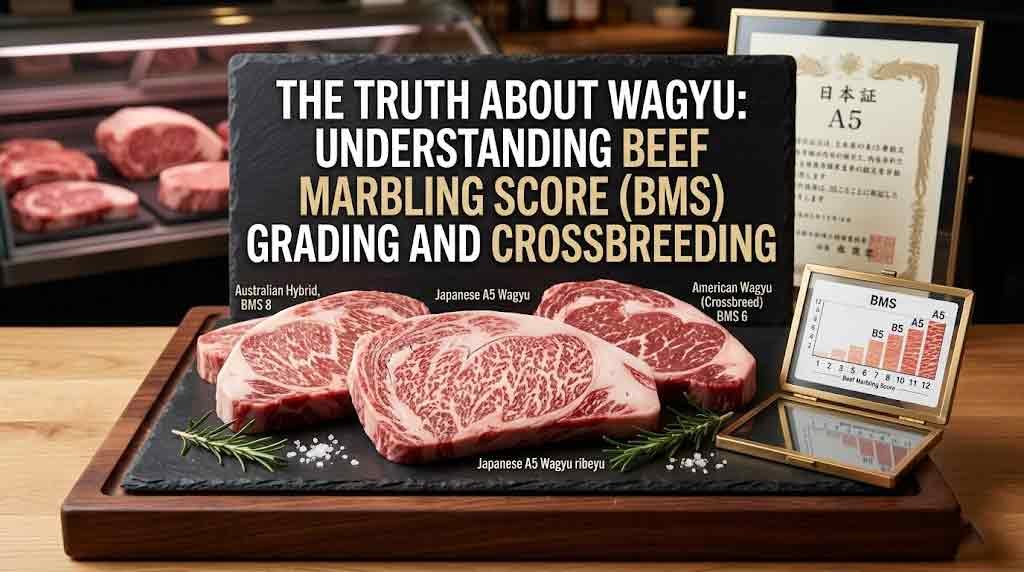
This is where the Beef Marbling Score (BMS) enters the picture. BMS is the sub-scale used to evaluate marbling specifically. It runs from 1 to 12. Trained graders examine the ribeye muscle between the 6th and 7th rib, assessing both the quantity of intramuscular fat and the evenness of its distribution across the muscle cross-section. The higher the BMS, the more visually striking and texturally luxurious the beef.
Here is how the BMS tiers map to the eating experience:
BMS 1–3: Minimal to light marbling. Lean and relatively firm. Closer in character to high-quality conventional beef than to the Wagyu experience most people are seeking. Rarely encountered in the premium Wagyu market.
BMS 4–6: Moderate to good marbling. Noticeably more tender and flavorful than USDA Prime (which tops out around BMS 5–6 at its peak). This is where American Wagyu and high-quality crossbred product typically lands — a genuine upgrade over the standard steakhouse experience, though not yet in the territory of the extraordinary.
BMS 7–9: High marbling with a rich, buttery mouthfeel and intramuscular fat content approaching 40–44%. This is where the Wagyu character becomes unmistakable — a lush, complex flavor and a texture that yields far more easily than any conventional beef.
BMS 10–12: Ultra-premium territory. The fat distribution in a BMS 12 cut is so dense that the beef appears almost white, with crimson-red lean visible within a latticework of ivory fat. Intramuscular fat content at this level can exceed 50–60%. Reserved for the finest Japanese Wagyu from celebrated regions like Matsusaka, Kobe, and Ohmi. Only approximately 3% of all Japanese Wagyu achieves the A5 designation, and the number reaching BMS 10–12 is a fraction of that.
One critical clarification: A5 and BMS are related but not interchangeable. A5 requires a BMS of at least 8 to 9 to qualify, which means an A5 steak can carry a BMS anywhere from 8 to 12. Two cuts both labeled A5 can deliver meaningfully different experiences depending on their specific BMS score. When purchasing high-end Japanese Wagyu, asking for the BMS alongside the grade gives you a more complete picture of what you are actually getting.
How USDA Grades Compare to BMS — and Why American Steak Falls Short
For American diners accustomed to USDA grading, the comparison to BMS is illuminating and a little humbling. The USDA system uses three primary grades for high-quality beef: Select, Choice, and Prime.
USDA Select represents the leanest of the three, with minimal marbling — roughly equivalent to BMS 1–2. USDA Choice, which covers about 75% of all beef sold in American supermarkets and restaurants, falls in the BMS 2–4 range. USDA Prime, the top tier of the American system that you find at high-end steakhouses and which represents only about 5% of domestic beef production, peaks at roughly BMS 5–6.
In other words, the absolute best that the USDA system offers tops out right at the entry level of authentic Japanese A5 Wagyu territory. Japanese Wagyu does not compete with USDA Prime. It begins where USDA Prime ends.
This explains why the first encounter with a genuine BMS 10+ A5 Wagyu slice is so disorienting for people who consider themselves serious steak eaters. The reference points they have built over a lifetime of eating — from backyard grills to Manhattan steakhouses — do not apply.
The Crossbreeding Landscape: F1, F2, Purebred, and Fullblood
Because Japan capped Wagyu exports in 1997, American ranchers have spent the decades since working with a limited genetic foundation, crossbreeding those original Japanese animals with domestic breeds — most commonly Black Angus — to build a commercially viable Wagyu industry.
The result is a spectrum of genetic classifications, each producing a distinct eating experience, and each being marketed with varying degrees of transparency.
Fullblood Wagyu is 100% pure Japanese Wagyu genetics, with documented lineage traceable to Japan through DNA certification. These animals are the offspring of two Fullblood Wagyu parents with no history of crossbreeding. Today, according to the American Wagyu Association, only approximately 5,000 certified 100% Fullblood Wagyu animals exist across the entire United States — out of a national beef herd of 30 million cattle. The product they yield represents the closest American-raised equivalent to what you would find in Japan: extraordinary marbling, the signature melt-in-mouth texture, and the complex umami depth that defines the breed at its peak.
F1 Wagyu is a first-generation cross between a Fullblood Wagyu bull and a conventional cow — most commonly Black Angus, which brings size, growth rate, and a familiar robust beef flavor to the offspring. The F1 generation is 50% Wagyu genetics. It is the most common form of “American Wagyu” on the market and what you will encounter in most restaurants and butcher shops that serve Wagyu without further specification. F1 Wagyu is genuinely superior to conventional beef — more marbled, more tender, with a richer flavor profile than anything in the USDA Prime tier — but it does not deliver the full-spectrum Wagyu experience. It is a meaningful upgrade, not a transformation.
F2 Wagyu results from breeding a Fullblood Wagyu bull back to an F1 cow, producing offspring with 75% Wagyu genetics. F3 (87.5% Wagyu) and F4 (93.75% Wagyu) follow through subsequent backcrossings. At F4, the cattle are classified as Purebred Wagyu — a designation specific to the American and Australian markets, indicating at least 93.75% Wagyu genetics. Purebred Wagyu delivers a richer, more intensely marbled product than F1 and approaches the character of Fullblood, though the full purity of Japanese genetics is absent.
The important takeaway: when a menu or butcher simply says “Wagyu,” it almost certainly means F1 cross. When it says “American Wagyu,” it almost certainly means the same. To know if you are getting Fullblood or Purebred product, you need to ask — and if the answer is vague or evasive, you should treat the product accordingly.
The Kobe Myth and the Question of Regional Certification
No word in the beef world has been more abused than “Kobe.” For years before Japan resumed limited exports to the United States in 2012, “Kobe beef” appeared on American menus as a marketing term attached to domestic Wagyu crossbreeds that bore no actual connection to Kobe. It was, in culinary terms, a fraud dressed as sophistication.
Authentic Kobe beef is not simply a grade — it is a regional designation with strict certification requirements. To qualify as Kobe, the beef must come from Tajima-lineage Kuroge cattle, raised in Hyogo Prefecture, Japan. It must achieve an A4 or A5 quality grade with a BMS of at least 6 (and typically much higher). The animal must be born, raised, and processed in Hyogo. Only approximately 4,000 cattle meet the requirements to be certified as Kobe beef annually worldwide — a number that makes the frequency with which “Kobe” appeared on American menus in the 1990s and 2000s statistically impossible.
Today, certified Kobe beef is imported to the United States in extremely limited quantities — roughly 3,000 kilograms per year spread across a small number of approved restaurants. If you are eating Kobe beef in a casual American restaurant, you are not eating Kobe beef. The appropriate rule of thumb: all Kobe is A5 Japanese Wagyu, but an infinitesimally small fraction of A5 Japanese Wagyu is Kobe.
How to Cook Wagyu Based on BMS Level
Understanding BMS also means understanding that the same cooking technique does not apply equally across the entire spectrum. High marbling fundamentally changes how beef behaves under heat, and using a conventional steak approach on a BMS 12 cut will produce a result that undermines everything the product has to offer.
For BMS 5–8 American Wagyu and crossbred product, high-heat searing in a cast-iron pan or on a well-seasoned grill works beautifully. The fat renders and bastes the meat as it cooks, contributing to a rich, self-basting effect. Internal temperatures in the medium-rare range (130–135°F) are appropriate.
For BMS 9–12 Japanese A5, the conventional American steakhouse approach is the wrong tool. The fat content is so high that the beef cooks with extraordinary speed — a thin slice of A5 in a hot pan may need only 20 to 30 seconds per side. Japanese preparations — yakiniku (tabletop grilling), sukiyaki, shabu-shabu, or thinly sliced teppanyaki — are designed specifically to showcase ultra-marbled beef, typically served in smaller portions where the richness enhances rather than overwhelms. At BMS 12, the beef is so internally lubricated that large portion sizes defeat the experience entirely. A few ounces, treated with restraint, is the correct approach.
Reading Labels, Asking Questions, and Buying with Confidence
The Wagyu market rewards informed buyers and exploits uninformed ones. The following principles can guide any purchase or order:
For Japanese Wagyu: insist on seeing the yield and quality grade together (not just “A5”), and ask for the specific BMS score. A reputable importer or restaurateur will have this information. An evasive answer is informative in itself.
For American Wagyu: ask whether the product is F1 cross, Purebred, or Fullblood. Ask for the intramuscular fat percentage or BMS estimate. Brands like Snake River Farms use proprietary grading systems that provide useful comparative data, though they are not equivalent to official Japanese certification.
For BMS claims on non-Japanese products: treat them as approximations unless accompanied by third-party certification. BMS numbers on Australian Wagyu are generally credible (the AUS-MEAT system tops out at 9+ and correlates closely to the Japanese scale through that range). BMS claims on generic “American Wagyu” without certification documentation should be viewed with skepticism.
The number on the label tells you what to expect. The honesty of the person selling it to you tells you whether that number is real.
Wagyu is one of those rare products where the complexity behind the marketing actually matches — and exceeds — the reality of the eating experience at its finest expression. A BMS 12 slice of Matsusaka or Kobe beef is not a trend or a status symbol. It is the result of generations of Japanese breeding precision, feeding discipline, and a grading system rigorous enough to filter a nation’s entire cattle herd down to 3% of animals worthy of its highest mark. Understanding that system does not diminish the pleasure of eating it. It deepens it — the same way knowing how a piece of English bridle leather is tanned and burnished makes the finished object more meaningful in your hand, not less.
The difference between A5 BMS 12 Wagyu and an F1 “Wagyu burger” at the chain down the street is not a matter of degree. It is a matter of category. And knowing the difference is the beginning of eating well.
Sources:
- Japanese Meat Grading Association (JMGA) — Wagyu grading criteria and BMS scale: https://www.jmga.or.jp
- WagyuAdvisor — Beef Marbling Score explained: https://wagyuadvisor.com/guides/beef-marbling-score
- Second City Prime — Definitive Guide to Wagyu Beef Grades: https://www.secondcityprime.com/blogs/news/the-definitive-guide-to-wagyu-beef-grades-understanding-a5-and-bms-scores
- The Meatery — BMS Score Complete Guide: https://themeatery.com/blogs/main-blog/expert-tips-on-how-to-choose-the-right-beef-marbling-score-bms-for-your-dish
- Carney Wagyu Cattle Ranch — Short Guide to Everything Wagyu: https://carneywagyu.com/about-wagyu
- Lone Mountain Wagyu — Wagyu Classifications in the United States: https://blogs.lonemountainwagyu.com/wagyu-classifications-in-the-united-states
- The Wagyu Shop — Purebred vs. Full-Blood Wagyu: https://wagyushop.com/blogs/news/the-difference-between-purebred-and-full-blood-wagyu
- Meat Dudes — Is All American Wagyu a Cross?: https://themeatdudes.com/wagyu/is-all-american-wagyu-a-cross/
- Texas Monthly — A Glossary of Wagyu Terms: https://www.texasmonthly.com/bbq/wagyu-beef-glossary/
- Steaks and Game — Wagyu Beef Grading and Marble Scores Guide: https://www.steaksandgame.com/wagyu-beef-grading-and-marble-scores-15658