The Meseta is where pilgrims quit. It is also where pilgrims are made. The difference is only a decision, repeated across forty flat kilometers.
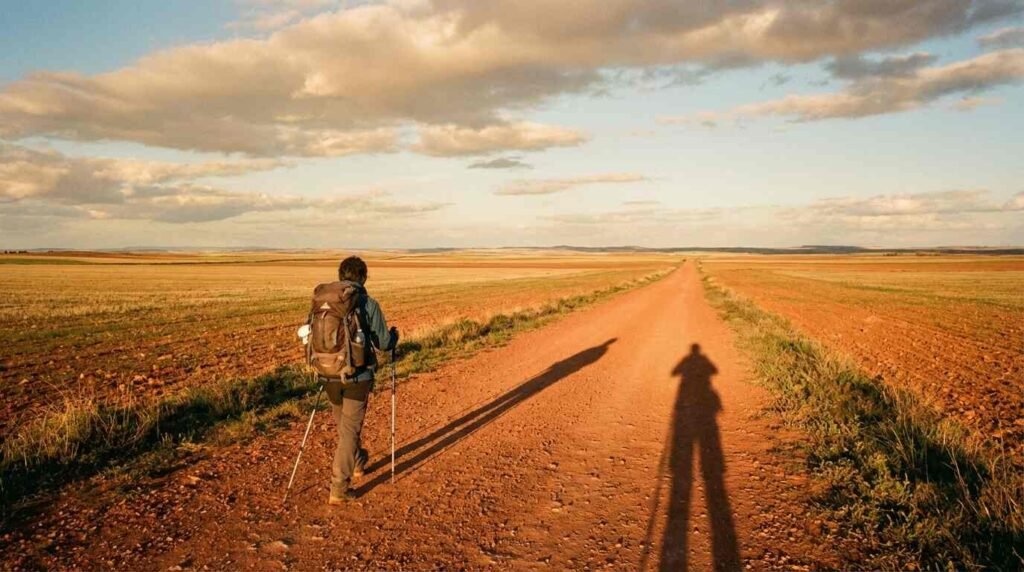
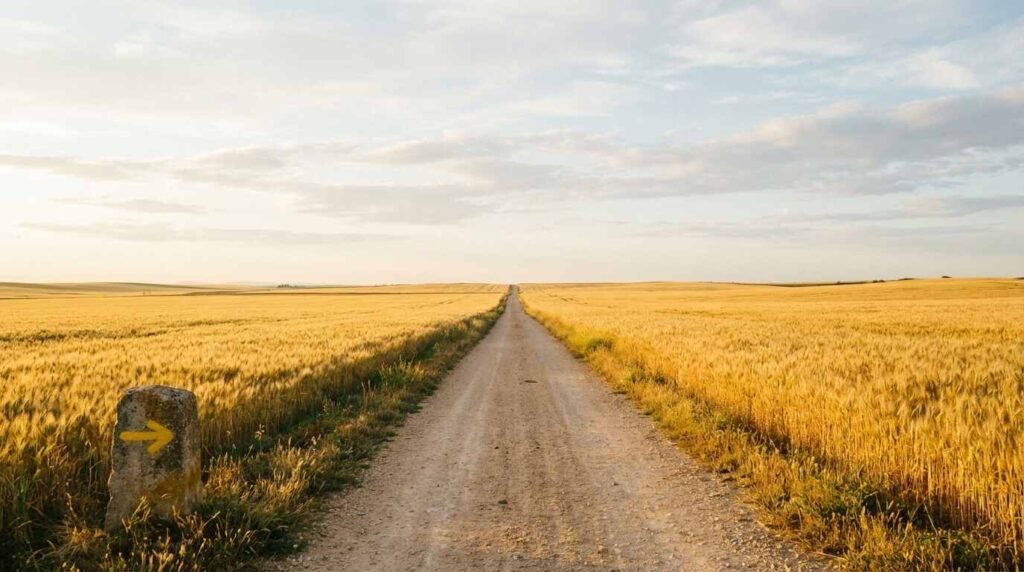
There are things the Camino’s promotional materials do not tell you, and the Meseta is the primary one. The route between Burgos and León — roughly 200 kilometers of the Camino Francés crossing the high plateau of Castile — appears in guidebooks with a kind of euphemistic respect. “Challenging.” “Minimalist.” “An opportunity for inner reflection.” What they mean, and what the landscape communicates without interpretation, is that there is nothing here. Wheat fields. Red earth. A line of yellow arrows pointing forward across a horizon that does not change for days. The sky is larger than the land below it. This ratio — more sky than ground — produces a specific quality of psychological exposure that the mountains, the valleys, and the cathedral towns do not prepare you for.
The Pilgrim’s Office in Santiago de Compostela issued more than 340,000 Compostelas in a recent year. The Confraternity of Saint James, which tracks pilgrimage records and routes, notes that a significant number of pilgrims beginning the Camino Francés choose to take the bus across the Meseta. This is reported without judgment. The Confraternity is not in the business of judgment. Neither, technically, is the Meseta.
But the Meseta is in the business of revealing exactly who you are when the scenery stops performing.
Day One: The Adjustment
The Meseta begins, by most accounts, outside Burgos — though the city’s urban sprawl takes an hour to clear, and the plateau announces itself gradually, the way serious weather announces itself: first as a change in the quality of light, then as a shift in what the wind carries, then as the undeniable fact of the thing itself.
The first day across the plateau is merely uncomfortable. The exposure is real — summer sun on the Meseta has a quality that feels less like warmth than like attention, like being examined by something indifferent to your comfort. The shade trees that the Camino Francés offers in Galicia and Navarre are absent here. A few villages break the route — Hornillos del Camino, Hontanas — small, stone, practical, existing because people needed somewhere to stop in a landscape that otherwise offers no reason to stop. Pilgrims fill the albergues, eat the pilgrim menus, treat each other with the provisional solidarity of people who have temporarily become neighbors by proximity.
Marcus Aurelius, in Book V of the Meditations: “At dawn, when you have trouble getting out of bed, tell yourself: I have to go to work — as a human being.” He was not writing about the Camino, which would not be formalized as a pilgrimage route for another fourteen centuries. He was writing about the fundamental problem of beginning — the gap between knowing what must be done and the body’s preference for not doing it. The Meseta removes every complication from that problem. There is no question about the destination. There is no decision to be made about the route. There is only the fact of the next kilometer, and then the next.
Day Two: The Exposure
By the second day, the social structures of pilgrimage have begun to break down. The groups that formed in Saint-Jean-Pied-de-Port or Pamplona or Burgos separate naturally on the Meseta — pace becomes destiny, and pace varies more than people expect. You walk with whoever walks at your speed, which turns out not to be the people you walked with yesterday.
Sociologist Nancy Frey, whose fieldwork on the Camino produced Pilgrim Stories: On and Off the Road to Santiago, documents this phenomenon with precision. The Meseta functions as a sorting mechanism — not morally, but psychologically. Pilgrims walking for external reasons — for the photograph at the Cruz de Ferro, for the Compostela, for the documentation of the journey — tend to struggle most on the plateau, because the plateau offers none of those things. There is nothing to document. The wheat field in the morning and the wheat field at noon and the wheat field at dusk are the same wheat field.
The pilgrim whose purpose is genuinely interior finds the Meseta tolerable, occasionally clarifying. The plateau has no interest in which category you fall into. It simply continues.
Day Three: What the Body Has to Say
The third day is the one the title promises. It arrives not as insight but as physical recalibration — a morning when the body, which has been negotiating with the terrain and the distance, stops negotiating and simply moves. Pilgrims describe this in different terms. Research published in the Journal of Humanistic Psychology on the Camino as transformative experience documents a common mid-journey shift in which the self-monitoring of early pilgrimage gives way to something more automatic, less effortful.
What the body is teaching, by the third day on the Meseta, is proportion. The problem that felt urgent in Burgos — the blister, the too-heavy pack, the question of whether any of this is being done for the right reasons — has been reduced to its actual size by the landscape’s complete indifference to it. The Meseta is not cruel. It is not therapeutic. It is simply vast and flat and old and entirely unconcerned with anyone’s interior life, which turns out to be the most useful thing anyone could offer a person who has been carrying their own thoughts as the heaviest item in the pack.
Aurelius: “Confine yourself to the present.” On the Meseta, this stops being philosophy and becomes the only available option. The past — whatever was brought to Saint-Jean-Pied-de-Port — does not improve the next kilometer. The future — Santiago, the Compostela, the life resumed afterward — is too far to be useful. What remains is the red earth path, the yellow arrow on the next stone, the specific weight of the body moving forward.
On Shortcuts
The bus across the Meseta costs perhaps fifteen euros. It departs from Burgos and arrives in León in under two hours. Many pilgrims take it. Many of those pilgrims complete the Camino, receive their Compostelas, and report that they do not feel diminished by the choice. Many who walk every kilometer report, also honestly, that the Meseta was the worst part and that they would skip it next time.
The Stoic position on shortcuts is not what people expect. Marcus Aurelius was not an ascetic. He did not suffer for suffering’s sake. He was an emperor who ate simply not because simplicity was virtuous but because simplicity was efficient — it removed a category of distraction. The question he would ask about the Meseta bus is not whether it constitutes cheating, which is a category the universe does not recognize, but what is traded when you take it.
What is traded, specifically, is the discovery that you can endure something purely without reward. The Meseta’s monotony is not incidental to its value — it is its value, if it has any. A landscape offering interest, beauty, stimulation, the ongoing satisfaction of the remarkable, does the work for you. The Meseta requires you to bring your own. If you cannot, it will wait.
What Remains at León
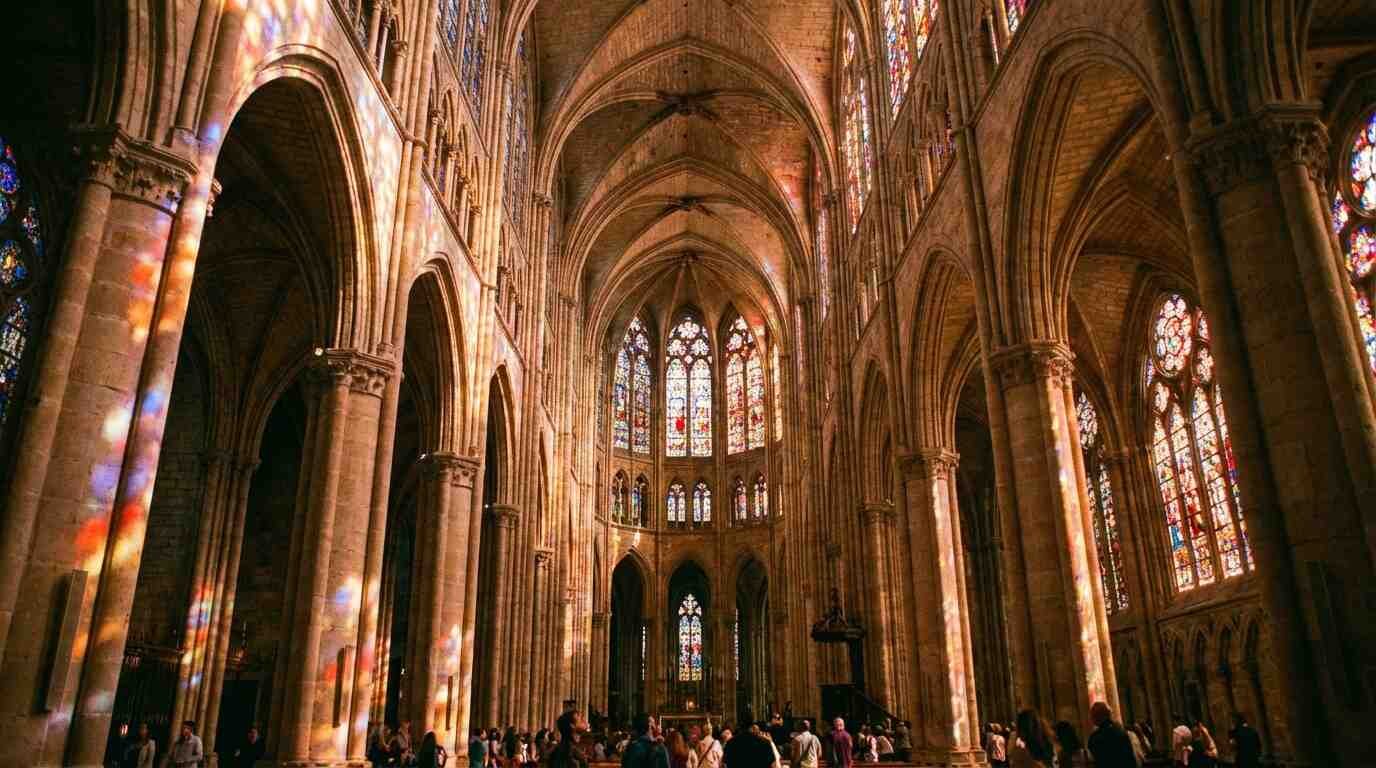
León appears, after the Meseta, with the disproportionate impact that comfort has on a person who has done without it. The Gothic cathedral, with its 1,800 square meters of stained glass — among the finest medieval glass in Europe by any architectural reckoning — is genuinely staggering after days of red earth and wheat. The human capacity to make something that beautiful is not diminished by having walked across a plateau to see it. It is possibly increased.
What the Meseta produces, by the time León arrives, is a residual quality of attention — a capacity to be present with something beautiful that the over-stimulated mind usually cannot quite manage. This is what pilgrimage is actually for, when it works. Not the destination. Not the credential. The discipline of moving through a landscape that offers nothing to consume, which produces, over time, a self capable of something other than consumption.
Aurelius, writing to himself in the camp on the Danube, would have recognized the condition. His Meditations were written in circumstances that offered little external reward — war, administration, illness, grief — and were nevertheless the most useful thing he produced. The Meseta is not the Danube frontier. But the logic is the same: what the barren place gives you is exactly what the comfortable place cannot.
You Might Also Like: The Montreal–Maine–Maritime Loop: A 1,200-Mile Fall Foliage Circuit You Can Drive in Five Days
Sources
- Pilgrim’s Office, Santiago de Compostela: oficinadelperegrino.com
- Confraternity of Saint James: csj.org.uk
- Frey, Nancy Louise. Pilgrim Stories: On and Off the Road to Santiago. University of California Press, 1998.
- Marcus Aurelius. Meditations. (Gregory Hays translation, Modern Library, 2002)
- Journal of Humanistic Psychology — research on the Camino de Santiago as transformative experience
- Moor, Robert. On Trails: An Exploration. Simon & Schuster, 2016.