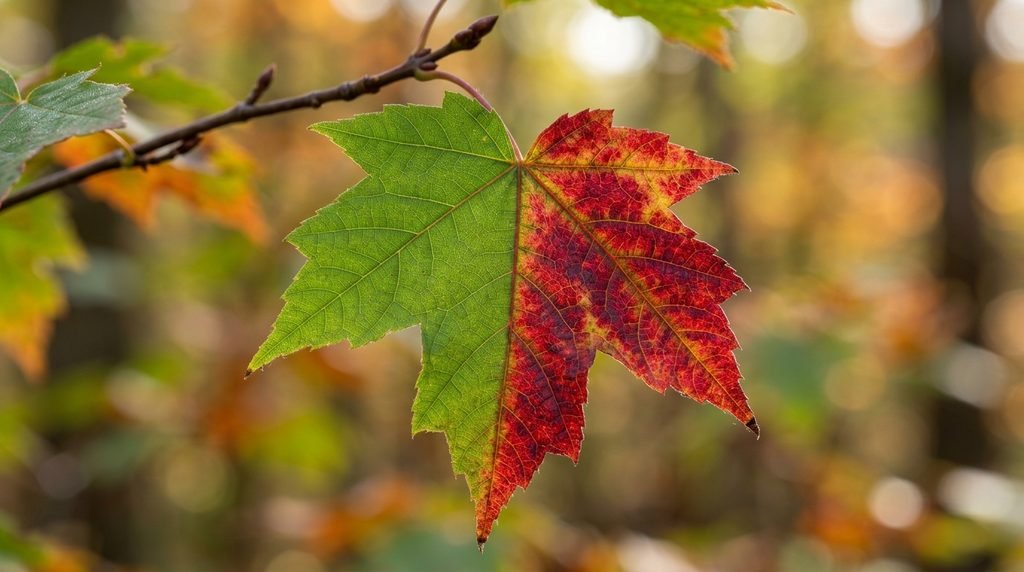
A maple leaf in October isn’t manufacturing red and gold pigment as some final act of seasonal theater. It’s doing the opposite — it’s stopping production of the one pigment that was hiding the colors underneath all along. Chlorophyll, the molecule responsible for photosynthesis and for making leaves look green all summer, is so chemically dominant that it masks every other pigment sitting quietly in the same leaf cells. Shut chlorophyll production down, which is exactly what a tree does as daylight shortens, and the colors that were there the entire time simply become visible for the first time since spring.
Daylight Is the Trigger, Not Temperature
The chemistry notes consistently published by extension services and research institutions point to day length, not cold weather, as the primary signal that starts the process. As nights grow longer relative to days, deciduous trees begin producing a hormone-mediated response at the base of each leaf stem that gradually seals off the vascular connection between leaf and branch — a structure botanists call the abscission layer. That sealing process is what eventually drops the leaf, but it’s also what interrupts the leaf’s supply of water and nutrients from the tree, which in turn starves chlorophyll production and forces the breakdown of what’s already there. Temperature affects the timing and vividness at the margins — a early hard frost can cut a foliage season short, a string of warm sunny days with cool nights can intensify it — but the calendar trigger is light, which is why foliage season arrives on a remarkably consistent schedule year over year despite real swings in weather.
Three Separate Pigment Systems, Doing Three Separate Jobs
What makes autumn foliage color genuinely complicated, rather than just “chlorophyll leaving,” is that a leaf contains several distinct pigment families that have been present and functioning all season, each for a different biological reason, and each becomes visible or forms on a different timeline once chlorophyll stops dominating.
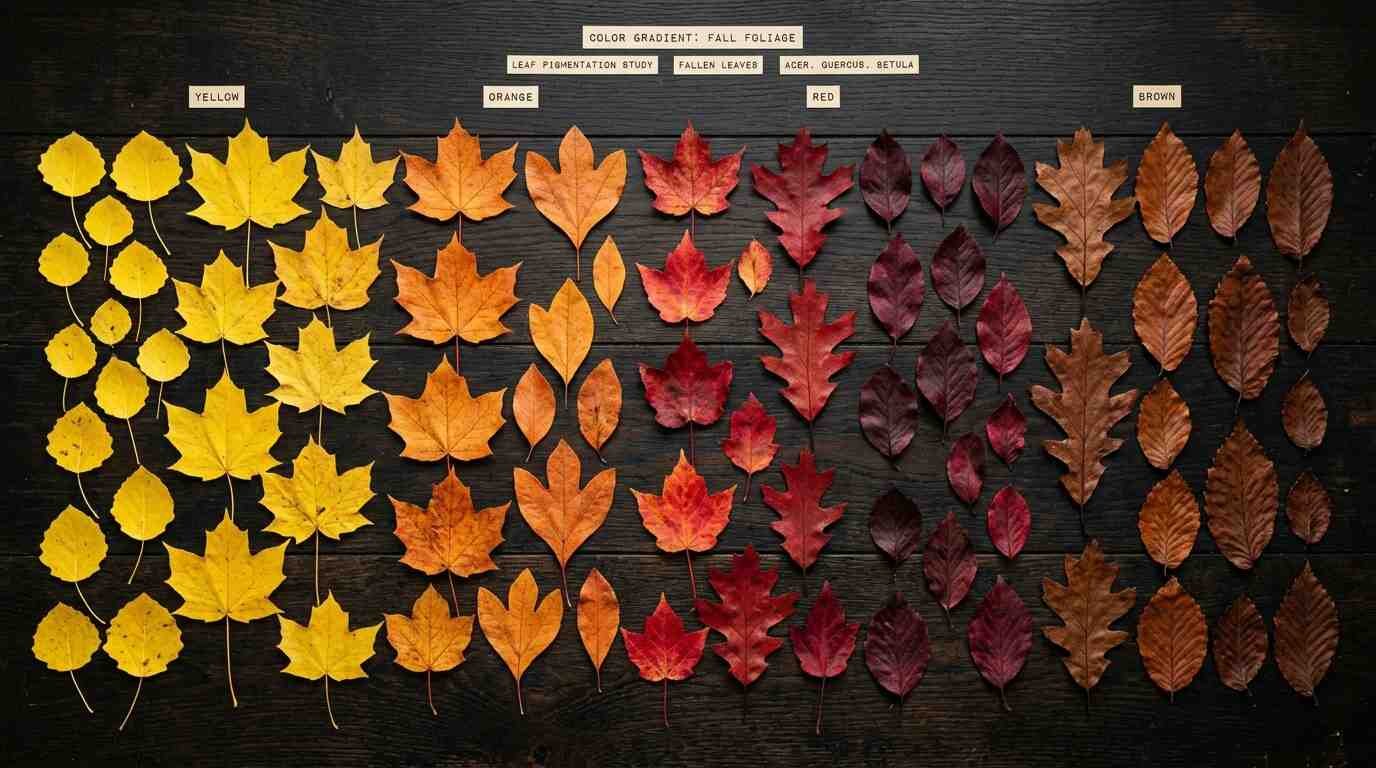
Carotenoids — the same pigment family responsible for the color of carrots and egg yolks — are present in leaves year-round, working alongside chlorophyll to help capture light energy during photosynthesis and to protect the leaf from light damage. They’re simply invisible under the overwhelming green of active chlorophyll. When chlorophyll breaks down, carotenoids are what’s left standing, which is why certain trees — birches, hickories, many poplars — reliably turn yellow and gold rather than red: they’re not producing a new pigment in autumn, they’re revealing one that was there all along, doing a completely different job.
Anthocyanins are the more dramatic case, because unlike carotenoids, many of them are newly manufactured in autumn rather than simply unmasked. Sugars produced during the growing season get trapped in the leaf once the abscission layer starts cutting off transport, and that trapped sugar, combined with bright sunny days and cool — but not freezing — nights, triggers active anthocyanin production as a kind of late-season chemical event. This is the pigment family behind the reds, crimsons, and purples in maples, sumacs, and oaks, and it explains why the most vivid red foliage seasons tend to follow a specific weather pattern: warm, sunny autumn days that keep photosynthesis and sugar production running, paired with cool nights that slow the sugar’s escape from the leaf. A rainy, overcast, warm autumn produces a duller season for exactly this reason — the sugar-trapping conditions anthocyanin production depends on simply don’t occur as reliably.
Tannins, the third major pigment group, are what’s left after both chlorophyll and the more colorful pigments have broken down, and they produce the brown that eventually dominates a leaf’s final stage before it drops. Oak leaves, high in tannin content relative to other species, often skip the vivid red-and-gold middle act that maples get and move more directly toward a muted russet-brown, which is one reason an oak-dominated hillside and a maple-dominated hillside can look like they’re experiencing entirely different seasons at the exact same point on the calendar.
Why Some Years Are Simply Better Than Others
Foliage trackers maintained by state natural resource agencies treat peak color less as a fixed date and more as the output of a specific weather recipe, and the recipe lines up directly with the chemistry described above. The ideal sequence is a growing season with adequate rainfall — drought-stressed trees tend to drop leaves early and dully, without ever producing a strong color event — followed by a string of clear, sunny autumn days and crisp, cool nights that stay above freezing. A hard freeze arriving too early can damage leaf cells outright and force an abrupt, colorless drop, skipping the color event entirely rather than intensifying it, which is the opposite of the popular assumption that a hard frost “brings out” the best color.
This is also why foliage forecasting is a genuinely difficult prediction problem rather than a simple calendar lookup, and why the same hillside can put on a spectacular show one October and a forgettable one the next, with no change in species, soil, or elevation — only a change in that specific sequence of rainfall, sun, and temperature across the preceding weeks.
The Color Show Is a Byproduct, Not the Point
None of this pigment activity exists for an observer’s benefit, however the postcards frame it. The entire sequence — sealing off the leaf, breaking down chlorophyll, trapping sugar, producing anthocyanins — is a tree’s mechanism for reclaiming nutrients before winter and shedding a structure it can no longer afford to maintain through months of insufficient light and frozen ground. Chlorophyll’s nitrogen and magnesium get resorbed into the tree’s branches and roots before the leaf falls, a recycling process substantial enough that researchers studying forest nutrient cycles treat autumn leaf drop as one of the dominant nitrogen-conservation events in a deciduous forest’s entire annual cycle.
The red and gold is simply what that nutrient-recovery process looks like from the outside, filtered through sunlight, on its way to a leaf that was always going to fall regardless of how it happened to be colored on the way down.