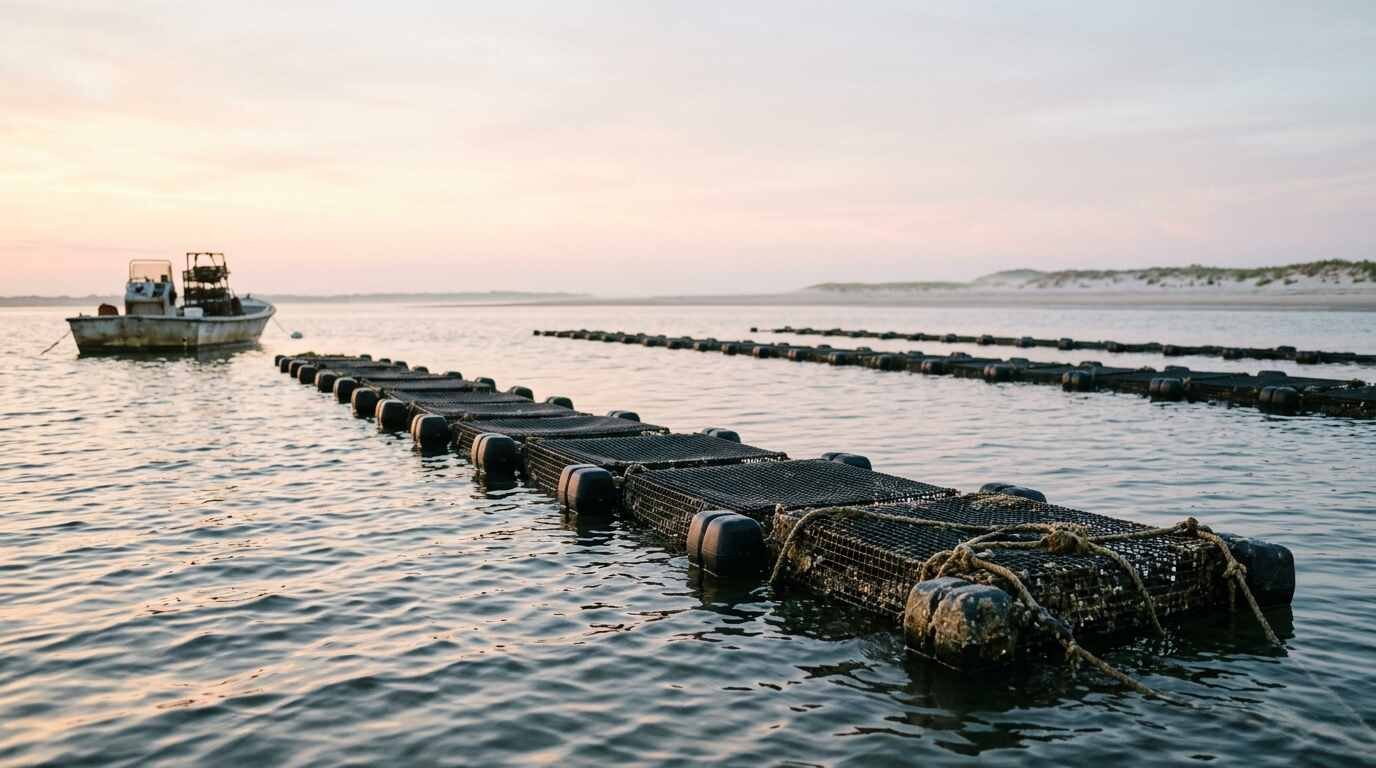
Between two ocean inlets on Long Island’s South Shore, in water only three to six feet deep, floating cages of oysters ride the chop while a former New York Liberty player works the lines. The operation is Violet Cove Oyster Co. in Moriches Bay, owned and run by Sue Wicks, and its oysters go to local restaurants and wholesalers.
Two Inlets, Floating Cages, and a Violet Shell
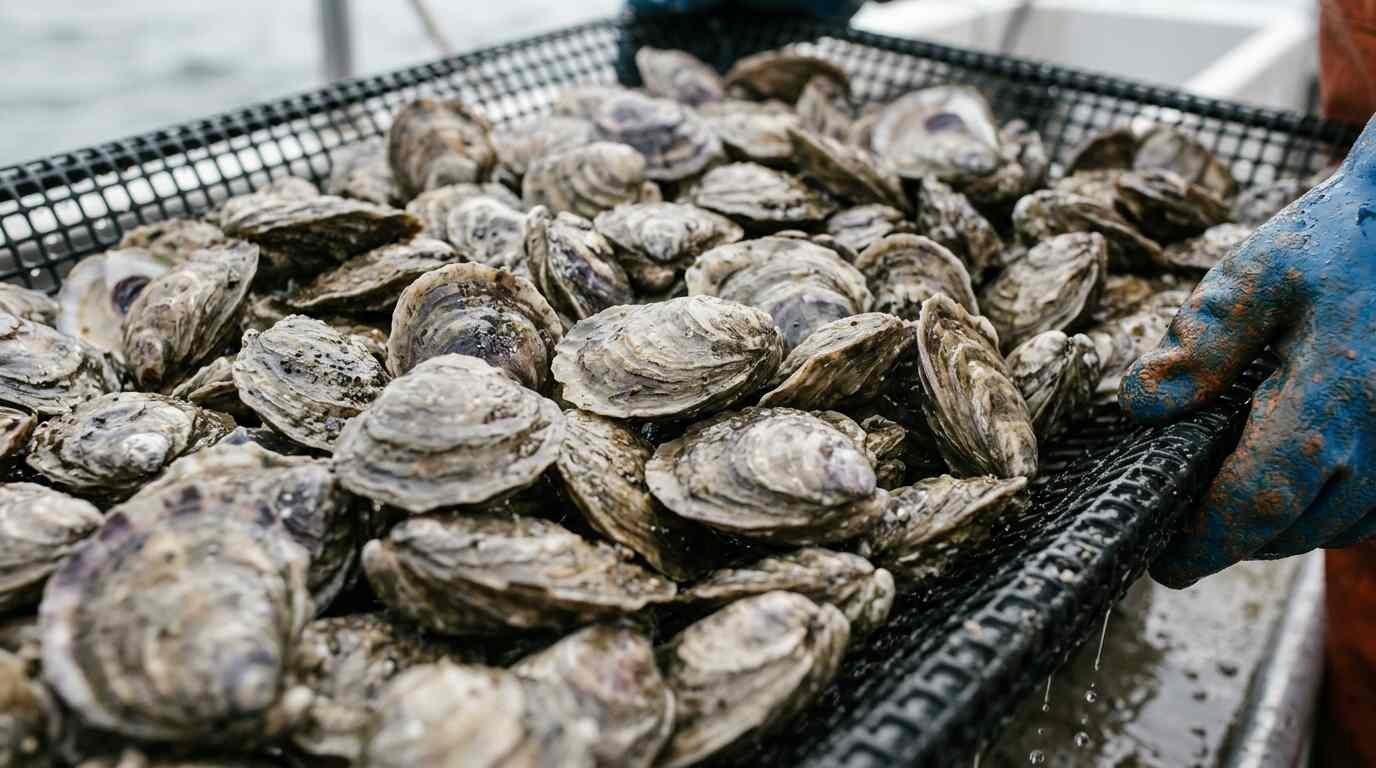
Island Creek Oysters, which has offered the farm’s oysters online in limited runs, describes a two-acre lease between two ocean inlets. Its listing says floating cages let constant wave action shape the shells into a deep cup that holds the liquor, and that summer nutrients tint the shells violet, which is where the name comes from.
Boating magazine’s January 2024 profile places the farm on shallow flats over a sandy bottom, roughly midway between Moriches and Shinnecock inlets. The floating containers tumble the oysters, and the article says that rolling smooths the shell edges and, along with the wave action, builds a larger adductor muscle and more glycogen over winter, which gives a sweeter oyster than the wild kind.
Edible East End added a few details in 2022. Freshwater springs run beneath the farm, December and January bring a sweeter, almond-leaning oyster, and spring ones taste brighter and brinier. “Just like real estate, oyster farming is all about location,” Wicks told the magazine. Northforker reported that oysters in her water reach market size in about five months, against the roughly eighteen months it typically takes elsewhere.
A Bayman’s Daughter Comes Home
Wicks grew up in Center Moriches, and the bay was the family workplace. GreenWave says her father was a lobsterman and bayman, and the Messenger traces her family’s presence on Long Island to 1635. The Mastic Beach Conservancy recalls her father’s boat at the Mastic Beach marina as one of her earliest memories of the area.
Then the shellfish gave out. Brown tides in the 1980s and 1990s, fed by nutrient runoff, devastated shellfish and fish stocks and hurt her father’s livelihood. “I watched my father lose his profession,” she told GreenWave.
Basketball came in between. She starred at Rutgers, played for the Liberty from the WNBA’s inaugural 1997 season, and was later inducted into the Women’s Basketball Hall of Fame. Boating reports that her brother tipped her off to an oyster farm in Center Moriches and that she applied about a year before opening. GO Magazine adds that she had no experience and learned the basics through an internship on another farmer’s operation. An AP feature carried by MPR News in December 2025 notes she started farming at 50.
She told Fox 5 the move felt like coming back around: “It kind of is full circle.” She also has a blunt view of why farms like hers matter. Northforker quotes her saying “the Long Island oyster does not exist any more” in the wild, since the local stock cannot reproduce without farmers and hatcheries.
Counting Oysters
Published numbers on the farm are scattered across a few years of coverage, and each comes with its own context.
| Source and date | What it reports |
|---|---|
| The Nature Conservancy, January 2021 | In a typical spring, about 6,000 oysters a week, mostly to restaurants and bars. In March 2020 that fell to about 500 a week, and she laid off her two employees. By summer 2020, sales were at about half of normal. |
| The Nature Conservancy, January 2021 | The farm sold 20,000 oysters for transplant in Moriches Bay through a restoration program. |
| Fox 5 New York, August 2022 | Thousands of bags of 100-count oysters sold to local restaurants and wholesalers, with work on the water five days a week. |
| Responsible Seafood Advocate, January 2024 | About 500,000 oysters in the current season, up from about 200,000 in her first year, sold mainly to wholesalers and a few restaurants. |
The 2020 episode is the best-documented stretch. When restaurants shut, The Nature Conservancy and the Pew Charitable Trusts launched a program called SOAR, which bought five million unsold oysters from farmers in seven states and placed them on wild reefs. More than three dozen New York farmers took part. Wicks told The Nature Conservancy that the sale brought real peace of mind and covered her workers’ pay and her boat for the next four months.
I think what makes you an oyster farmer is radical optimism.
Sue Wicks, quoted by The Nature Conservancy
The Kelp Experiment in Shallow Water
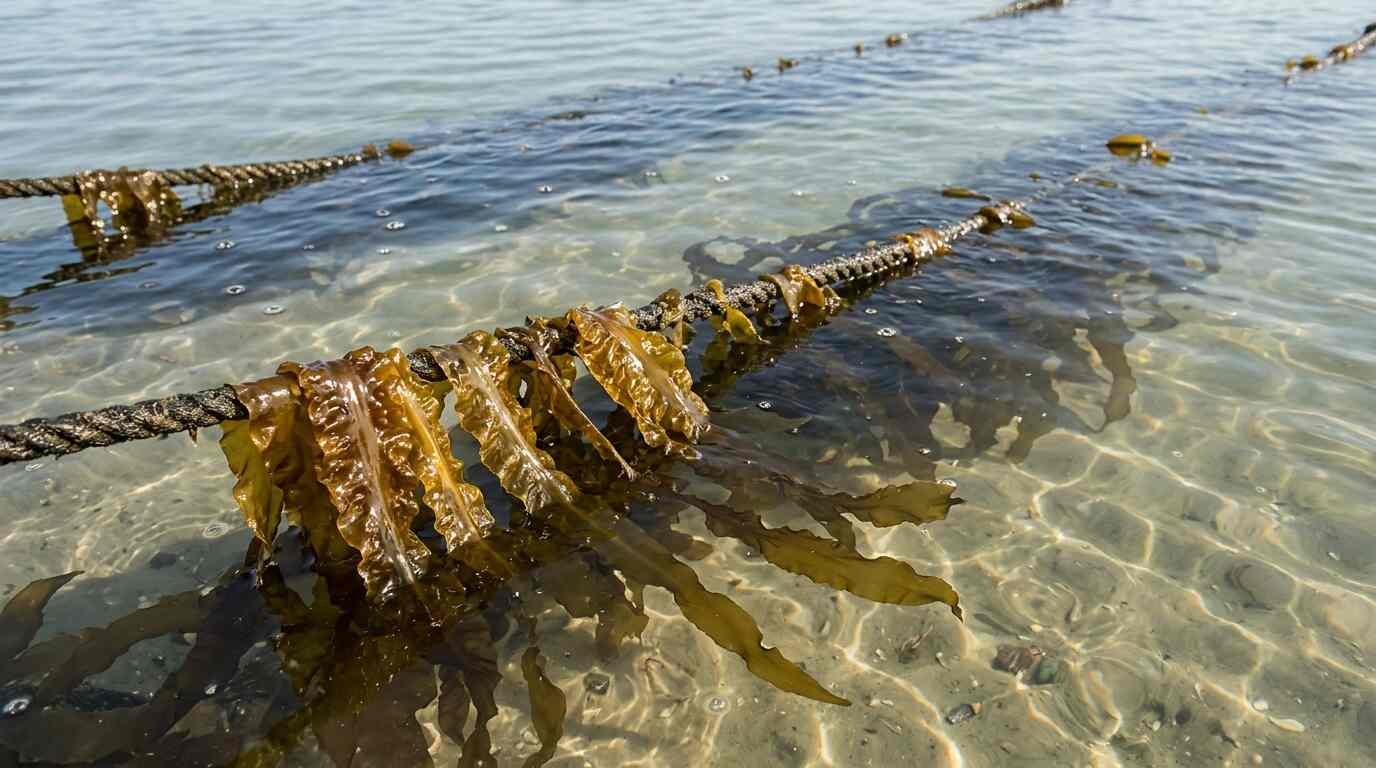
In 2021, Wicks filed New York’s first application to add kelp to an oyster lease. According to GreenWave, she spent two years working with the Army Corps of Engineers before approval came in spring 2023, which made her the first farmer in the state with a commercial kelp permit.
The engineering is the interesting part. GreenWave reports that Mike Doall of Stony Brook University designed a shallow-water system that grows sugar kelp in two to six feet of water, where kelp elsewhere usually needs at least eighteen. Her first season called for thirty lines, each 100 feet long, set inside the existing oyster lines. Doall’s argument, per GreenWave, is that growing seaweed with shellfish can protect the shellfish and speed their growth.
Responsible Seafood Advocate reported in January 2024 that she expected roughly 50,000 pounds of kelp in the first year. A cosmetics company wanted the whole crop. She turned down the sure sale to build a wider set of buyers. “I think Sue landing the first permit is historic,” said Wendy Moore of Lazy Point Farms in that piece.
The first commercial harvest was celebrated at the farm in May 2024, with county and town officials in attendance, according to the Messenger. The kelp was dried on racks on the property, and the Moore Family Charitable Foundation is named as a partner. News 12 covered the switch from basketball to seaweed:
From the Bay to the Plate
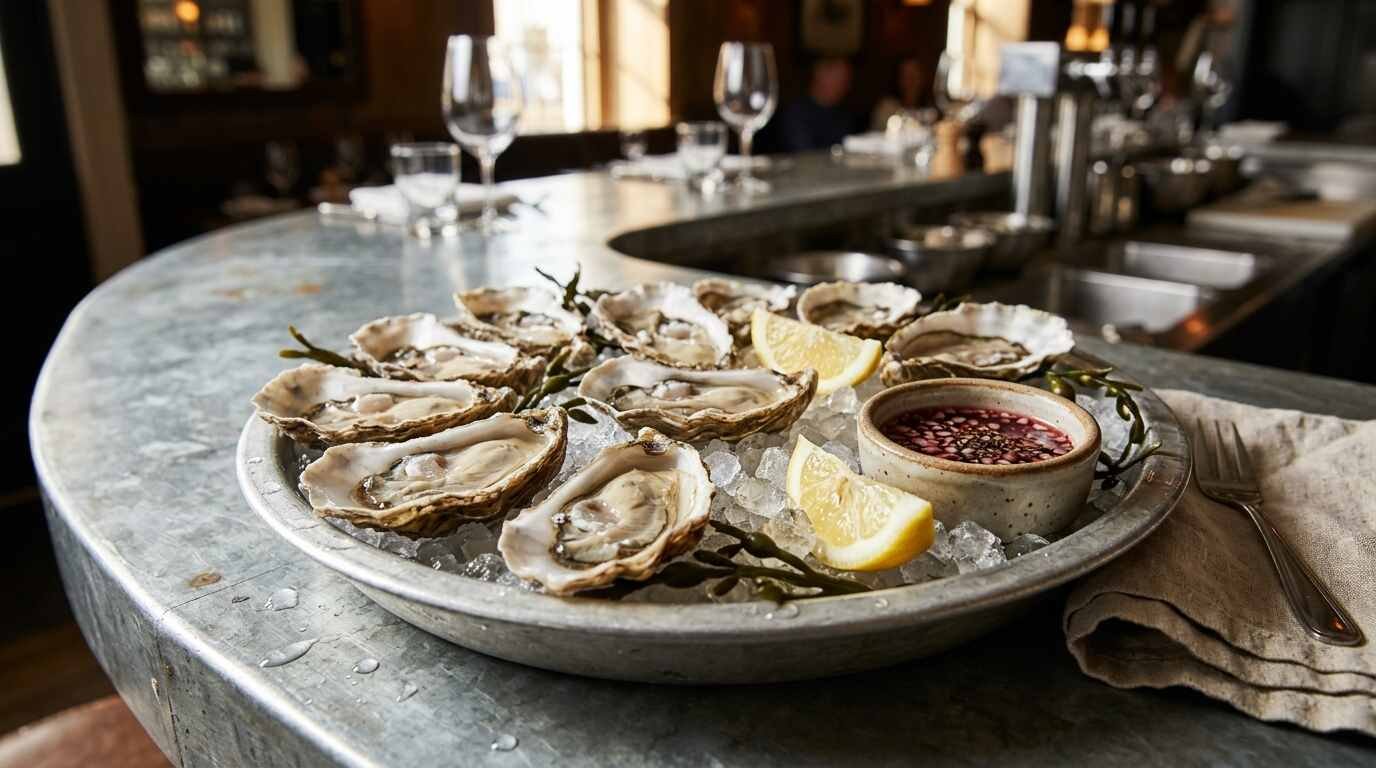
Who buys the oysters is the least documented part of the story. Fox 5 and The Nature Conservancy both describe restaurants and bars as customers, and Responsible Seafood Advocate says wholesalers account for most of the volume. None of the coverage names the kitchens, so no restaurant is listed here.
Fox 5’s 2022 segment shows the work on the water:
Outside the island, Island Creek Oysters has offered the farm’s oysters for overnight shipping, and its listing read sold out at last check. Its storage advice is useful for any half-shell oyster: keep them refrigerated for five to seven days under a damp cloth, and skip the ice. The farm’s Instagram handle, per the Mastic Beach Conservancy, is @violetcoveoysterco.
For readers who want the Long Island shellfish story from other angles, there is the Cold Spring Harbor oyster economy that fed New York City, the clam bars still working the South Shore, and two ways to eat Blue Point oysters.
Loose Ends in the Record
Sources disagree on a few basics, and the differences are worth laying out.
| Detail | What sources say |
|---|---|
| Start year | Boating says the farm opened in 2015. GreenWave says 2018. Northforker’s 2022 piece says about five years earlier. |
| Lease size | Island Creek lists two acres. Fox 5 and Northforker say three. |
| Customer mix | Mostly restaurants and bars in 2020 (The Nature Conservancy), mostly wholesalers by 2024 (Responsible Seafood Advocate). |
On whether the farm is still running, the most recent reporting is from late 2025. An AP photographer photographed the farm on November 20, 2025, and the December AP feature describes a working operation with hundreds of cages on lines, some drifting off after windy days. No 2026 coverage turned up, so anyone planning a purchase should check the farm’s Instagram first.
Sources
- WNBA legend Sue Wicks’ 2nd act: Long Island oyster farmer, FOX 5 New York, August 11, 2022
- On Board With: Sue Wicks, Boating Magazine, January 29, 2024
- Sue Wicks Oyster Farming, The Nature Conservancy, January 25, 2021
- Meet the woman who’s pioneering commercial kelp farming in New York, Responsible Seafood Advocate, January 8, 2024
- Susan Wicks Secures First New York State Commercial Kelp Permit, GreenWave
- First Commercial Kelp Harvest in NYS Held at Violet Cove Oyster, Messenger Papers, May 16, 2024
- Say ‘Shuck Yeah’ To Long Island Oysters, Edible East End, Summer 2022
- Former WNBA Star Sue Wicks Now Owns An Oyster Farm On Long Island, GO Magazine, March 26, 2020
- Violet Cove Oysters from Moriches Bay, NY, Island Creek Oysters
- From hoops to oysters: Inside the unexpected second acts of WNBA stars, AP via MPR News, December 15, 2025
- Beach Day: Sue Wicks, Mastic Beach Conservancy, May 9, 2023
- Northforker profile of Sue Wicks and Violet Cove Oysters
- Former Rutgers, WNBA Liberty star Sue Wicks now owns Violet Cove Oyster Co., Newsday on YouTube
- WNBA star Sue Wicks trades basketball for kelp farming, News 12 on YouTube
- WNBA legend Sue Wicks is now an oyster farmer on Long Island, NY, FOX 5 New York on YouTube