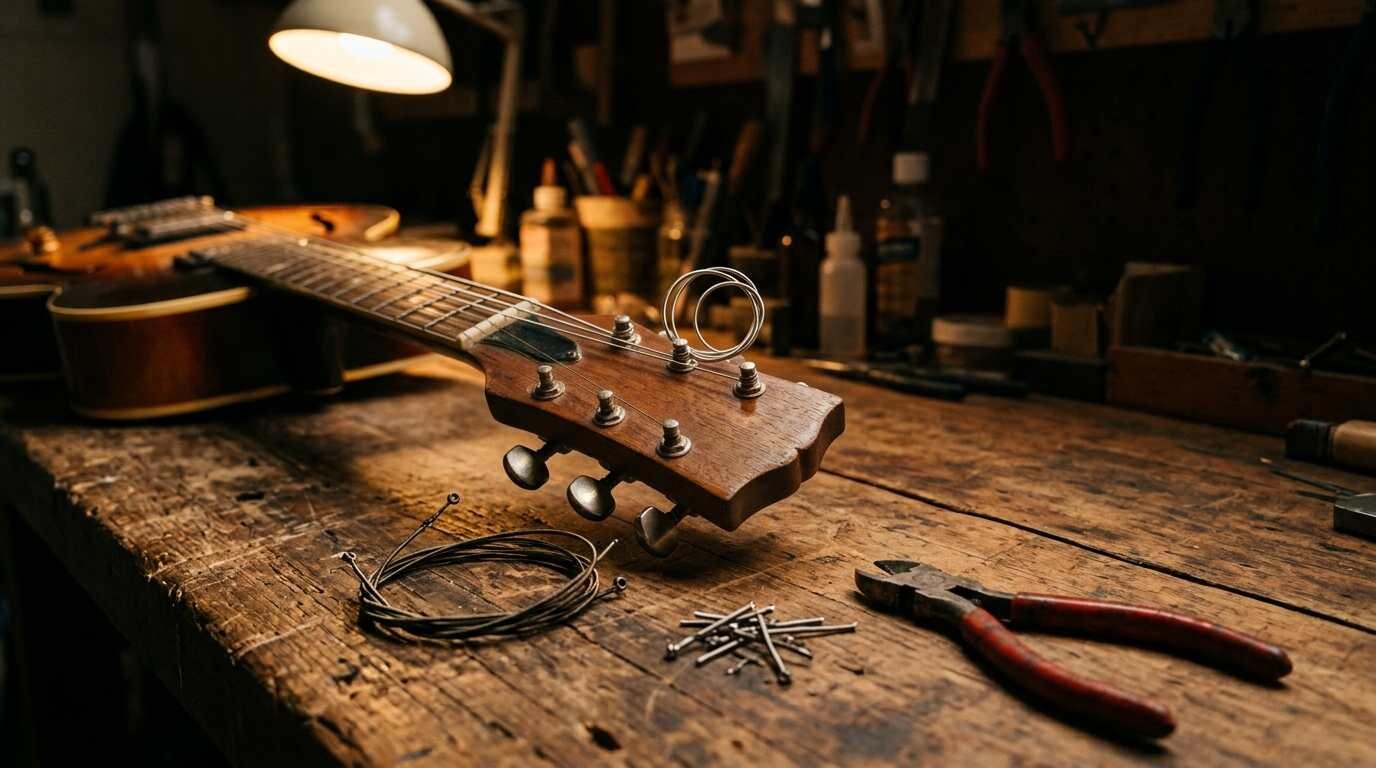
Seven years is a long time to leave anything on a guitar. In 2017, Guitar World ran a short piece about a player who had gone that long without changing the strings on his Gibson ES-175, then recorded the guitar before and after a fresh set went on. Larsen’s own warning was that viewers would probably find the result a bit surprising.
Whether a string is dead turns out to be a question with a physical answer, an aesthetic answer, and a financial one, and the three rarely agree. The sources below come from guitar publications, a recording guitarist, and two string makers with a stake in the answer, and they pull in different directions.
How a String Goes Dull
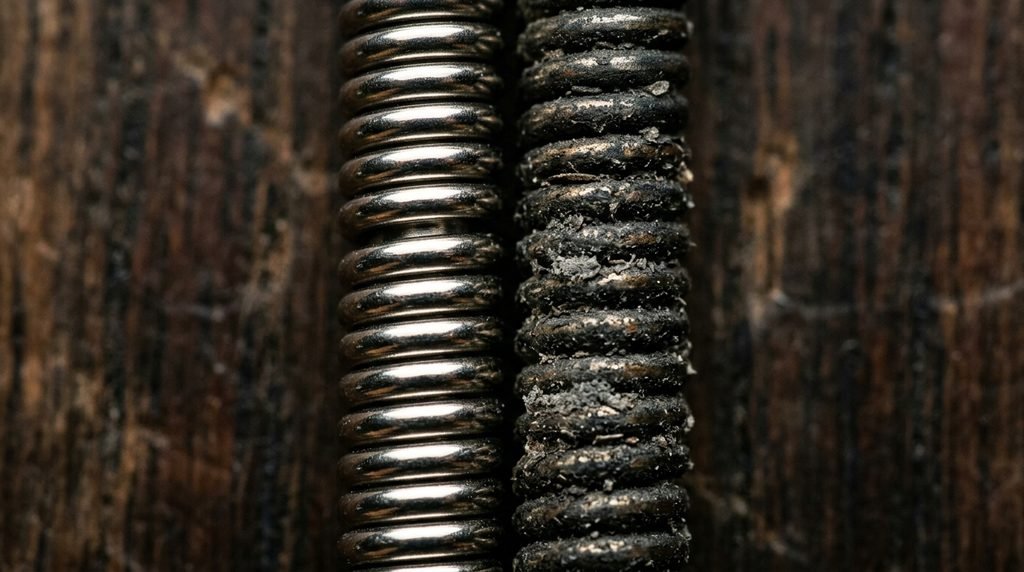
S.I.T. Strings, a string manufacturer, names contamination as “the primary enemy of any guitar string.” Sweat, skin oils, dirt, humidity, and airborne grime all settle on and between the windings. As the buildup grows, the company says, strings gradually lose brightness, harmonic content, sustain, tuning stability, and responsiveness.
MusicRadar’s Richard Blenkinsop, writing in March 2024, puts the mechanism more bluntly. Uncoated strings collect “dead skin, dust and dirt” inside the windings, and the top-end frequencies go first. A set that sounds dull is usually a set that has lost its upper register.
Human chemistry swings the result widely. S.I.T. observes that some players “tarnish a fresh set within days” while others get months from the same strings, and it points to acidic sweat as one factor. Nobody in the sources offers a pH figure, so treat that as a manufacturer’s observation rather than a measured law. The practical upshot is that a set’s life depends more on whose hands are on it than on the brand printed on the packet.
A Gibson, Seven Years, and a Short Recording
Guitar World’s Christopher Scapelliti described a video by guitarist Jens Larsen, who left the strings on his Gibson ES-175 untouched for seven years, then recorded the guitar through the same setup before and after a change. The article places the old-string sample about 42 seconds into the clip and the new-string sample at roughly 1:09.
No measurements came with it. The piece reports no frequency analysis, no sustain figures, and no intonation data. Larsen simply invited listeners to hear the difference for themselves. A recording gives a listener evidence to react to, which is not the same as proof, so the clip works best as a way to test your own ears. The original page is on Guitar World.
The Producer’s Heresy
Recording guitarist Joe Gore tackled the same question in Premier Guitar in 2015, updating the piece in 2021. He compared brand-new strings with a set about 18 months old. The new set had “a bit more shimmer” in the highs. The old set sounded “a little plonky-sounding.” He also found that the gap could be partly recreated with an EQ move around 2 kHz, and that the worn strings “didn’t intonate too terribly.”
His larger argument is about context. In a full band mix, with effects and other instruments crowding the same frequencies, he says the difference between old and new strings shrinks to almost nothing, and the quality of the performance is “approximately 937 times more important” than subtle tonal differences. Only on an exposed solo guitar recording does the string age come to the front.
Gore’s advice is refreshingly unscientific: “go with whatever is most likely to inspire your best performance.” For some players that is a brand-new set. For others, it is the worn-in feel of strings that have settled. One recording guitarist’s view should not be treated as settled fact, though it is a useful counterweight to string-change dogma.
Coated, Treated, or Bare: The Comparison
Three kinds of string sit on the shelf, and the makers describe them differently.
| Type | How the sources describe it | Tone and feel | Longevity claim |
|---|---|---|---|
| Uncoated | No barrier; windings collect “dead skin, dust and dirt” (MusicRadar) | The baseline; brightness fades as buildup grows | The reference point |
| Coated | A “very thin polymer coating” around the core, the wrap, or the whole string (MusicRadar) | “Not as loud and not as complex” when new (Martin); “a little smoother,” sometimes “slippery” (MusicRadar) | Two to five times longer (Martin); can cost double (MusicRadar) |
| Treated | Treatment “chemically bonded to the strings” (Martin) | “Sound identical to traditional uncoated strings” (Martin) | Two to five times longer (Martin) |
Martin Guitar, whose August 2023 blog post draws the coated versus treated line, adds that coatings eventually flake from fret impact, whereas treatments do not. That is a string maker describing its own category, so the comparison is worth reading with that in mind. MusicRadar, an independent publication, backs the tone point from the other side: fresh coated strings may have “less top end,” and don’t quite sound as complex or as loud as fresh uncoated ones.

The Arithmetic Nobody Prints on the Package
MusicRadar says coated strings “can set you back double” the price of uncoated. Martin says coated and treated strings can last two to five times longer, depending on playing style and body chemistry. Put the two together and the math gets interesting.
At twice the price and twice the life, a coated set costs the same per hour of playing as an uncoated one. At twice the price and five times the life, it costs 60 percent less per hour. Anything below a doubling of lifespan, though, is a loss on cost alone, and a player whose standard sets already last months may never reach the break-even point. Those multipliers are one maker’s claim, with Martin itself hedging that results depend on the player.
Playing context matters too. Gore’s studio point suggests that in a band setting, the extra upkeep of fresh uncoated strings buys little. On a solo acoustic part, the shimmer of a new set may justify the swap.
A Rule That Holds Up
Pulled together, the sources support a modest, practical rule rather than a single answer.
- Change strings when brightness drops and tuning will not hold, two of the losses S.I.T. lists.
- Play your own strings through your own setup, then play a fresh set the same way, as Larsen did. Your ears beat anyone’s advice.
- If your sweat tarnishes a set in days, the cost arithmetic above favors coated or treated strings. If strings last you months, it probably doesn’t.
- For a band mix, don’t lose sleep. For a solo recording, give the fresh set its due.
Quick Answers
How long do strings last? No source gives one number. S.I.T. says life depends on body chemistry, playing frequency, climate, storage, and maintenance habits, and adds flatly that “eventually, all strings wear out.”
Do coated strings sound worse? Fresh from the pack, they may have less top end and a little less complexity, according to MusicRadar, and Martin calls them “not as loud.” Over time the picture flips, since uncoated strings lose their highs as grime builds up in the windings.
Will old strings ruin a band recording? Joe Gore says no. In a full mix with effects, he finds the difference between old and new minimal, with the exposed solo guitar as the main exception.
Are all coated strings alike? They are not. S.I.T. warns that “not all coated strings are constructed exactly the same way” and that they “vary significantly in feel, tone, and overall playing experience.”
Dead is a spectrum, and fine is another one. For further reading on the guitars these strings go on, see Two Gibsons and The Strat vs. The Les Paul.
Sources
- Coated vs Uncoated Guitar Strings: What’s the Difference?, Richard Blenkinsop, MusicRadar, March 6, 2024
- Coated Strings Versus Treated Strings, Martin Guitar blog, August 9, 2023
- Coated vs Uncoated Guitar Strings, S.I.T. Strings
- New Strings vs. Seven-Year-Old Strings: What’s the Difference?, Christopher Scapelliti, Guitar World, May 10, 2017
- Old vs. New Guitar Strings, Joe Gore, Premier Guitar, December 10, 2015 (updated October 15, 2021)