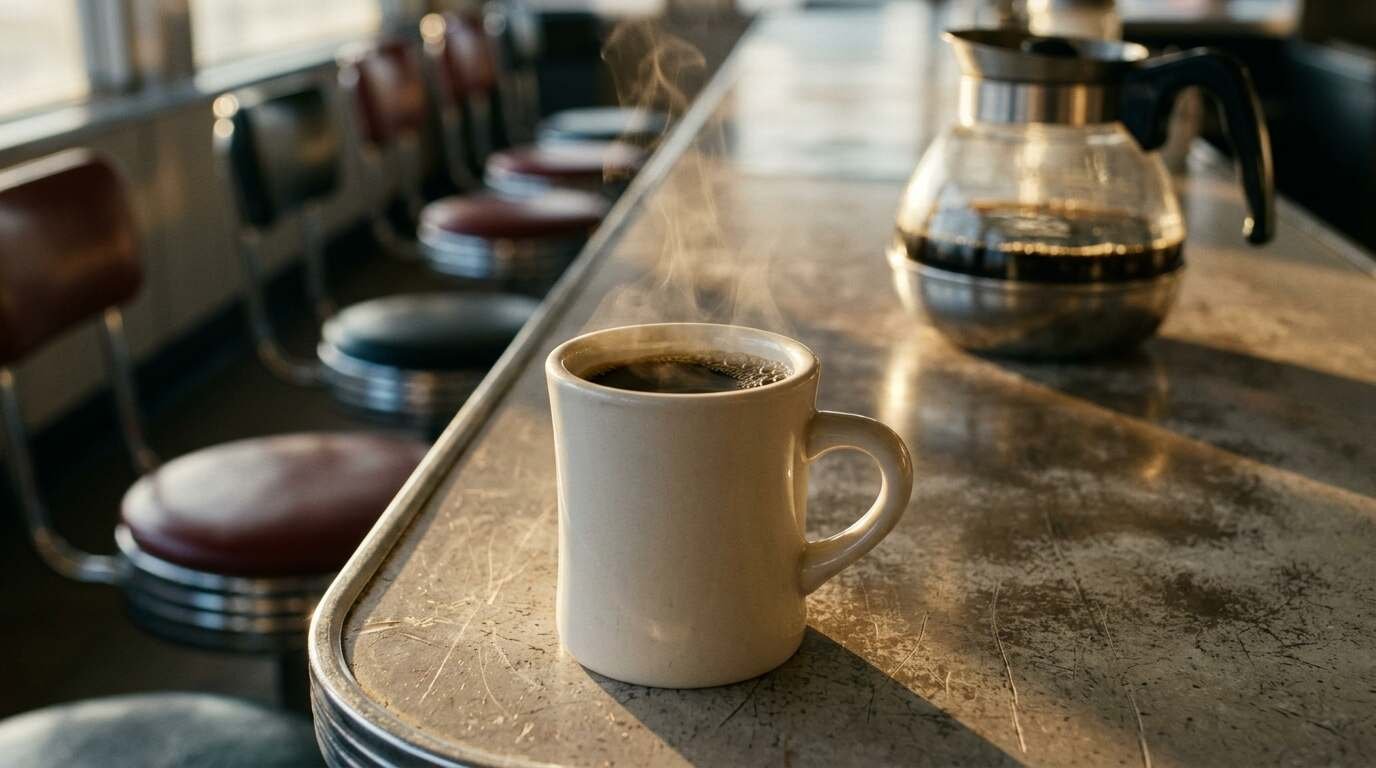
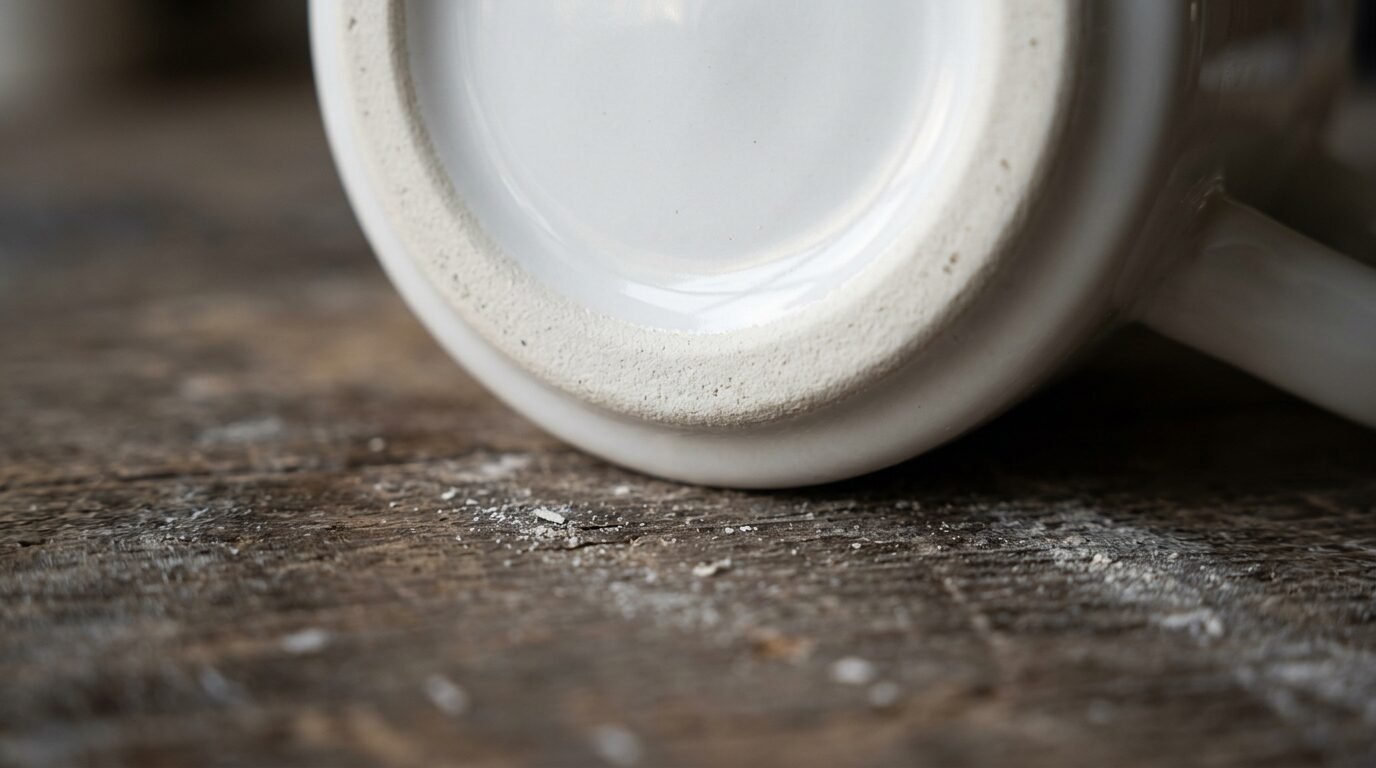
The rough, unglazed ring on the bottom of a diner mug was never a design choice. A glazed foot would have stuck to the rack during production, so the foot stayed bare, and a manufacturing flaw became the grip that kept the mug planted on a tabletop. Most of what people love about the diner mug started the same way, as a constraint somebody had to work around.
The Navy Wanted Something That Would Not Slide
Early in World War II, the U.S. Navy went looking for a coffee mug that could survive a ship in rough water. Ordinary cups slid, spilled and broke. The request went out to manufacturers across the country, and a company in the Finger Lakes town of Victor, New York, answered with the material it knew best.
Victor Insulators made porcelain for electrical lines. Fred M. Locke had founded the business there in 1893, the Depression shut it down in 1932, and local investors revived it in 1935 under the Victor name. Thick insulator porcelain makes a heavy mug that is hard to knock over and keeps a drink hot, which is close to a job description for a Navy mess. Victor won the contract with a thick-walled, straight-sided mug fired at roughly 2,250 degrees Fahrenheit, according to The Henry Ford, and the first version had no handle at all. Without one, a fall could not snap it off.
The handle came back after the war, once the customers were coffee shops and diners rather than warships. Each one was attached by hand and finished to look molded in a single piece. Nelson McKee, a Victor factory employee quoted by HuffPost, said the handles were smoothed better because they had smaller fingers. The Henry Ford credits one of the three women employed at the plant with attaching them.
Other Potteries Got There First
The tidy version of the story, in which one factory invented the diner mug for one Navy order, leaves out an industry that had spent decades learning how to make dishes survive a restaurant.
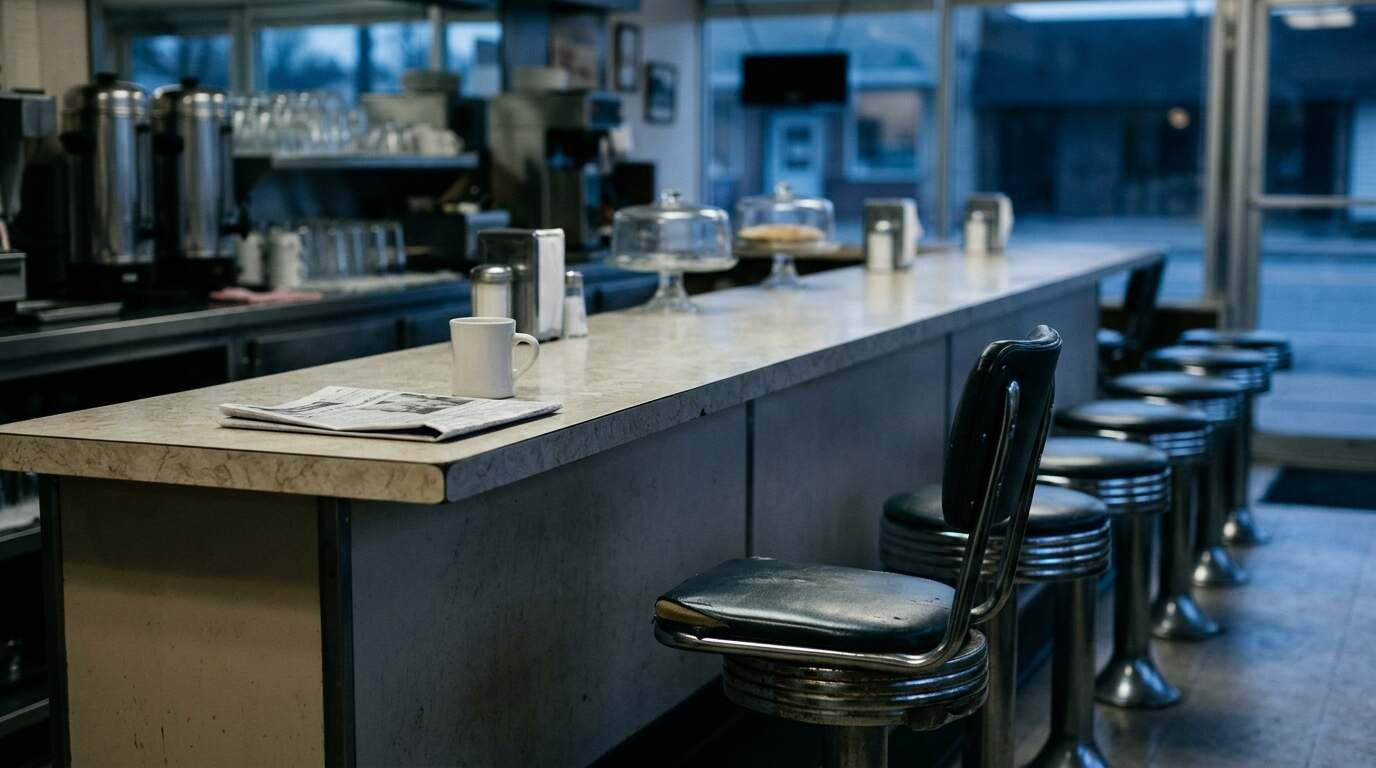
Early restaurants served on fragile porcelain and porous earthenware that chipped, stained and cracked under daily use. Potteries answered with vitrified ware, fired until the body and glaze fuse into something close to glass. The Henry Ford’s curator Aimee Burpee describes the payoff: sturdier pieces that resist chipping, hold heat, shrug off temperature shocks and survive commercial dishwashers. Buffalo Pottery, founded in 1901 by soap maker John Larkin, made its first restaurant ware in 1903. Syracuse’s Onondaga Pottery introduced vitrified stoneware with a rolled edge in 1896 and built a factory devoted to commercial ware in 1924.
According to Randy Garbin, founder of Roadside magazine, as reported by HuffPost, Syracuse was already selling a similar mug shape by 1926, stamped with the initials OPCO. So Victor did not invent the heavy white mug. What Victor owns is the Navy contract, the stamped name on the base, and the story that stuck.
Neither of those older potteries survived as an American manufacturer. The Henry Ford reports that Buffalo China’s factory was sold in 2004, ending production, and that all Syracuse China production had left North America by 2009, closing 138 years in Syracuse.
A Hole in the Table for the Cup
Before the mug had a handle, the counter already had a place for it. In the early 1900s, quick-lunch counters were fitted with tables that had a hole cut into the top to hold a coffee mug, according to restaurant historian Jan Whitaker. Restaurateurs and customers agreed that coffee makes the restaurant, and by 1935 about nine in ten restaurant customers ordered it with a meal.
The price was part of the bargain. From the mid-1800s to the 1890s, inexpensive restaurants generally charged five cents a cup, while a luxury house like Delmonico’s charged a quarter. Many places moved to a dime in the 1930s and 1940s. In 1944 a federal order froze restaurant coffee at its October 1942 price, and a handful of chains, among them the Automat, Bickford’s and Thompson’s, kept serving a nickel cup until late 1950. (The Automat’s wall of little glass doors has its own history in an earlier feature on the site.)
The free refill is murkier than its reputation suggests. A widely repeated line traces it to the 1890s: the book The World of Caffeine (2001) says free refills were common in American coffeehouses by then and that Europeans found the habit remarkable. That is one book making the claim, and none of the sources reviewed for this feature names who poured the first free second cup. Whitaker’s trail picks up in the 1970s, when a quarter was the going rate and many restaurants offered refills to customers who ordered a full meal. Wendy’s charged 30 cents in 1977 and Friendly’s 35. About a decade later, a dollar was common.
How a refill works as a business, from urn to cup, is covered in Diner Coffee Was Never Bad. It Was Designed for Something Else. The mug matters here for a simpler reason. Vitrified ware holds heat better than the fragile china it replaced, a quiet advantage when a cup sits through a second and third pour.
Eighty-One Cents Against Forty-Five
The thing that ended the Victor mug was arithmetic. Around 1980, cheaper imitations from China started reaching restaurants. By one account in Exploring Upstate, Victor’s cost to make a mug was 81 cents while the knockoffs sold at retail for 45, a cost set against a shelf price, but the gap tells the story. Some of the copies were stamped VICTORY, with a poorly pressed Y. In the mid-1980s Victor began marking its own mugs “Made in U.S.A.” to tell them apart.
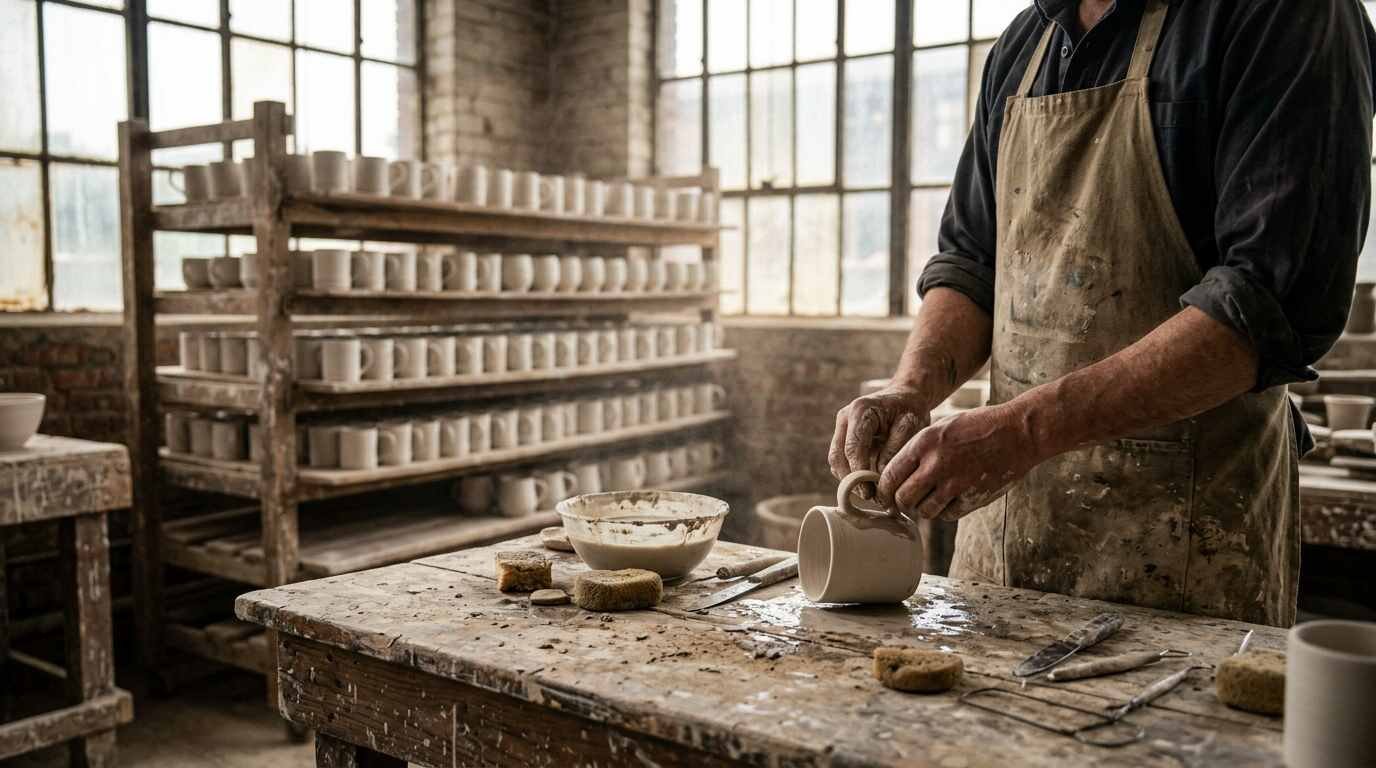
It was not enough. The Rochester Democrat and Chronicle reported in July 1991 that Victor had stopped making the mug in spring 1990, and company officials blamed cheaper imports, chiefly a Chinese look-alike selling for less than half the price. The company had needed to sell 25,000 to 30,000 dozen a year to turn a profit, which works out to something like 300,000 to 360,000 mugs, and was not reaching 60 percent of that. Personnel manager John Saxby said continuing was just not economically feasible.
Several later retellings, including the Takeout and Visit Finger Lakes, give 1987 as the end of production. The 1991 newspaper account is the closest to the event of any source reviewed, so 1990 is the date this feature uses.
Victor Insulators outlived the mug. It filed for Chapter 11 in 2008 and, after reorganizing, kept operating as one of only three porcelain insulator companies left in the United States.
The Seat Comes Before the Cup
A mug only becomes a diner mug when someone returns to the same stool to drink from it. Sociologist Ray Oldenburg gave those places a name in The Great Good Place (1989): third places, informal gathering spots outside home and work where conversation is the main activity and status counts for little.
Rural America has its own term for the table where it happens. A liars’ table is a large table a proprietor sets aside, usually in a diner or similar spot, where men gather for coffee and talk about local business and politics. The name is a joke about how much of it is true. The tradition has been recorded in states from Maine to Mississippi and Texas, and when Duffy’s Deli in Alabama closed in March 2014, the local headline mourned its Liar’s Table alongside the chili and the sandwiches.
The habit is not limited to diners. At a Dunkin’ Donuts in Newtown, Connecticut, a regular named Dave Ryan told the Newtown Bee in 2006 that he and other men used a table by the door six days a week, talking for 45 minutes to an hour. Another regular, George Wheeler, gave the purpose in one line: we gather here to tell each other lies. The franchise owner said his staff knew what to make for them the moment they walked in, and knew their families.
A 2018 Tow Center report in Columbia Journalism Review described the same ritual in Ohio County, Kentucky, at general stores that double as gas stations. Farmers, miners and local politicians met there as early as 5:15 a.m. to trade news about obituaries, closings and neighbors who needed help. One participant pointed out that women doing the same thing would be called gossipers.
Even the server’s memory leans on the fixed seat. A study of waiters in Buenos Aires, relayed by MinnPost in 2009, found they relied on table position, faces and clothing to match drinks to customers, and when volunteers swapped seats before a second round, all but one waiter made mistakes. A regular who takes the same stool every day is, in effect, handing the server that cue.
Who Was Allowed the Stool
Not everyone got to become a regular. Woolworth’s opened its first luncheonette around 1923 in New Albany, Indiana, and dime-store counters kept going up through the 1950s. At the Woolworth’s counter in Greensboro, North Carolina, in 1960, African American customers and their supporters sat in areas reserved for white customers and insisted on being served. Part of that counter now sits in the Smithsonian’s National Museum of American History, and the former store houses the International Civil Rights Center and Museum.
A regular, in other words, is someone a counter agreed to see. In much of the segregated South, that agreement was withheld from many of the people who were ready to pay for their coffee. The Formica surface under those mugs has its own story in The Formica Conspiracy, but the stool was never just furniture.
What survives is a small bargain that outlasts the factory that made the cup: a heavy white mug, a refill that arrives before it is requested, and a seat that stays open until the person it belongs to walks in.
Quick Answers About the Diner Mug
Who made the first thick white diner mug? No single maker can be named. Syracuse’s Onondaga Pottery was selling a similar shape by 1926 according to Roadside magazine’s founder, and Buffalo Pottery had been making restaurant ware since 1903. Victor Insulators is famous for the Navy contract and the factory story.
Are Victor mugs still made? No. Victor Insulators stopped making them in spring 1990, according to the Democrat and Chronicle, although some retellings say 1987. The company still manufactures porcelain insulators.
How can you tell a Victor mug? Authentic ones are stamped “VICTOR” on the underside, and some also say “Made in U.S.A.” Copycats exist, and by one account some were stamped VICTORY.
Sources
- Aimee Burpee, “Clean Plates, Empty Mugs: The Hidden Histories of Diner Ware,” The Henry Ford, March 5, 2025.
- Paul Anthony Jones, “Why Do Diners Across America All Use the Same Mugs?” Mental Floss, November 18, 2025.
- Chris Clemens, “How the Victor Coffee Mug Changed the Way We Drink Coffee,” Exploring Upstate, 2016.
- Jillian Capewell, “The Humble Victor Diner Mug, An Icon of Americana,” HuffPost.
- Kat Olvera, “How a Wartime Invention Shaped Every Diner Mug You Know,” The Takeout, August 23, 2025.
- “Victor Insulators,” Wikipedia.
- “The Diner Mug,” Visit Finger Lakes.
- Diana L. Tomb, “Victor stops making mugs,” Rochester Democrat and Chronicle, July 14, 1991 (citation record, Insulators.info).
- Jan Whitaker, “When coffee was king,” Restaurant-ing through history, February 21, 2016.
- “Free refill,” Wikipedia, citing Weinberg and Bealer, The World of Caffeine (2001).
- “The Great Good Place,” Wikipedia.
- “Liars Table,” Wikipedia.
- Nancy K. Crevier, “Regulars: Grabbing a Cup of Coffee and… Community,” The Newtown Bee, January 20, 2006.
- Andrea Wenzel and Sam Ford, “Truths from the liars table,” Columbia Journalism Review, March 20, 2018.
- “How does that great waiter remember all those orders?” MinnPost, August 2009.
- “Lunch counter,” Wikipedia.