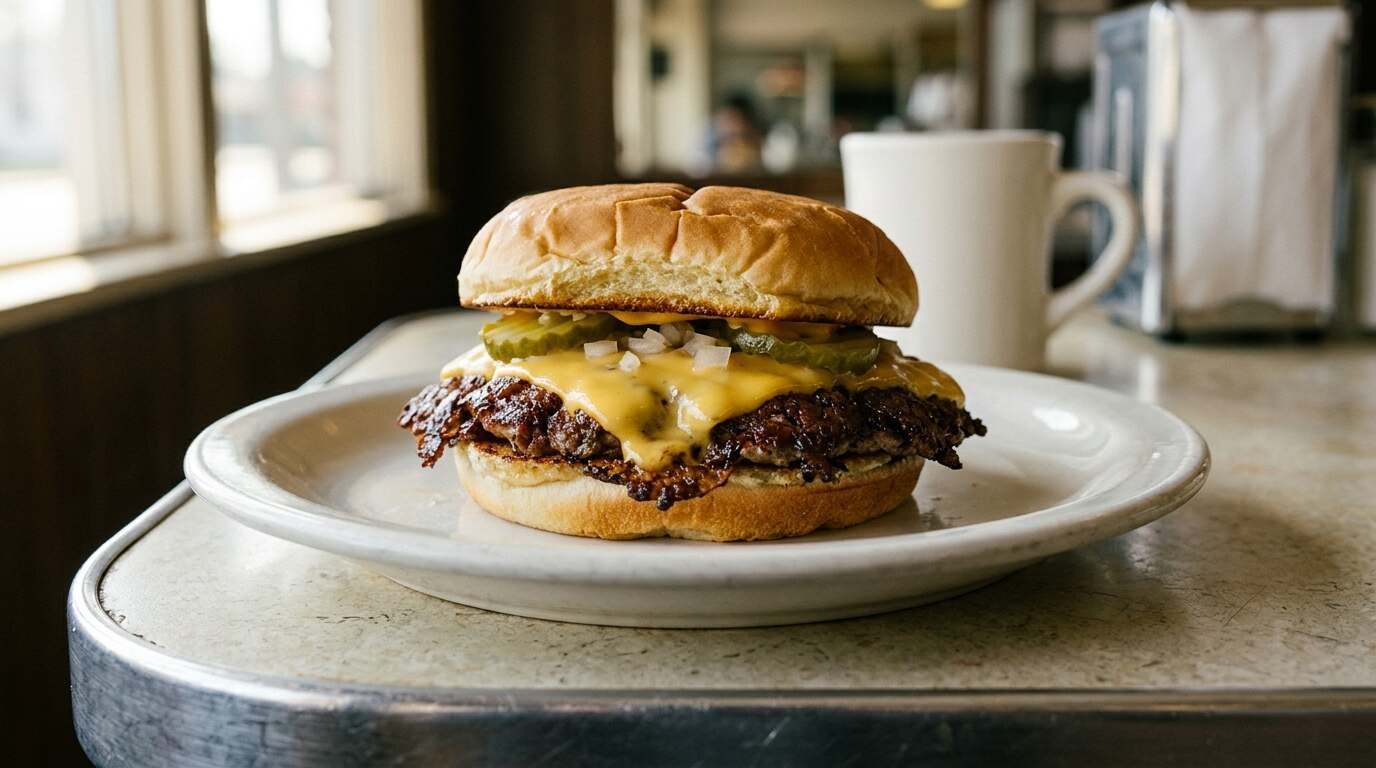
On January 5, 2017, the Pasadena Chamber of Commerce unveiled a plaque at 1500 West Colorado Boulevard, where a credit union office now stands, to mark the birth of the cheeseburger. The plaque points to January 5, 1924, a date drawn from an old menu at The Rite Spot, the sandwich shop the Sternberger family ran on that corner. Lionel Sternberger was 16, a short-order cook working his father’s grill, and the menu listed an “Original Hamburger with Cheese” for 15 cents.
Nobody can prove it. Writing for PBS SoCal in 2013, Katherine Spiers laid out the rival claims: Kaelin’s in Louisville, Kentucky, which gave the sandwich its name in 1934; a Denver restaurant that received the cheeseburger trademark in 1935, narrowly ahead of an application from the founder of Steak ‘n Shake; and O’Dell’s in South Los Angeles, which sold burgers under cheese, chili and spaghetti by 1928. Spiers landed on Pasadena as the likeliest birthplace while admitting that comfort-food origins resist clean paperwork. National Today, quoted by Pasadena Now, moves Sternberger’s moment to 1926.
The format has kept moving ever since. On July 27, 2026, ABC News published a segment on Chef Jae Lee of the New York restaurant Nowon making his “Legendary Cheeseburger,” the dish behind what the network called the viral Nowon smashburger recipe. Lee builds it from two 4-ounce patties of 70/30 beef, yellow American cheese, pickle chips, minced Spanish onion and a buttered, toasted brioche sesame bun, with a kimchi mayonnaise standing in for the usual special sauce. In the Good Morning America write-up, he says, “I wasn’t trying to reinvent the burger.” The restaurant’s own version is a family recipe he keeps private, so what he published is an at-home approximation.
Strip the kimchi away and the skeleton is the one Sternberger worked with a century ago: ground beef, a flat surface that runs hot, a slice of cheese, a soft bun. What follows hangs that skeleton on a home stove, minute by minute, using published numbers from the AmazingRibs.com diner burger recipe, the USDA’s Food Safety and Inspection Service, and the butcher’s-counter advice Kenji López-Alt gave La Voce di New York in 2025.
What to Buy Before the Griddle Heats Up
Beef comes first, and fat percentage is the number that matters. AmazingRibs calls for finely ground chuck or short rib at 20 percent fat or higher, and puts the useful range at 20 to 30 percent, enough to keep the burger juicy after the surface browns hard. López-Alt, speaking to La Voce di New York, skips packaged beef altogether and asks a butcher to grind chuck, short rib and brisket together, a blend he says gives “an orchestra of flavors,” at 80/20. Lee goes fattier still, at 70/30. Pick a point inside that spread and stay with it.
Weigh each patty at about 4 ounces and roll it into a ball roughly 2 inches across; a leveled #8 ice cream scoop is a handy guide. Cheese is American, the variety National Today says Sternberger laid on that first griddled patty. Buns should be soft, with about a teaspoon of butter set aside for each one.
Salt deserves a measured hand. AmazingRibs specifies coarse kosher salt, and because crystal size changes the amount that fits in a spoon, the conversion in A Teaspoon of Diamond Crystal Is Not a Teaspoon of Morton is the reference to check before measuring. For the griddle itself, beef fat, bacon fat or a neutral vegetable oil all work; AmazingRibs advises against butter there because of its water content. Anyone picking an oil can compare the figures in Three Smoke Point Charts Give Three Different Numbers for Olive Oil. Pickle chips and onion, sliced thin or minced, finish the build.
Minute by Minute at the Griddle
Twenty minutes out. Roll the beef into balls and chill them. AmazingRibs puts them in the cold for about 20 minutes so the centers cook more slowly than the crust. Hold the salt for now; it goes on after the smash, and only on the first side.
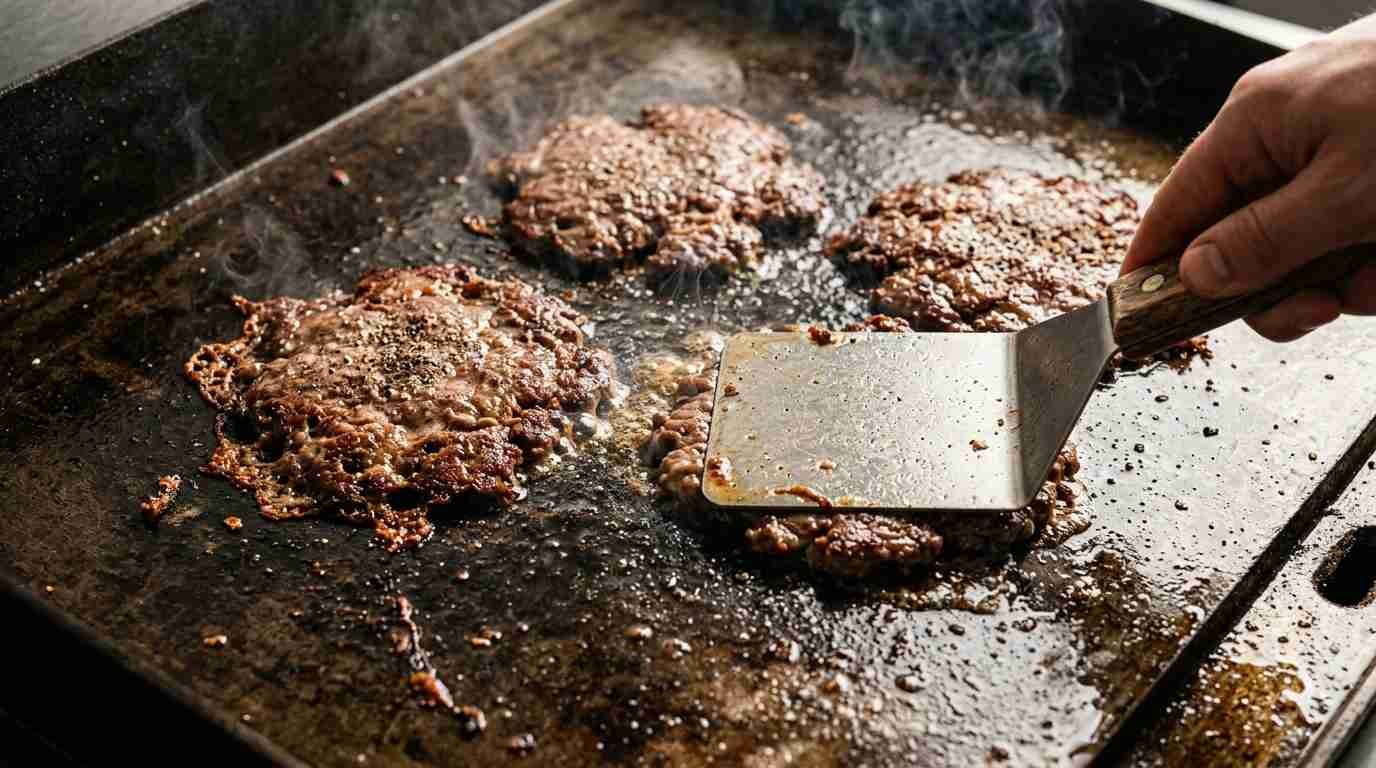
Ten minutes out. Set a cast iron griddle or heavy pan over the burner and let it get as hot as it will go, with 350°F as the floor. Maillard browning begins around 300 to 310°F, which is why the floor sits well above it. Cast Iron Seasoning Is Baked-On Oil, Not Magic, and Soap Won’t Strip It covers keeping an iron surface in working order. Unwrap the cheese and lay out the pickles and onion within arm’s reach.
Four minutes out. Toast the buns. Spread about a teaspoon of butter per bun on the griddle, set the buns cut side down, and weigh them with a dinner plate until golden. AmazingRibs wants the edges extra crisp. Wipe the surface clean afterward, before any beef goes down.
Minute zero. Coat the griddle thinly with beef fat, bacon fat or oil. When the fat starts to smoke, the balls go down and each gets one firm smash with a stiff spatula. Work the edge of the spatula around the rim until the patty is thin and ragged, then salt the top. Leave the patty alone. No second press until the flip.
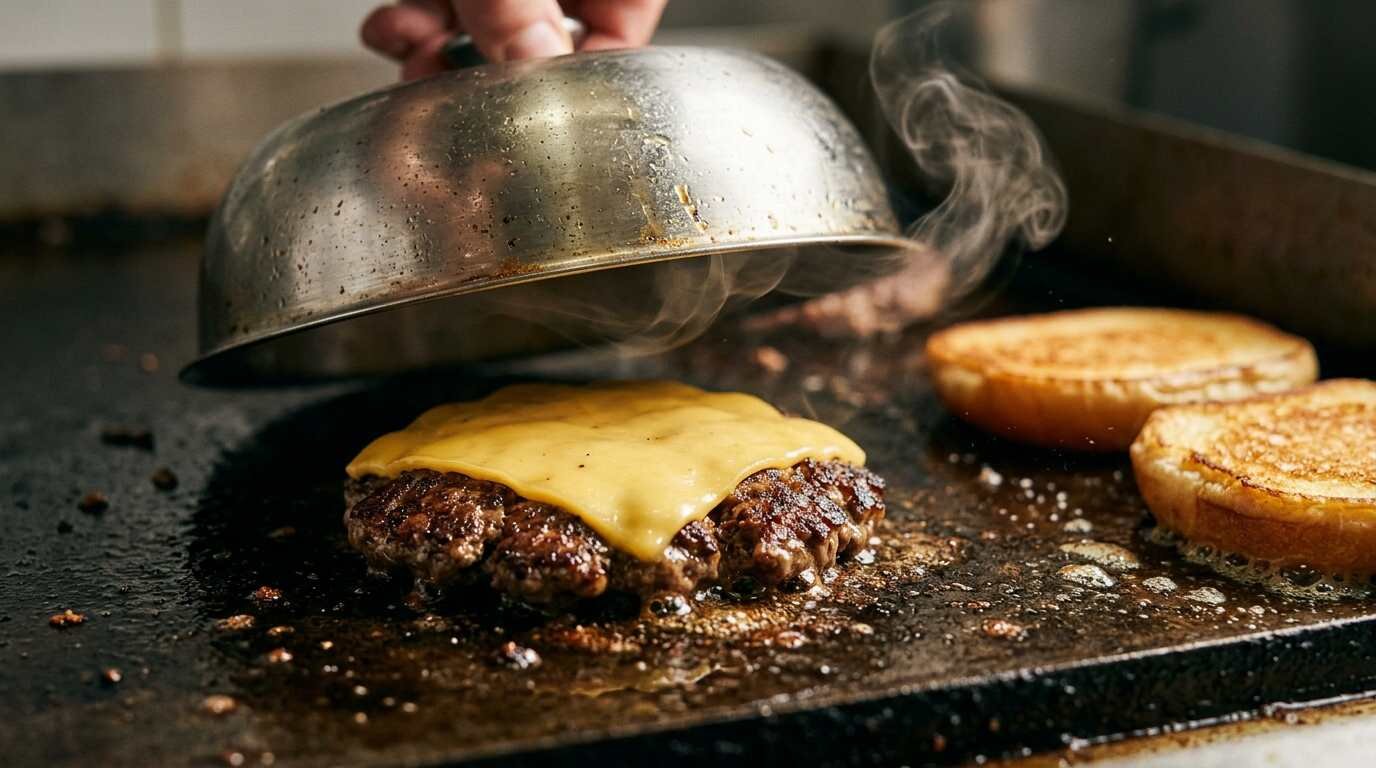
Minute three. The bottom takes about 3 minutes, sometimes up to 5 depending on how hot the pan runs. Flip when the underside is dark brown, pressing lightly so the patty keeps contact without squeezing out juice. Lay the cheese on right away and cover the patty so the slice melts into the lacy edges.
Minute five. The second side needs roughly 2 minutes. Cook until the surface is deeply browned, even if the interior looks done, then take the temperature rather than trusting the color.
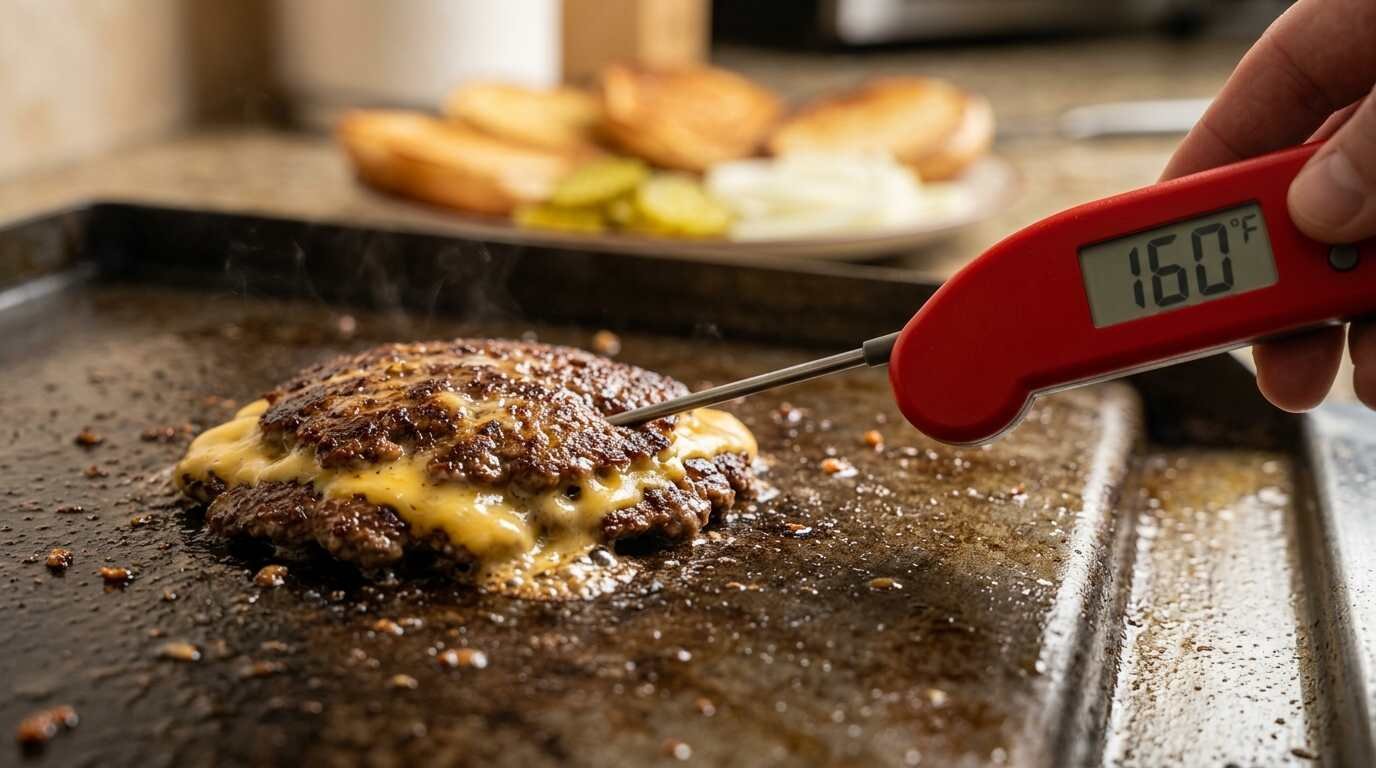
The USDA’s Food Safety and Inspection Service says raw ground beef should reach 160°F, measured with a food thermometer. Insert it at least half an inch into the thickest part of the patty, and from the side when the patty is too thin to probe from the top. Color is a poor witness: in FSIS testing, more than a quarter of fresh patties turned brown before they were safe, some looking finished at about 131°F, while lean patties can stay pink above 160°F.
Minute six. Build while everything is hot. Lee’s order runs bottom bun, sauce, onion, cheesy patty, pickles, more sauce, top bun, and any sauce you prefer can take the place of his kimchi mayonnaise.
Gear That Fits This Method
Three tools cover most of the steps above, and all three are optional if a heavy pan, a flat spatula and a thermometer already live in the kitchen.
- Lodge BOLD 12 Inch Seasoned Cast Iron Griddle — A 12-inch seasoned cast iron griddle, a heavy flat surface suited to the 350°F floor. See it on Amazon (affiliate link)
- ThermoPro TP19H Digital Instant Read Meat Thermometer — A digital instant-read thermometer for confirming 160°F in the thickest part of each patty, from the side when the patty is thin. See it on Amazon (affiliate link)
- Stainless Steel Burger Press, 5.5 Inch Round Smasher (Tshya) — A 5.5-inch round stainless steel press for the single firm smash the method calls for. See it on Amazon (affiliate link)
As an Amazon Associate I earn from qualifying purchases. A commission may be earned if you buy through this link, at no extra cost to you.
Frequently Asked Questions
What internal temperature should a cheeseburger reach?
The USDA’s Food Safety and Inspection Service sets 160°F for raw ground beef, measured with a food thermometer in the thickest part of the patty. Check a second spot if the first reading looks off.
Should the beef be 80/20 or 70/30?
Published recipes disagree. López-Alt aims for 80/20, AmazingRibs puts the range at 20 to 30 percent fat, and Lee uses 70/30. Any of those works on a hot griddle; choose one and keep it consistent between batches.
Can I make this without a griddle?
AmazingRibs allows a cast iron griddle or a heavy pan, and López-Alt recommends cast iron or stainless steel because their slightly sticky surfaces help build a crust.
When does the cheese go on?
After the flip, once the bottom is dark brown. Cover the patty for a moment so the slice melts into the edges, then pull it off the heat and build the burger.
Who invented the cheeseburger?
Pasadena’s plaque credits Lionel Sternberger at The Rite Spot in 1924, though Louisville, Denver and Los Angeles all have competing claims, and National Today dates Sternberger’s version to 1926.
Recipe: Classic Diner Cheeseburger
Prep Time: 25 minutes (including a 20-minute chill)
Cook Time: 15 minutes, in batches
Total Time: 40 minutes
Servings: 4 cheeseburgers
Difficulty: Easy
Ingredients
- 1 pound ground beef, chuck or a chuck, short rib and brisket blend, 20 to 30 percent fat, divided into four 4-ounce balls about 2 inches across
- Coarse kosher salt and black pepper
- 4 slices yellow American cheese
- 4 soft hamburger buns
- 4 teaspoons butter, for the buns
- 1 to 2 tablespoons beef fat, bacon fat or neutral vegetable oil, for the griddle
- Dill pickle chips
- Onion, sliced thin or minced
- Sauce of choice, optional
Instructions
- Chill the beef balls on a plate for about 20 minutes.
- Heat a cast iron griddle or heavy pan as hot as it will go, at least 350°F.
- Butter the buns with about 1 teaspoon each on the griddle, set them cut side down, and weigh them with a plate until golden. Wipe the griddle clean.
- Coat the griddle thinly with fat. When it starts to smoke, add the beef balls in batches and smash each once with a firm spatula, working the edges thin and ragged. Salt and pepper the top.
- Cook undisturbed for about 3 minutes, up to 5, until the underside is dark brown.
- Flip, press lightly, top with cheese, and cover to melt. Cook about 2 minutes more until deeply browned.
- Check that the patty reads 160°F in the thickest part, from the side if thin.
- Stack on the toasted buns with onion, pickles and sauce.
Notes
- For double cheeseburgers, shape eight balls and stack two patties per bun.
- Salt only the first side.
- Skip butter on the griddle; its water content works against the crust.
You Might Also Like
- Smash or Stack: The Burger Format War Blowing Up Food TikTok Right Now
- White Manna: The Mechanics of the Hackensack Slider
- Smash Burgers vs. Classic Burgers: The Science Behind Why They Taste Different
Sources
- ABC News: The viral Nowon smashburger recipe (video, July 27, 2026)
- Good Morning America: Chef Jae Lee’s recipes
- PBS SoCal: Were Cheeseburgers Invented in Pasadena?
- Route 66 News: 100th anniversary of the Pasadena cheeseburger
- Pasadena Now: On National Cheeseburger Day, the Best Deals Are in Pasadena
- USDA FSIS: Ground beef and food safety
- AmazingRibs.com: The Ultimate Diner Burger Recipe
- La Voce di New York: Kenji López-Alt’s blueprint for the perfect summer burger