Eight o’clock, Sunday night, October 30, 1938. CBS carried dance music, and then the music stopped.
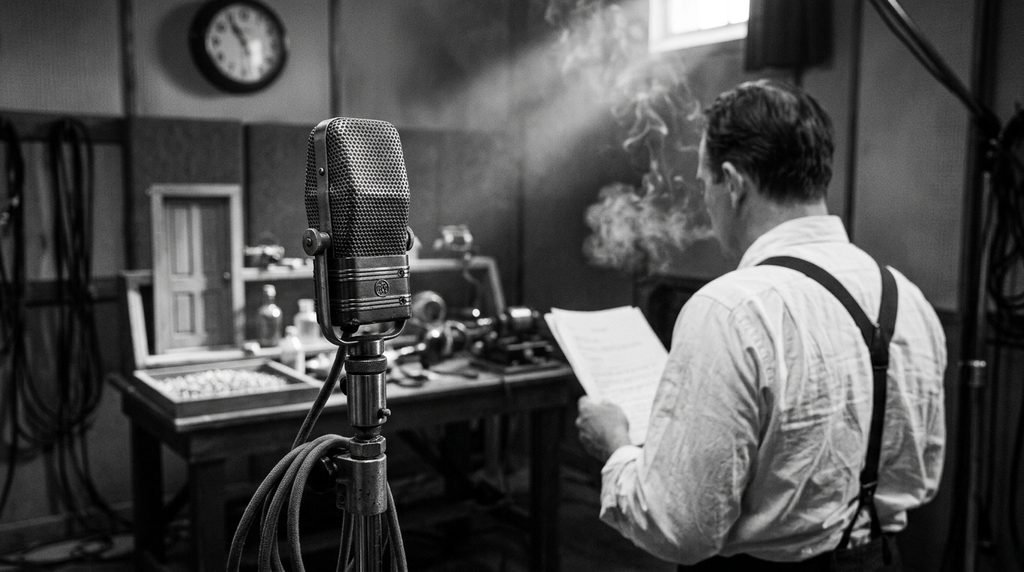
What followed, on The Mercury Theatre on the Air, was a 23-year-old Orson Welles directing and narrating Howard Koch’s adaptation of an H.G. Wells novel about Martians, with the landing moved from England to Grovers Mill, New Jersey. The first two-thirds of the hour were built from simulated news bulletins that interrupted the music. Welles later said he had “conceived the idea of doing a radio broadcast in such a manner that a crisis would actually seem to be happening.”
By the next morning, front pages across the country described a nation in flight. The story has been retold for eighty-eight Halloweens as proof that a microphone could frighten millions. Three numbers put pressure on that version.
Two Percent
The C.E. Hooper ratings service surveyed about 5,000 households about what they had been listening to that night. According to Slate’s reading of the survey, only 2 percent said they were tuned to a radio play or to the Orson Welles program. The other 98 percent were listening to something else, or to nothing at all.
The competition was formidable. Ventriloquist Edgar Bergen’s Chase and Sanborn Hour ran opposite the broadcast and pulled much of the audience, and some CBS affiliates, Boston’s WEEI among them, pre-empted the program for local shows. A panic needs an audience, and on this night the audience was thin.
Six Million, One Million, and a Category Error
The figure most often repeated comes from Princeton’s Hadley Cantril, whose 1940 study estimated about 6 million listeners and roughly 1.2 million who were frightened. Radiolab, as NPR noted in 2013, used a similar estimate of about a million believers.
Slate’s critique goes at the word choice. Cantril, it argues, “committed an obvious categorical error by conflating being ‘frightened,’ ‘disturbed,’ or ‘excited’ by the program with being ‘panicked.'” A listener who felt a chill and turned the dial is a different thing from a household loading the car.
Two Thousand Calls
Some of the evidence for the legend is real. History.com reports that police in Trenton, New Jersey, received 2,000 calls within two hours, and that in Providence, Rhode Island, callers asked the electric company to cut the power. Wikipedia’s summary adds that 27 percent of roughly 2,000 letters sent to Welles and the FCC came from frightened listeners.
A call, though, is a data point of a particular kind. Someone phoning the police to ask whether the Martians had landed is asking a question, and the question may well have been answered in thirty seconds. This is interpretation rather than finding, but it is the distinction the skeptical historians keep drawing. Snopes reports that researchers found no confirmed suicides, no verified hospital admissions, and no deaths attributed to the broadcast, and that a rumor of shock cases at Newark’s St. Michael’s Hospital was “checked and found to be inaccurate.”
Four Reminders
The broadcast did not leave listeners alone with the fiction. Wikipedia counts four announcements during the hour that the program was a dramatization: at the beginning, before the intermission, after it, and at the end. CBS repeated the disclaimer at 10:30, at 11:30, and at midnight. Snopes adds that WABC issued a statement an hour after the broadcast saying “the entire content of the play was entirely fictitious.”
Welles, at a press conference the next day, said he “can’t imagine an invasion from Mars would find ready acceptance,” according to History.com, and later called the scale of the response “flabbergasting.” A National Archives post on a Universal newsreel of that press conference shows a tired young director who had rehearsed a new play until dawn.

Why Newspapers Wanted a Panic
If the audience was small and the evidence is thin, why did the front pages say otherwise? The answer on offer from several scholars is money. Radio had drawn advertising away from newspapers through the Depression. Slate argues that papers “sensationalized the panic to prove to advertisers, and regulators, that radio management was irresponsible and not to be trusted.”
The record has traces of that motive. The New York Times ran the headline “Radio Listeners in Panic,” as Snopes notes, and PBS reports that its editorial said radio “has not mastered itself” after mixing “blood-curdling fiction” with news techniques. Communications scholars Jefferson Pooley and Michael Socolow argue that “almost nobody was fooled,” per Wikipedia’s account, and media historian W. Joseph Campbell reached a similar verdict.
> The panic and mass hysteria so readily associated with ‘The War of the Worlds’ did not occur on anything approaching a nationwide dimension.
> — W. Joseph Campbell, media historian, as quoted by Wikipedia
What the Legend Got Right
None of this makes the broadcast a non-event. Some listeners were frightened, and the letters and calls prove it. History.com reports that the aftermath carried no FCC sanctions and that Welles came out of it with a sponsor, Campbell’s Soup, and a path to Citizen Kane.
The lasting lesson is about stories rather than Martians. A claim that a medium can make people stampede is attractive to everyone who competes with that medium, and to everyone who wants to regulate it. The 1938 version was repeated by newspapers, then by a respected study, and public radio was still retelling the panic as fact in 2013. Anyone who has followed a modern viral scare has seen the same machinery run faster.

For another Halloween-season story where the popular version and the record part ways, see the 135-year history of candy corn and the economics of pumpkin spice.
This article summarizes published historical research and reporting.
Sources
– The Myth of the War of the Worlds Panic, Slate, 2013
– 75 Years Ago, ‘War of the Worlds’ Started a Panic. Or Did It?, WNYC / NPR, October 30, 2013
– The Legend of the War of the Worlds, PBS NewsHour
– Inside the War of the Worlds Broadcast, Christopher Klein, History.com